

become obsessive:
Reef Builders RSS Feed Contact Reef Builders Reef Builders on Twitter Reef Builders on Facebook Reef Builders on Youtube

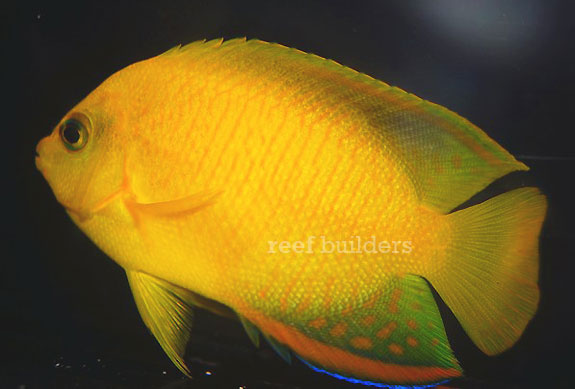
Another hybrid pygmy angelfish, what is it?

16 Leave a comment

bicolorheradli

Another day, another hybrid pygmy angelfish and we still have another one to post for you in a couple days. From the producers of “Tigerpyge“  comes the story of yellow pygmy angelfish which is neither a heraldi, nor a woodhead, nor a lemonpeel. We could tell you what we think it is but we’d rather watch all the fishheads duke it out in the comments. So what do YOU think this fish is? Big thanks to Russo’s Reef for sharing this gem with us.


  1. Russo's Reef seems to get the lions share of rare fish in the wholesale side of the trade :)

  2. Its a Heraldwood Lemonhead Tigerpyge Dwarf Pygmy Angel~!i!i

    No, I really have no idea what it is. But if I were to guess, I would say a Coral Beauty with a Lemonpeel or Flame..?

    Idk,

  3. Heraldi x Elibi

  4. Looks to me like a xanthic bicolor, but just guessing!


  5. The finnage almost screams C. bicolor and the colours suggest a yellow morph of C. eibli or C. loricula.. hmmm, without the three you've omitted it's really a pretty uncertain thing.

  6. I'm gonna go with Bicolor x Heraldi given that's what the name of the image file says ;)


  7. I see what the image file says, but given that it's a wild caught hybrid, there's potentially mutliple possibilities. My gut, regardless of what the image file says, is C. bicolor X C. eibli, OR possibly another variation of the Tigerpyge. Hybrids can vary wildly in what traits they get from the parental species. The body shape certainly suggests C. bicolor. The orange coloration over the yellow isn't present in C. loricula, C. flavissimis, C. heraldi etc…but it IS from C. eibli. However, we are totally lacking the darker color compontents that the Tigerpyge gets from C. eibli, and most certainly you'd guestimate that a C. bicolor hybid might carry some of its predominantly blue coloration through. But the faint orange vertical stripes really have me thinking there is C. eibli in the mix. But, if you look at the anal fin of a C. bicolor, you can see the same patterning in the anal fin of this fish, but the color is different. Can the yellow from a parental species like C. flavissimis or C. heraldi really overpower that much dark coloration??

    Very interesting find Joe!


  8. The dark area behind and above the eye screams heraldi. I think the all-knowing image file may have it right! :)

    Hi Matt!


  9. The only things that make me think hybrid are the such pronounced dorsal and anal fin markings (but C. heraldi has similar markings normally) and the vertical bars. I really don't see bicolor because I doubt that there would be no bicolor coloration showing. Matt I agree the dark behind the eye = C. heraldi. Could it just be an aberrant heraldi? The striping might be C. eibli, but then I doubt the yellow would be so bright and the tail and at least dorsal would be darker.


  10. Guys, there really isn't a way to determine what it is unless you conduct some genetics tests… one can't really say whether a dark color can overpower a lighter one or not, when the parents cross, some traits are dominant and others not, so if say the yellow is a dominant trait, and the dark in the other species is not, then the hybrid may just be yellow, regardless of how intense the dark coloration may seem… So, we can guess all we want, but being that it is a natural hybrid, there's no way to know without a dna test, and even then we could have some complications!! Good guesses though!


  11. Of course, people have a tendancy to assume that hybrids will be 50:50 intergrades between the two putative parent species, in terms of their phenotype, but this is not always true.

    That said, in looking at the picture, I think this could be one of those large Centropyge that has temporary xanthic coloration (due to sex hormones?). I bet it will change after a few months in captivity.

    If the colors are permanent, not knowing the collection location puts everyone at a serious disadvantage, but Kuiter's book has a very similar picture of a C. bisinosa from Samoa.

    Jay


  12. It's understandable that contemporary methods for DNA testing (very precarious) will yield identical results for close related species… however, as new methods arise, DNA testing will be the sole method of identification, leaving meristics aside. The reason why the Centropyge and Zebrasoma species have very similar DNA is that they have "evolved" most probably by isolation, adapting coloration, etc. to their environments, and these differences are extremely subtle in their DNA, same reason why they're able to interbreed and generate hybrids.
    However, I will agree with Jay in saying that this specimen is probably a temporary coloration that will change with time and captivity. If not, it could also be a rare variation of one of the mentioned species by means of recessive genes that very occasionally show in the phenotype. For the time being, I'd classify it as Centropyge sp. using just meristics, not a hybrid.


  13. There is no earspot so I doubt it is an xanthic bicolor. Also the slope of the head it is not as steep as a bicolor's. The anal and dorsal fins however are very pointed, C. heraldi can have pointed fins, but they seem more pointed as in bicolor.

    For this type of fish I don't think DNA would be very helpful just because of the fact that the parents are probably so closely related that there would be no difference in DNA. Most of these "hybrids" are fertile so are they really "hybrids"?…

    Also as far as displaying phenotypes, I think the reason most people assume them to be split between the parents is because they usually are. If you looks at franks resplendent fisheri hybrid, the lemonpeel half blacks, the lemonpeel eibli, the list goes on and on and on. I think this is due to such similar DNA.


  14. Also all those xanthic bicolors show a dark eye. Where this one has yellow in it.


  15. Yeah, about DNA testing on fish, 3 centropyge species and Zebrasoma species had Identical DNA during a recent test.

    <a href="http://glassbo-design.com/2009/dna-testing-marin…” target=”_blank”><a href="http://glassbo-design.com/2009/dna-testing-marin…” target=”_blank”><a href="http://glassbo-design.com/2009/dna-testing-marin…” target=”_blank”>http://glassbo-design.com/2009/dna-testing-marin….


Leave a Reply