EcoReef One – the preview

By on Mar 21, 2010

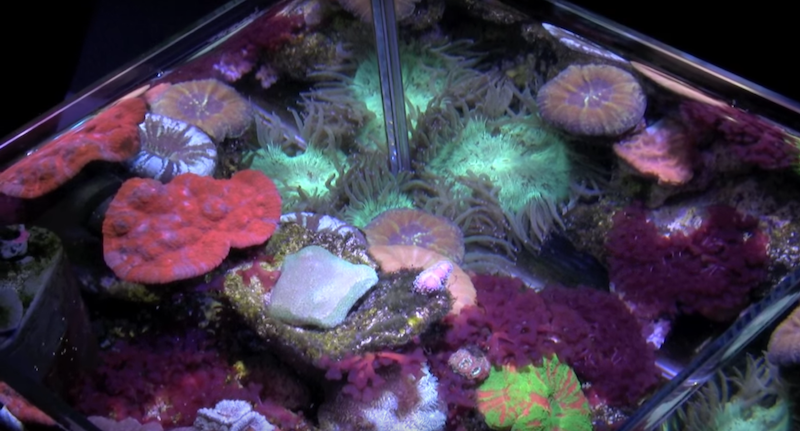
5 gallons, 6 months old. No live rock, no live sand. No skimmer, no additives, no testing. Small internal filter, Nano Customs 15 watt PAR 38 LED spotlight and ESV B-ionic Seawater. Full article coming soon in Advanced Aquarist.
Posted in Reef News |
Search More:  
   
  • Jon Hahn

    ‘No Flow’ either? Looks great. Amazing results for only one LED spotlight.

  • Jon Hahn

    ‘No Flow’ either? Looks great. Amazing results for only one LED spotlight.

  • Philip Root

    looks a little light on the zooxanthellae in places.

  • Philip Root

    looks a little light on the zooxanthellae in places.

  • http://coralidea.com Jake Adams

    @Jon: the flow was turned off for the video

    @Phil there is one small slice of Diaseris which has been bleached for 5 months, you can barely make out a faint brown streak in the video where zoox are re-infecting.

  • http://coralidea.com Jake Adams

    @Jon: the flow was turned off for the video

    @Phil there is one small slice of Diaseris which has been bleached for 5 months, you can barely make out a faint brown streak in the video where zoox are re-infecting.

  • Mike

    might be “only” one spotlight LED, but come on it’s only 5 gallons.

  • Mike

    might be “only” one spotlight LED, but come on it’s only 5 gallons.

  • pickle

    Nice. I do notice that there seems to be very healthy growth of red Dictyota. That stuff can look pretty but it will take over. I just had to clean out my Xenia fuge because that stuff was growing out of control.

    After getting rid of the dictyota and moving the Xenia to another tank, I converted it into a DSB fuge/Brainarium (my Trachyphyllia collection) lit by 12 watts of LED. It’s shallow so the LEDS have plenty strong to keep both the Xenia and the brains extremely happy.

    I was skeptical at first, but the LEDS are working just fine, surprisingly.

  • pickle

    Nice. I do notice that there seems to be very healthy growth of red Dictyota. That stuff can look pretty but it will take over. I just had to clean out my Xenia fuge because that stuff was growing out of control.

    After getting rid of the dictyota and moving the Xenia to another tank, I converted it into a DSB fuge/Brainarium (my Trachyphyllia collection) lit by 12 watts of LED. It’s shallow so the LEDS have plenty strong to keep both the Xenia and the brains extremely happy.

    I was skeptical at first, but the LEDS are working just fine, surprisingly.

  • Jon Hahn

    @Mike. It might only be 5 gallons, but its still only 15 watts, one spotlight or many. Save me the watts per gallon lecture… I know, I know… but its still something to consider here overall. Due to the integrated blue LED’s and the fact that these aren’t XP-G’s, I doubt these are pushing anything much higher than 50 lumens/watt… less efficient than say… a couple of small T5NO’s. So thats 3 watts per gallon, and of a ‘not the most efficient’ 3 watts at that, and although some corals look like they are a little less intense due to that lower light, they seem happy still. Of note: no fish or massive waste producing population to crud up the water. Most species are LPS that have internal mechanisms for directing light (internal optics) to where and how they need it.

  • Jon Hahn

    @Mike. It might only be 5 gallons, but its still only 15 watts, one spotlight or many. Save me the watts per gallon lecture… I know, I know… but its still something to consider here overall. Due to the integrated blue LED’s and the fact that these aren’t XP-G’s, I doubt these are pushing anything much higher than 50 lumens/watt… less efficient than say… a couple of small T5NO’s. So thats 3 watts per gallon, and of a ‘not the most efficient’ 3 watts at that, and although some corals look like they are a little less intense due to that lower light, they seem happy still. Of note: no fish or massive waste producing population to crud up the water. Most species are LPS that have internal mechanisms for directing light (internal optics) to where and how they need it.

  • clive@nanocustoms

    Jon, don’t judge a book by its cover. You don’t need to be running XP-Gs to have a successful LED lamp. Those lamps are running XR-Es (Q5 whites and D15 royals) at 700mA and are more than efficient enough to put out more PAR per watt than any other light source. 15W with 60 degree optics at the distance Jake has the lamp mounted above the tank will put about 100 PAR anywhere on the bottom of that tank, which is perfectly suited to a tank like this. 15W is more than enough. Heck, I’m running 60W of LED spots over a 40g breeder and growing sps quite well. Don’t think that’s enough?

  • clive@nanocustoms

    Jon, don’t judge a book by its cover. You don’t need to be running XP-Gs to have a successful LED lamp. Those lamps are running XR-Es (Q5 whites and D15 royals) at 700mA and are more than efficient enough to put out more PAR per watt than any other light source. 15W with 60 degree optics at the distance Jake has the lamp mounted above the tank will put about 100 PAR anywhere on the bottom of that tank, which is perfectly suited to a tank like this. 15W is more than enough. Heck, I’m running 60W of LED spots over a 40g breeder and growing sps quite well. Don’t think that’s enough?

  • http://coralidea.com Jake Adams

    I have some PAR values from this tank, using the PAR38 lamp which I will post in the future. IF I recall the average was about 120 PAR on most of the ceramic reefscape and down to 70-90 PAR on the bottom of the tank.

  • http://coralidea.com Jake Adams

    I have some PAR values from this tank, using the PAR38 lamp which I will post in the future. IF I recall the average was about 120 PAR on most of the ceramic reefscape and down to 70-90 PAR on the bottom of the tank.

  • Jon Hahn

    Its neat, dont get me wrong. Im not saying that these are bad lights or something. Im just taking a guess as to the total light output that these are putting out, and stating what it would be similar to in technology that would be more familiar to those w/o LED’s. 100-120 on most of the tank is good for lower light species and some medium light ones. Every species picked for the tank are just right for that. Thats good husbandry.

    I ran my 20g fuge with 2x24wattT5HO (one midday, one blue+), and at 6″ of depth the intensity was in the 100′s. At 12″ depth (the rest was sand) the light was about 50-60 micromols/m2*s. That adds up to 2.4 watts per gallon with a 12″x24″ footprint. If I had to guess, I would say this tank is about 12″x12″x8″h? So I would say that the two light sources are about matched for output per watt. Then again, the LED can have its optics narrowed to really hit just one spot if desired, while my T5′s glare all over the place, even in an enclosure and with Icecap SLR reflectors.

    If I take one of my PCB’s with 7 Cree XP-G’s on it and run them at about 700 mA (almost the same wattage), the incidental light intensity is more than double because they are that much more efficient.

  • Jon Hahn

    Its neat, dont get me wrong. Im not saying that these are bad lights or something. Im just taking a guess as to the total light output that these are putting out, and stating what it would be similar to in technology that would be more familiar to those w/o LED’s. 100-120 on most of the tank is good for lower light species and some medium light ones. Every species picked for the tank are just right for that. Thats good husbandry.

    I ran my 20g fuge with 2x24wattT5HO (one midday, one blue+), and at 6″ of depth the intensity was in the 100′s. At 12″ depth (the rest was sand) the light was about 50-60 micromols/m2*s. That adds up to 2.4 watts per gallon with a 12″x24″ footprint. If I had to guess, I would say this tank is about 12″x12″x8″h? So I would say that the two light sources are about matched for output per watt. Then again, the LED can have its optics narrowed to really hit just one spot if desired, while my T5′s glare all over the place, even in an enclosure and with Icecap SLR reflectors.

    If I take one of my PCB’s with 7 Cree XP-G’s on it and run them at about 700 mA (almost the same wattage), the incidental light intensity is more than double because they are that much more efficient.

  • Pingback: Welcome to Ecoreef Zero, population 1 | The Depot of Talk

  • Pingback: Great turnout and response at Reef-A-Palooza this year | The Depot of Talk

  • Pingback: Fish ideas for the uninspired nano reef keeper « Saltwater / Reef « The Depot of Talk

  • Pingback: Simple, clean nano aquarium makes big impression

  • Pingback: Simple, clean nano aquarium makes big impression « Saltwater / Reef « The Depot of Talk