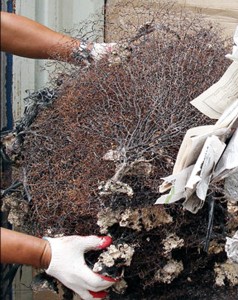
Massive coral reef, twice the size of Manila, destroyed in Philippines by poachers

By on May 25, 2011

A tragic crime that is being described as “the rape of the ocean” took place in the Philippines where poachers decimated an entire reef area almost twice the size of Manila harvesting over 21,000 pieces of black coral and killing 161 endangered sea turtles and other marine life.

Bureau of Customs officials intercepted the contraband two weeks ago and recovered 134 bundles, or 21,169 pieces, of “sea fan” black corals and 15 bundles, or 196 kilograms, of “sea whip” black corals that was taken from an area located off the coast of Cotabato province. Tragically one of the many turtles killed was a male with and estimated age of 80 to 100 years old.

“The Moro Gulf and the Sulu Sea off Cotabato are supposed to be unexplored reef areas but with this collection, we can see that they have also been disturbed,” said Ludivina Labe, a senior marine biologist of the Bureau of Fisheries and Aquatic Resources (BFAR).

“It’s like a forest that has been cut down,” Labe said. “One reef complex was decimated.”

According to Labe, only a few colonies of black coral grow in one hectacre of sea floor. Since each piece of black coral represents one colony, they estimate the harvest area could be as large at 7,000 hectacres that is roughly twice the size of the city of Manila. To put this in U.S. perspective, Manila is around 1,399 sq. km in area roughly comparable to to Indianapolis or the entire San Francisco/Oakland area.

“These web-like colonial organisms are not lush or bushy. They’re found on reef walls or reef slopes. One piece is equal to one colony,” Labe said. “One piece of black coral is not just one organism. There are thousands of other organisms who live there.”

According to Theresa Mundita Lim, director of the Department of Environment and Natural Resources-Protected Areas and Wildlife Bureau, said one of the turtles killed measured 40 inches and was aged “80 to 100 years old.”

“There were also small ones who were only juveniles or just 4 years old,” Lim said. “This is saddening because we have reduced this illegal trade and now we catch something as big as this.”

Officials are looking into giving some of the seized contraband to marine biology schools to study while the black coral, although already dead, could be returned later to the sea.

The rough market value of the seized contraband is around PHP 35 million or over $800,000 USD. Studies by the World Wildlife Fund estimate that the economic cost of over a 25-year period of destroying one kilometer of coral reef is somewhere between $137,000 and $1,200,000 USD. Black coral is harvested and used to make exotic jewelery.

Thanks Jerad for the heads up on this news.

[via Philippine Daily Inquirer]

Posted in Reef News |
Search More:  
   
  • http://twitter.com/NewAgeReefs Skipper

    Very sad situation..

  • http://www.facebook.com/people/Spencer-Shepard/100000684083622 Spencer Shepard

    That is truly sickening.  So they end up stuffing the turtles?  Who is buying this stuff??

  • http://www.facebook.com/people/Willy-Ba/72603752 Willy Ba

    quite sickening, i know as an aquarist, its hard to avoid wild-caught specimens in as a whole. but an onslaught on the ocean like this, is not only unnecessary but also decapitating.

  • Anonymous

    Why am I not surprised this is still going on.  The Philippines will always be like this sadly.  BFAR is probably still corrupt like it was back in the late 90′s as well despite what they spin you read here.

  • http://www.facebook.com/people/Alexis-Desplanques/1187493712 Alexis Desplanques

    this news make me very very sad

  • Anonymous

    I can’t imagine how hard it must be to try to patrol/defend a section of the ocean that size. Unless you had constant patrols out there with really good technology (radar, gps, night vision, etc). It seems like it would be impossible.

    Very sad. 

  • John Moe

    Cutting the chain does not have to start at the supply.  A cut in any part will  make the chain fall apart.  Go after the demand may be easier than patrolling the ocean.   When there is no demand, there will be no one to supply.  A simple law making anyone owning black coral jewelry a crime will quickly reduce the demand.   Similar to to blood diamonds, if owning diamond is made to be a crime then there will be few blood diamonds around.

  • http://www.facebook.com/shandy.say Shandy Say

    Boooo!!! Thats just wrong…and for what? Jewelry! 

  • http://pulse.yahoo.com/_NUNA36QYGKE4Q2D6ZBCLBZ5LBU dog gy

    Im from the Philippines, WWF member. This makes me feel ashamed. Here is the usual scenario. Rich foreigner looks for exotic animals/plants/corals, hires “probinsyanos”, fishermen in this case (people living in the provinces, generally uneducated and very poor). They do the dirty work not knowing the effect of this to their livelihood (because they are uneducated). After some time, fish become scarce, they use dynamite, destroys more corals, then no more fishes. They go to the city, either become beggars, or join the rebel group in the south. Sickening really, but as they say, money is the source of evil. If the rest of the world does not get involved then Im afraid my country is doomed. There are only few of us who have knowledge and are willing to help nature.

  • http://www.reefbuilders.com Brian Blank

    Thank you for the firsthand perspective! Its what has caused problems all along, lack of money and lack of education. From cyanide fishing to poaching — the need for money when there is not a lot of avenues to earn it legitimately will keep this happening over and over. Sadly, education processes are often underfunded and not supported by the government and local community as well. Its always the path to easy money… 

  • http://pulse.yahoo.com/_NUNA36QYGKE4Q2D6ZBCLBZ5LBU dog gy

    You are welcome. Sadly this will probably happen again. The foreigners will never be caught. Only the local fishermen. The foreigners will simply hire another fisherman from another area. We have vast coral reefs here but I think these reefs will not reach the end of the century.

  • Anonymous

    dog gy: Unfortunately, it’s not just the fishermen who are to blame in PI.  BFAR was corrupt back in the late 90′s and probably still is today.  Government corruption throughout PI is rampant, not just in the marine ornamentals trade.  

  • http://www.facebook.com/people/Tim-Myers/100000299030336 Tim Myers

    Considering we are thought to be the most intelligent animals on this planet, we sure do some stupid and irresponsible things.  

  • http://twitter.com/BIGgourami Jon Rienzo

    This is the purpose of a boycott.

    Every item we as consumers purchase is a vote. The fishes and corals bought from such back-room practices and those that support them is another vote for destruction.

  • http://www.facebook.com/people/Manny-Esteves/576692466 Manny Esteves

    1960′s kinalbo nila ang buong gubat ng Cotobato. Ngayun ang lamang dagat naman ng Cotobato. Sino ba ang may sala, ang dayo o ang mga nakatira dito……Hindi kami papalupig Hindi kami pa iilalim sa mga dayuhan yan ang sigaw ng bansang Pilipinas…. Sino sila?

  • Anonymous

    Yeah, becuase that has worked so very well in other areas. Just how long have drugs been illegal now? And just how well has the “war” on it reduced the amount of users?

    But, its a great way to get revenue.

  • Anonymous

    Not going to work when dealing with the black market. All you would be boycotting are legal and lefitimate businesses following the laws and who actually care about their resources.