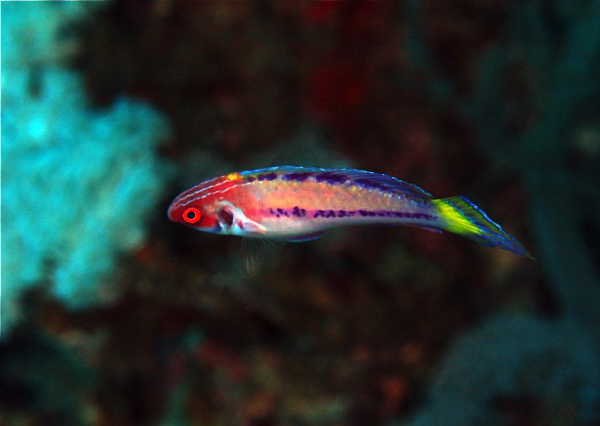
Cirrhilabrus blatteus, more aptly named the purpled-boned fairy wrasse, is a member of the genus that is so extremely seldom seen that these handful of pictures of the fish in this post are probably some of the best out there. The elusive fish is a deep water species that as of yet, has not entered the aquarium trade, and is endemic to the Red Sea, more specifically, the Gulf of Aqaba.

The males of this species are identified by the complete and unique purple stripe that runs down the length of the body, starting from the back of the pectoral fin all the way down to the caudal peduncle. The caudal fin is yellow and trails off in a lanceolate manner. This lanceolate characteristic of the tail is shared with a few prominent species in the genus, namely Cirrhilabrus lanceolatus and C. roseafascia, although not as long and showy.
Males also develop some degree of red coloration on the head and are overall much more colorful. Females, as with most other species in the Cirrhilabrus genus, are duller. The purple stripe is often not as pronounced and may be manifested in form by a row of spacey purple dots. Elongation of the tail is not as pronounced as males and so is the intensity of overall coloration. The purple-boned fairy wrasse is a deep water species, often found swimming around deepwater slopes in reef margins.

 Dr. Eran Brokovich has kindly shared with us a few pictures of Cirrhilabrus blatteus photographed in its natural habitat in Eilat, Gulf Of Aqaba. The pictures were taken at a depth of 65m (about 200ft), which explains the general lack of corals and dimly lit surroundings. The bottom two pictures show a closer look at the females, highlighting the shorter length of the tail and the dotted purple line that runs down the body. (Left picture by Dr. Eran Brokovich, Right picture by Thomas paulus)

Do not expect to see this fish entering the Aquarium trade anytime soon. Like Cirrhilabrus lanceolatus, the deep dwelling nature of the fish makes collection tedious and difficult, not to mention that the range of C. blatteus makes it harder for collection to be done.
 These drool worthy pictures that lace this post will have to suffice for now, and tracking down such good pictures of this super elusive species is no small task. We would like to thank Dr. Eran Brokovich once again for sharing with us these precious pictures of Cirrhilabrus blatteus in the wild. Although i’m not quite sure if these pictures are exactly satisfying our wrasse-hungry readers, or simply fueling the disappointment due to the unobtainable-ness of the fish. Whatever it may be, we’re leaving you with two more pictures at the end of this post.