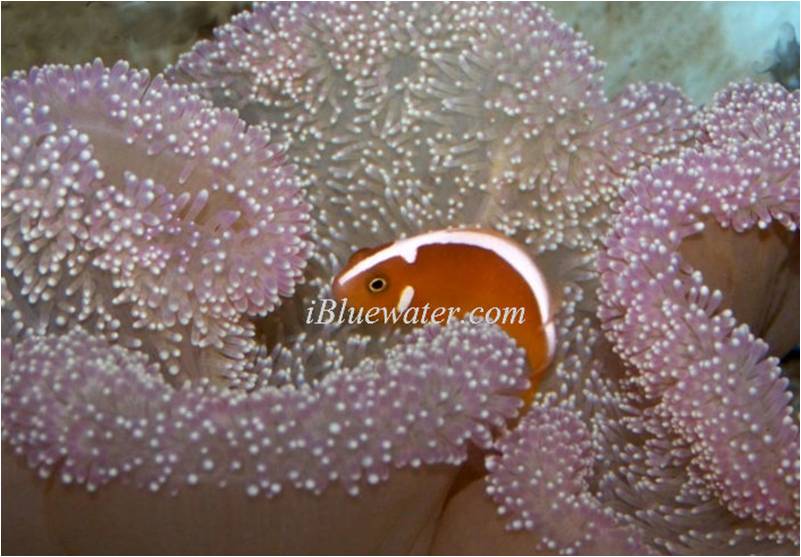
The Orange Skunk Clown is very ubiquitous in the trade but word has it that there exist a variation of sorts with a pretty little “cap”. Terry from iBlueWater has recently obtained one such specimen after almost a decade of hearsay of this elusive clownfish. The white cap skunk clown was thought to be a mislabeled Thiellei that would regularly appear on stock lists, and when received, they always turn out to be just that – a mislabel.

After collecting several A. latifasciatus from Madagascar this year, Terry decided to travel to the Indo-pacific to look for some A. thiellei clowns. Four days and multiple dives later, he was informed by his counterpart that the elusive white cap skunk clown had been found by a villager who frequents free diving in the most remote location along the island chains. To be absolutely sure, Terry paid the villager a visit to hunt for the said clownfish.

Fortunately, clownfishes do not venture too far away from their anemone hosts (with the exception of A. clarkii), and so looking for the clownfish wasn’t much of a problem. Terry used a rebreather, and with the amazing sense of direction that the villager had (no GPS), they made a 24 feet dive and the orange skunk clown with the funny cap was found. Terry kept the GPS coordinates for future dives. The villager has since found three more of these in the same chain of islands. The DNA for this fish is being sequenced and compared against A. ocellaris, A. theillei, A. sandaracinos and A. periderion, to see if it is a distinct species, or just a hybrid. We’d like to thank Terry once again for sharing with us this interesting piece.