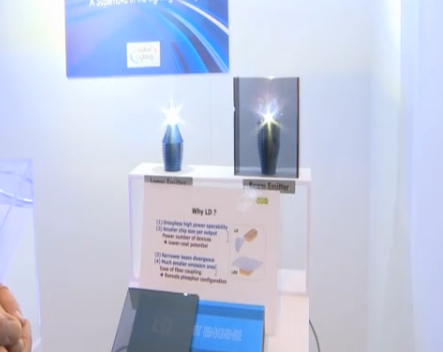
LD Lighting Engine is a new type of light source from Toshiba

By on Jul 23, 2012

LD Lighting is a new type of light source from Toshiba which uses lasers to light up an emitter. Not to be confused with LED, LD Lighting stands for “Laser Diode” lighting so instead of using broad emission LED like we are used to, the LD Lighting from Toshiba uses special laser diodes to create lighting energy. The laser diodes of the LD Lighting engine are mounted in a remote enclosure, very ballast like, and the blue laser light from them is combined and transferred to a remote light emitter which is packed with phosphors to produce white light. 

Much like the Cree XT-E and its remote phosphor applications, the Toshiba LD Lighting engine takes that concept to a higher order of magnitude, with its blue light source capable of being placed up to 25 meters away from the emitter, that’s over 80 feet! The emitter itself includes the phosphors which convert the blue light to broad spectrum emission, and it also incorporates the optics necessary for different applications which so far includes broad angle or narrow beam “lenses”. The current LD Lighting system developed by Toshiba produces 4500 lumens using 90 watts, so it’s not breaking any records but as this technology matures it should come down in price while increasing efficiency.

LEDs are cool and all but having all the light of an aquarium emanating from a single point source like the end of a gooseneck would make for quite a dramatic display, nto to mention removing all the heat and potential electrical hazards from the setup. Laser Diodes are available for hobbyists to purchase and so are fiber optic components so its not out of the question for some interpid reefers to DIY their own LD Lighting engine even before Toshiba ever makes it available. What do you think, could you make use of a tiny little light source like this to light up small and large tanks alike? What else would it need to really make corals and fish really pop?

Posted in Reef News |
Search More:  
   
  • http://www.facebook.com/profile.php?id=555379745 Christopher Jung

    love this technology, but you would still be encumbered by the limitations of phosphor technology. Much like flourescent and other phosphor based technologies, the bandwidth of the light is fairly narrow. As much as i love LED. and I LOVE LED. Broadband technologies have been tried and true and offer some compelling benefits that an array of multicolored light sources (be them LED or phosphor based) are trying to surmount (ie color mixing, differences in relative spectral intensities, the limitations of semiconductors and their bandgaps).

    Still, in non biological lighting scenarios, a very very cool technology.

  • http://www.facebook.com/people/Joseph-Callahan/1475945250 Joseph Callahan

    Still waiting for the ULED systems to come out.

  • http://twitter.com/SeanoHermano Herman
  • Clive Bentley

    Very cool concept that hopefully gets adopted and improved. 50lm/W isn’t going to cut it for mass adoption, but I’m sure there will be some critical applications that this will be very useful for, even now. Surgery lighting, as well as lighting for explosive environments would be obvious choices.

  • http://www.facebook.com/people/Joseph-Callahan/1475945250 Joseph Callahan

    Sorry meant OLED not Uled

  • http://www.facebook.com/people/Wyatt-Patry/708661852 Wyatt Patry

    Interesting Thorlabs and EIO already seem to have a manual and parts showing up for this on google. I still don’t understand if this is a plasma chamber thats being ingnited with the laser or if its just a laser shining on a phosphor surface like he explains in the video? Been waiting for another laser plasma source to pop up… I’m such a plasma fanboy.

  • Brad Morrow

    @Christopher. As an Electrical Engineer, I’m skeptical about your comments that phosphors provide a limited spectrum and are thus not suitable to support photosynthesis. There is no doubt that ‘naked’ LED’s (without phosphors) provide almost monochromatic light. But have you ever looked at a fluorescent tube through a prism or spectrometer and compared it to the sun (through the same device)? There are a variety of different phosphors lining the tubes that each have their own emission spectrum. Combined, they can provide a broad spectrum with small wavelength gaps only. On top of that, the spectrum of the sun is not uniform. There are plenty of holes due to the absorption of certain wavelengths of the Chromosphere and photosphere around the sun (theorized). I can’t speak for MH lighting as I have not seen it through a spectrometer but I imagine it has its own spectral gaps.

    In short LED’s with phosphors (and by extension, T5-HO, VHO, and LD) are acceptable forms of artificial lighting in my opinion. While the emission spectrum is always going to be more ‘peaky’ than natural sunlight, its still usable. If you want to know how well a lighting holds up to natural sunlight. I would read about CRI (color rendition index).

    Suns emission spectrum for all you geeks out there.

    http://wps.prenhall.com/wps/media/objects/1351/1384105/image/sun_spectrum.jpg

    Fluorescent emission spectrum (6500k).

    http://i91.photobucket.com/albums/k311/playavince_vodka/spectrum_small.jpg

  • Clive Bentley

    Chris is actually right. While there are many phosphors out there that can produce almost any wavelength of light, not all of them are suited for LED applications. Many of the phosphors that you are referring to that are in use in fluorescent lighting need excitation wavelengths in the UV range, hence why mercury is heavily used in that particular technology.

    The range of LED compatible phosphors is much more limited, and are typically limited to wavelengths of 525nm and above. This is the primary reason that we always see a droop in output in the 480nm-520nm range. There just isn’t a phosphor available right now to easily fill that gap.

    The only current way to duplicate the suns spectral output with LEDs is to use a base white LED with reasonable spectrum, and fill the holes with discrete LEDs of varying wavelengths. Plasma is one of the few artificial light sources to come close to recreating the suns output. There are a few different types of metal halide that can come close (like ceramic MH), but plasma can do it easier, and more accurately due to the inherent design of plasma lamps

  • Brad Morrow

    Plasma emissions are really nice. And I do agree that there is a short wavelength limitation on LED systems. My LED system has dedicated 420nm Violet LEDs to fill that hole as you described. I don’t run green LED’s however, just royal blue, blue, UV, and cool white.

    Not convinced that the excitation wavelength (~430nm) is a limiting factor for adequate artificial lighting. The ‘droop’ in the cyan-green spectrum (480-550nm) could be by design or not, either way I think it is the least important (only by a narrow margin) area of the spectrum needed to support photosynthesis.

    Photosystem II absorption spectrum

    http://course1.winona.edu/sberg/ILLUST/fig15-5.jpg

    Edit: More specific zooxanthallae absorption spectrum from a previous AA article.

    http://www.advancedaquarist.com/2002/2/aafeature_album/Image1.gif