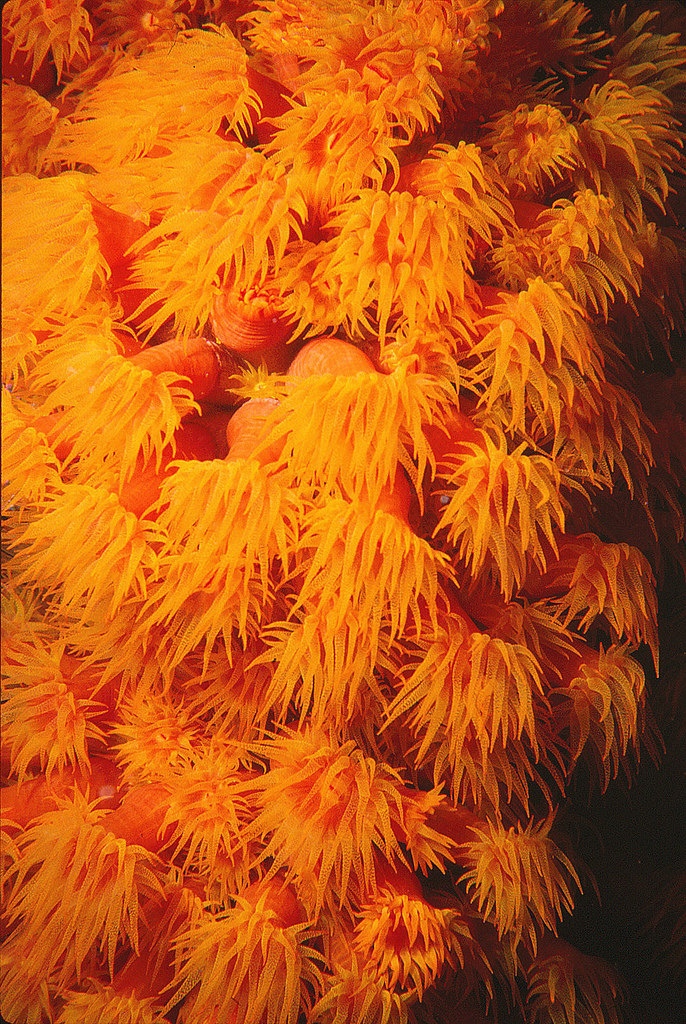
Tubastraea faulkneri and Tubastraea coccinea are like brothers from another mother. The two species of sun coral are similar to a point where the names are casually interchanged by hobbyist trying to identify their sun coral, but distinct to a point that a careful observer can easily identify the differences. Both species offer the spherical growth from and rock beautiful yellow polyps we are all so fond off, so differentiating can seem daunting. But once you realize the differences between the two (or difference really) identifying them should be a breeze and could help to tease out specific care requirements of these two corals.

Photo by Flickr user Celina =)
The key in differentiating the two lies in the corallite spacement, aka the spacement between the “cups” or “turrets” supporting the polyps. In Tubastrea coccinea the coralites are densely spaced while in Tubastrae faulkneri the coralites are widely spaced. So basically if there are gaps between the corallites it is most likely Tubastraea faulkneri, if the polyps are closely clustered it is most likely Tubastraea coccinea.

Photo by Flickr user Reef Reflections
For instance, based on the coralite spacing of the coral in the picture above be can determine that it is Tubastraea faulkneri. For the picture below we can determine the coral to be Tubastraea coccinea based on the lack of spacing between the coralites. The header imagine is a bit trickier since on a first glance it could be either Tubastraea faulkneri or Tubastraea coccinea. But take a closer look at the four center polyps, and note what is clearly a space between the polyps. Based on this space it is safe to assume that it is very likely to be Tubastraea faulkneri.

Photo by unkown
Easy enough isn’t it? Well, the majority of the time it is not going to be such a clear distinction, especially since the growth form of both Tubastraea coccinea and Tubastraea faulkneri can be altered because of currents and other environmental conditions. That said, you can now feel more educated when making a guess of what species your sun coral might be. So why should you care, and why does it matter? The truth is you don’t really need to know the exact species sinceas far as we know they both require basically identical conditions and feeding regimens. But knowledge is never a bad thing, and worst things come to worse you could always you use it impress you geeky reefing friends.