Plectranthias kelloggi from Japan shows up in Singapore

By on Mar 03, 2012

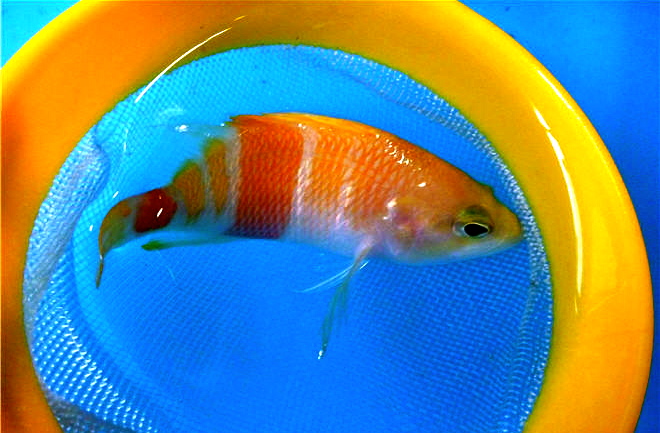
Plectranthias kelloggi. Pictured by Oh Chee Fong.

Plectranthias kelloggi (Zalanthias kelloggi) is a rather large member of the Plectranthias group so much so that some have placed it in another genus or subgenus. Unlike most of its smaller cousins, P. kelloggi grows to about 12cm and is rarely encountered in the trade. While not as intricately beautiful as P. pelicieri, P. kelloggi is pretty in its own way. 

Plectranthias kelloggi in the wild. Picture by ItaDivingCentre.

P. kelloggi can be found in Hawaii, Taiwan and Japan, but all specimens that enter the trade come out of Japan. The white body with vertical bands of red and the maroon spot on the caudal peduncle make for a nice contrast. The rare perchlet arrived in Singapore’s New Trio Fisheries along with some Halcurias anemones, Assessor randalli and Callanthias japonicus. New Trio Fisheries is responsible for some of the more exotic livestock that enter the country, and even created the man made hybrid between the panther grouper and the bumblebee grouper.  Below is a short video of P. kelloggi in the wild.

YouTube Preview Image
Posted in Reef News |
Search More:  
   
  • Michael Toney

    Any particular reason they are not collected in Hawaii? (Depth, Location, Etc.)

    ~Michael

  • TeaYK

    I’m not too sure on that. In fact, if i’m not wrong, the holotype specimen was caught in Hawaii and the species was described from there. 

  • http://www.facebook.com/people/Chingchai-Uekrongtham/100001947935217 Chingchai Uekrongtham

    Very interesting fish. Hope I can have him one day.

  • El Temprano

    Though it likely occurs at shallower depths in Hawaii, published records from this archipelago are all in 200–400 meters range. In 1980 Randall divided this species into three subspecies (Hawaii=kelloggi, Japan=azumanus, New Caledonia=rubromaculatus). Today Randall is of the opinion that these are better regarded as separate species. Consequently, true P. kelloggi is restricted to Hawaii and the Japanese population is P. azumanus