

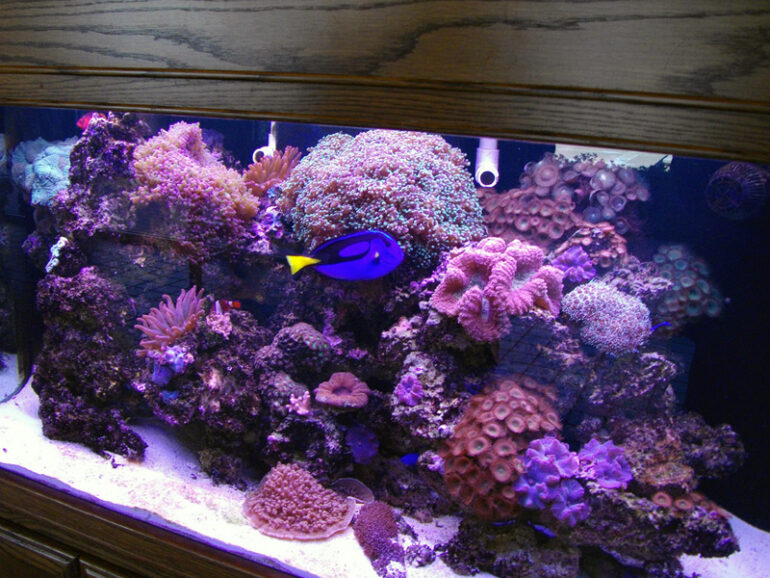
Many beginner saltwater aquarium hobbyists are tempted to “get their feet wet” with a small system, assuming it will require a correspondingly small investment of time, effort, and income to maintain. Then, the thinking goes, after nurturing their aquarium-husbandry skills and succeeding on a small scale, they can always upsize to something bigger.
While smaller systems—including very small, or “nano,” tanks—represent an exciting and burgeoning niche of the saltwater aquarium hobby, there are several good reasons for beginners to “go big,” at least at first. Here are four of them:
1. Greater margin of error
Accidents happen, and we all make careless mistakes from time to time. We may occasionally feed our fish more heavily than intended; a dead, decomposing specimen hidden somewhere in the rockwork may go undetected; or we may forget to wash lotion or some other contaminant off our hands before reaching in the tank. The larger the system, the greater the dilution of dissolved pollutants and, therefore, the lower the impact such mishaps will have on water quality and the health of the livestock.
2. Greater stability of water parameters
Fluctuations in water chemistry and temperature tend to be much less pronounced in larger systems. Unacceptable changes that might occur over the course of just a few hours in a nano system (for example, a dangerous plunge in water temperature after a heater malfunction) may take many hours or even days to occur in a larger system. If you’re testing your water parameters regularly, this means you’ll have ample time to recognize and correct a developing problem before it reaches crisis proportions.
3. Fewer compatibility problems
Territorial squabbling among tankmates tends to becomes less problematic as the size of the aquarium increases. Larger tanks offer more flexibility in terms of rockwork configurations, so there are more places to hide, more territories to claim, and more structure to disrupt the line of sight between aggressive specimens and their potential targets. Also, big tanks with lots of live rock are often a necessity if you plan to keep more than one specimen of a given species—for example, that harem of lyretail anthias (Pseudanthias squamipinnis) you’ve got your eye on.
Even coral aggression is minimized in larger tanks. There’s more room to space out specimens so they aren’t constantly stinging one another, and the larger volume of water helps dilute any toxic compounds many invertebrates produce in order to kill or inhibit the growth of neighbors.
4. Greater stocking flexibility
Let’s face it, with so much beautiful and fascinating livestock available to saltwater aquarium hobbyists, it’s hard to settle for just a few specimens! Just remember, the larger the tank, the greater the bioload it can accommodate. That gives you much more latitude with respect to the number or maximum size of specimens you can safely keep.
So, how big is big enough for a beginner? We recommend an aquarium capacity of at least 30 gallons, with more being even better.


Hmm, was the tank cycled before the fish were added? Also, keep in mind that adding 10 damsels under the best of conditions can be highly problematic, even in a large tank, as many damsel species are extremely territorial and will torment conspecifics relentlessly.
So we set up our 130 gallon salt tank took water sample to store , he said water looked
Ok . So we bought 10 Danzel fish . They were all dead but one the next morning . What went wrong ?
Thanks for sharing these insights, Chance!
My first tank was a 5.5g AIO that my buddy with an 80 Breeder made for me. One little maxi-jet in the “sump” and one good sized chunk of live rock and a few pounds of aragonite sand is what got me started (addicted). The only downside I could see looking back is that all of my corals outgrew the tank pretty quickly. The only livestock I had were a few snails, a sexy shrimp, and then one baby Ocellaris Clown.
I can absolutely attest that with small tanks, when it rains, it pours.
Thank you so much, Appasamy! It’s wonderful to hear that you found one of my books useful!
Great Article, I read a book of Jeff Kurtz and found it very useful. Thanks for sharing your experience Jeff !. Appasamy Singapore
Thanks for your kind remark, Kendra, and thanks for joining us!
This is indeed a great post. Thanks for sharing this to us and keep posting.