

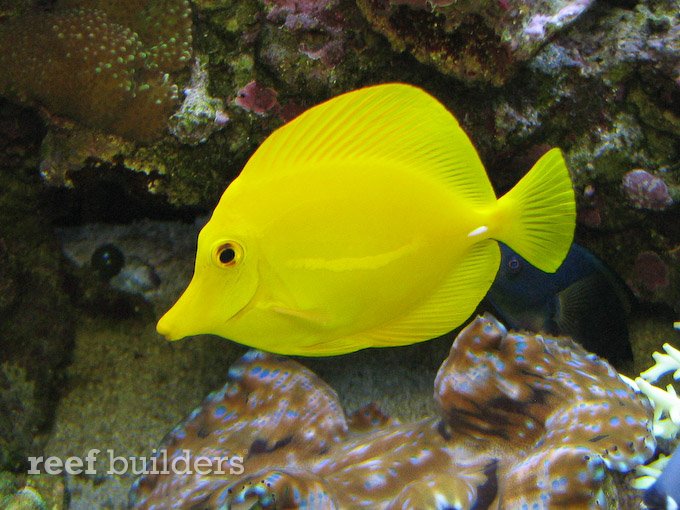
Captive Bred Yellow Tangs? Not quite yet…

6

yellow tang
For nothing short of years, there have been rumors of captive-bred tangs permeating hobbyist chatter.  Most of these rumors are fueled by the collection of small Regal Tangs (Paracanthrus hepatus) and a general misunderstanding of what “tank raised” means (quite literally, tank-raised means reared in a tank for an unspecified amount of time, and is most often applied to wild caught youngsters that are reared and then later sold.   Tank-raised does not imply that captive parents spawned and created viable offspring that were reared, aka. captive-bred fish).  In the past week alone, two bits of news relating to Yellow Tang (Zebrasoma flavescens) breeding projects will probably add fuel to the rumors suggesting that there are captive-bred tangs.  Better to set the record straight right now.

First, there is a new report, “Advances in Breeding and Rearing Marine Ornamentals”, by Olivotto et. al, running in the April, 2011 edition of the Journal Of The World Aquaculture Society.  It was a pretty solid piece, but one sentence caught my attention.  “A smallscale culture-technology for Parvocalanus spp. copepods was used to successfully rear some“difficult species” such as the flame angel fish, Centropyge loriculus, and the yellow tang, Zebrasoma flavescens (Laidley et al. 2009).”  Of course, this blew me away.

I had to track down Dr. Laidley, who was quick to clarify what has, and has not, been achieved.  My take – “success” means different things to different people, and the authors of this journal article do not share the same definition of the term.  Yes, there has been progress by Dr. Laidley, but they have yet to see fish past settlement, let alone reaching a market sized juvenile (my version of success when it comes to breeding marine fish).

A second bit of news was announced in the March 2011 Regional Notes of the Centers for Tropical and Subtropical Aquaculture (CTSA).  The news?  Captive-spawned Yellow Tangs (Zebrasoma flavescens) making it to 14 days post hatch at the Oceanic Institute in Hawaii.  This is being promoted by some as “big news” and maybe it is, but in truth, it’s almost a month less than the current “official” record I can track down, belonging to Syd Kraul, 42 days post hatch.   Of course, I can’t find the reference, but I genuinely seem to recall Kraul having larvae at 70 days post hatch, and still no settlement.  With a larval duration claimed to be 10 weeks, and with other fish (i.e. Centropyge sp. Angelfish) known to have similar durations, it’s safe to say that we have a long way to go.  I think the thing that really caught my attention is that once again, Dr. Laidley is cited as one of the people responsible for this 14 days post hatch success (along with Chatham K. Callan, Melissa D.C Rietfors, Michael Dean Kline, and Eric W. Martinson).

I certainly don’t wish to detract from the work of this team, but we need to put it in perspective.  Afterall, I’ve never even spawned a Tang.  They are certainly making progress.  Knowing that related fish (the Rabbitfishes…think “Foxface”) are cultured as foodfish, it is conceivable that we will crack the code for breeding and rearing Acanthurids, possibly in the next decade or less.

The take away lesson? Even the scientific literature can be misleading at times.  Many people in the hobby like to say they’ve “bred” something, when in reality all they’ve done is had a spawning.  It pays to investigate and dig deeper, to be a “Skeptical Reefer” as our friend Richard Ross would encourage.  I wish to thank Dr. Laidley for quickly clarifying the first news item, and simply can’t wait for the next big breakthrough.  Please join me in wishing this team the best of luck!  Let me say it now, if they break the code on Yellow Tangs, next up should be Achilles and Chevrons (or maybe Gemmatums?)




Top Related Stories:

  • http://pulse.yahoo.com/_QSDPQ6KDZJ64Q25D2NVBTL2YTM wood

    First we’ll need to learn to breed them, then we can hybridize them! Bubble eye tangs! Everyone would want one!

    Unfortunately, that seems to be the way she blows for a lot of captive bred fishes…

  • http://www.facebook.com/people/Mike-Gioia/824913918 Mike Gioia

    Many store owners promote the tank raised regals and other tank raised fish, although they may do a bit better than regular wild caught, they still are not much better on the environment. I can’t wait until more and more fish are captive bred. I have heard that likely in our lifetime most to all of the reefs will be gone due to global pollution and climate change.

  • DrB

    I also wish them the best of luck. I imagine that yellow tangs are the most heavily collected of marine aquarium fish, captive breeding would have a huge beneficial impact on wild populations, and of course, would lead to the captive breeding of many other varieties of tangs and other fish. Like Mike said above, I’ve also heard that all reefs will be gone in our lifetime, but I simply don’t believe that statement. Corals and reefs will adapt. Whether it’s physical or physiological changes, or simply the migration of corals and reefs to cooler or deeper waters, I think corals will adapt and overcome. They have for millions of years, and will continue to do so. I hate to see all that’s happening in this world, with greenhouse gases, global warming, pollution, nuclear waste & radioactivity, etc, etc, but I have tremendous faith in survival through adaptation. I’m sure we will see the extinction of some corals and we will also see the arrival of new corals through evolution. I believe in global warming, it has been happening since the last ice age. I just feel that humans are speeding up that process, and every single one of us need to make the necessary changes to try and slow it down and let it take it’s natural course.

  • http://www.facebook.com/profile.php?id=1020440313 Tal Sweet

    Thanks for clarifying this Matt! I too am looking forward to the next big breakthrough and wish this team the very best.

  • http://pulse.yahoo.com/_FI3G7ZEP23ZGCS7GWWRYDUBFIM FrankF

    Matt I am glad your bringing this to peoples attention. Not having read Advances in Breeding and Rearing Marine Ornamentals”, by Olivotto et. al. I really can’t comment on how the quote was used in the paper. But the actual paper that was quoted did clarify that the success was with the flame angels and that the yellow tang research was ongoing.
    I had the great fortune and pleasure to work at the Oceanic Institute for 6 years and part of that time was working on Dr. Laidley’s team. So I am slightly biased in my opinion of what the breakthroughs have been and are. There is an amazing amount of data and detail that goes into the research they are looking at. To get a brief idea you should look up Chatham K. Callan thesis ASSESSMENT OF THE FLAME ANGELFISH (Centropyge loriculus). AS A MODEL SPECIES IN STUDIES ON EGG AND LARVAL QUALITY IN MARINE FISHES. His thesis just cover the research that went into the diet of the flame angel broodstock, not even the research that was going on with system design, live feeds, larval rearing etc.
    Sorry for writing on, one of thouse topic i could spend days talking on. I will jsut leave it as Knowing the people on that team I know they will be presenting more breakthroughs as time goes on. Not as fast as we would like but it will be just as important as when they were the first to spawn and rear the flame angel (Centropyge loriculus)

  • Anonymous

    Frank, if you have access to the paper that was referenced, I’d love to see a copy as I wasn’t able to track it down myself (which was why I reached out to Dr. Laidley directly). Dr. Laidley did point out that they are using a very methodical approach to these projects, tackling individual portions vs. the whole thing in one shot.

    Understandably, such an approach will offer many revelations along the way, but the layman no doubt might see it as an inability to achieve the end goal (captive bred tangs), dragging out the project (job security), or simply the layman might want to see the success first and then worry about refining the project (run a marathon, and then figure out how to run it faster). I hope I’m able to show both sides of the coin, as well as really keep the rumors in check (and when it comes to captive bred Tangs, you’d think Unicorns were real too the way the rumors fly around).