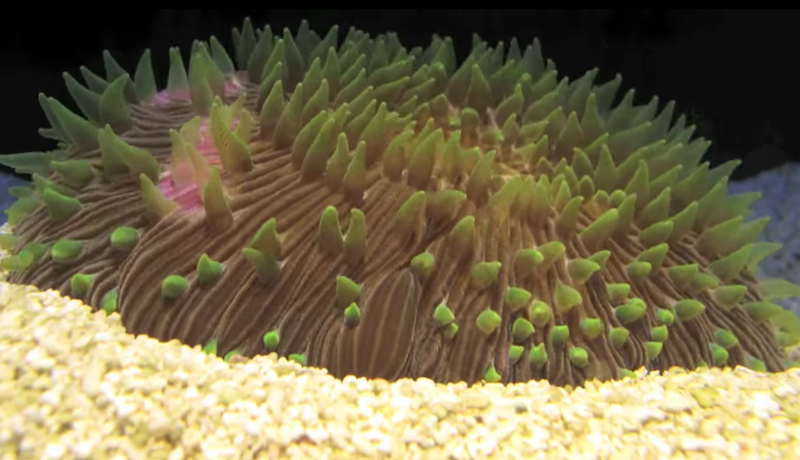
It’s fairly well known that disc coral and tongue coral can excavate themselves after being buried with sand but a couple new time-lapse videos of Fungia scutaria and Herpolitha limax show something more. Not only do both of these corals inflate the fleshy part of their polyp in response to being buried, but they also display a rhythmic pulsing of inflation that appears very quickly on the time lapse videos.
Whether the rhythmic pulsing of the coral in response to being buried is a case for intelligence could be stretching the connection a little far, but there’s no doubt that this action is a form of behavior. Corals may not have enough of a nervous system to ‘think’ but they are basically animals and they have nerve cells andhere’s enough of a spark in a coral polyp to respond to light, flow, temperature, food, neighbor warfare and being buried alive – That’s behavior.