Using ‘Double Down’ to stimulate spawning of the Lightning Maroon Clownfish

By on Apr 23, 2012

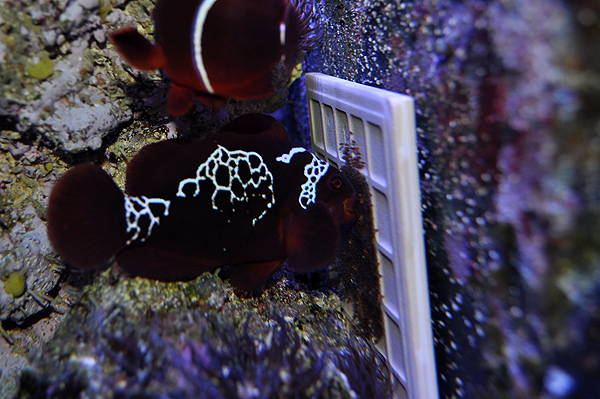
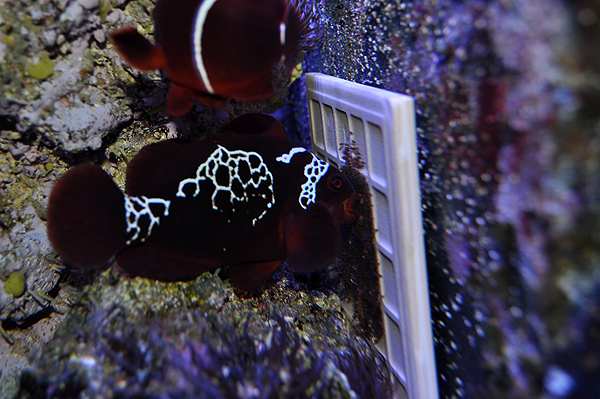
Lightning Maroon Clownfish tending an orphaned Percula nest

Lightning Maroon Clownfish tending a borrowed nest from percula clownfish

The Lightning Maroon Clownfish has not spawned. While the image above (and video below)  shows the Lightning Maroon and her mate tending a nest of eggs on a tile, those are NOT their eggs.  This technique has been called by some (including Mitch May, possibly the technique’s originator) as a “Double Down”.  The premise – take a reluctant pair of clownfish who are clearly bonded and interested in mating, but not actually doing anything, and add in a nest of eggs from another pair of clownfish.  You either wind up with the nest being eaten (and lots of good nutrition being dumped into your reluctant breeders) or you get the pair tending their own eggs next.

Since the Lightning Maroon pair has been cleaning a nest site since September 2011, and the male is a proven fertile spawner, we are all waiting to see what happens next.  Initially, it’s looking promising.

YouTube Preview Image

Still, some of you may think we’re pulling a belated April Fool’s prank on you all.  So, first, a look at the Percula nest being laid late on 4-20-2012:
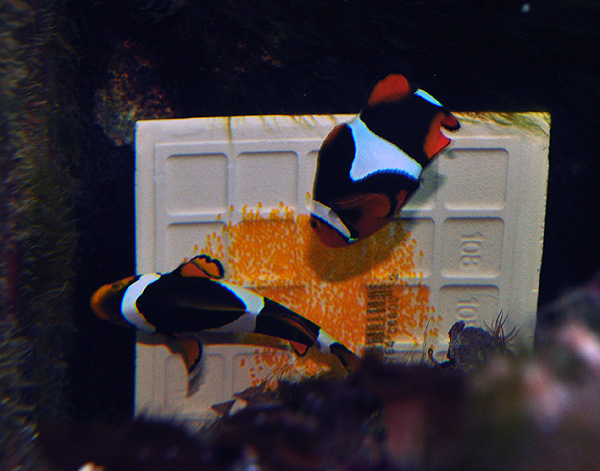
Onyx Perculas spawning

Onyx Perculas spawning

That same nest, 48 hours later, being tended by the Lightning Maroon and her mate:
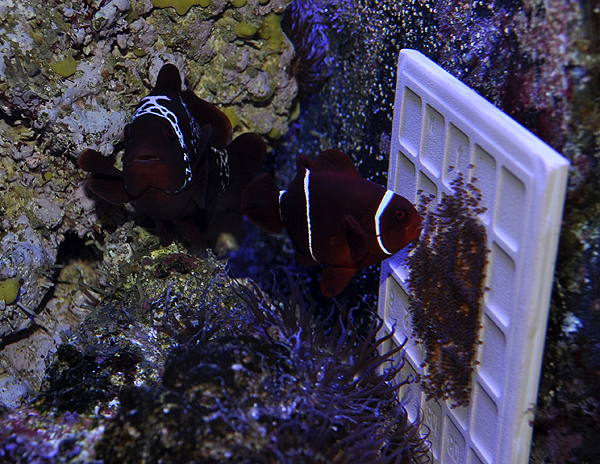
Lightning Maroon Clownfish and her mate tending a nest of Percula Clownfish Eggs.

Lightning Maroon Clownfish and her mate tending a nest of Percula Clownfish Eggs.

Posted in Fish |
Search More:  
   
  • mcallahan

    You robbed the cradle Matt!! The perc pair must be an emotional WRECK right now wondering where their eggs went!  

    I have to say this is neat to see and you’ve got a heck of a lot more patience than I do to go through the effort you are putting into this project.  Great work.

  • CaliReefer

    Matt, what are your thoughts on the behavior you are seeing with the maroon pair? Watching the video, the female seems to clean the eggs quite a bit. I only have experience with ocellaris, but from my experience the female rarely tends to the eggs. The male is constantly cleaning them while the female stays in the anemone. If he tries to stop/leave the area the female will chase him back to work. It doesn’t seem like your lightning quite has the dominant role down yet, but I do wish you all the luck in the world at getting some good offspring. I know how rare and special the lightning maroon is and this project has been years in the making.

  • themingler99

    Crush a Viagra up in the food. :O

  • mpedersen

    CaliReefer, the fact that the “female” hasn’t destroyed the nest in the last 24 hours suggests to me that she’s accepting a role. You’re entirely right, females seldom practice much brood care in the day-to-day of incubation, but that doesn’t mean the fish outright ignores it.  What we don’t know is perhaps the wild past of the Lightning Maroon…was it a “male” in a spawning pair at some point it its life?  Perhaps the nest tending is an instinctual return of such a prior male role?

    It IS fair to say that the Lightning Maroon is a bit more timid than I’d like….I may need to block out the sides of the tank or something.

  • http://www.facebook.com/people/Randy-Olszewski/1503470506 Randy Olszewski

    Very cool!  Good luck Matt.

  • http://twitter.com/Bg2681 Barry Geller

    Matt, 

       What your seeing is them working out the rolls, both my akindynos and black clarkis did this when they first started to spawn. The “female” shows the male what to do and where to do it. I have video of my female GBR tending to a clutch. 

  • Michael Civiello

    Never thought I would hear someone complain their maroon is too timid!

  • http://www.facebook.com/wally.do Walle Do

    So hosting those sweet nems aren’t helping I take it?