It appears that 2026 may be the year of high profile court cases. This time, it’s Dr. Tim that’s in the crosshairs.
The American Cichlid Association (ACA), a prominent Ohio-based non-profit dedicated to the study, conservation, and hobbyist enjoyment of cichlid fish, has filed a massive civil lawsuit against its former treasurer, Dr. Timothy Hovanec.
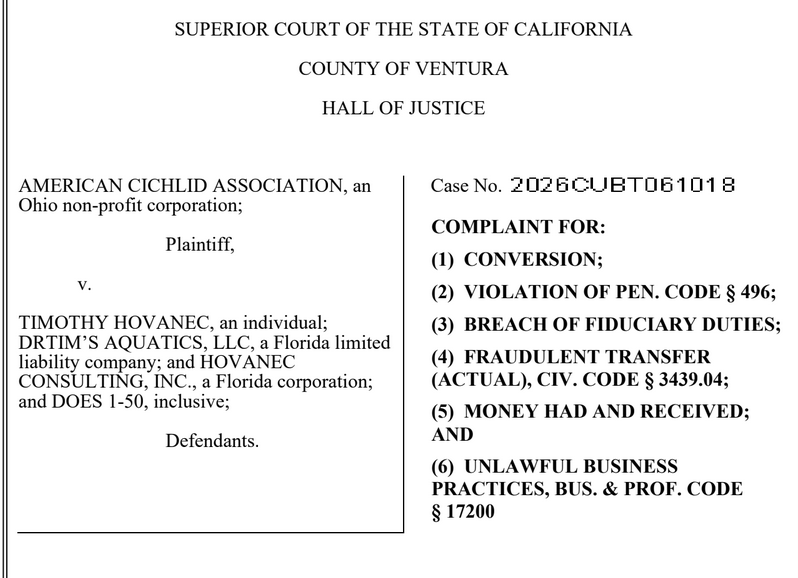
The complaint, filed on February 3, 2026, in the Superior Court of California, County of Ventura (Case No. 2026CUBT061018), alleges that Dr. Hovanec engaged in a systematic, multi-year scheme to misappropriate nearly $800,000 of the organization’s funds to finance his private businesses. Named as co-defendants in the suit are his Florida-based companies, Dr. Tim’s Aquatics, LLC, and Hovanec Consulting, Inc.
According to the court documents filed by the Los Angeles law firm Greenberg Glusker Fields Claman & Machtinger LLP, the ACA accuses Dr. Hovanec of transferring massive sums from the non-profit’s coffers into his own personal and business accounts. The plaintiff alleges unauthorized transfers of at least $641,200 from the ACA’s Bank of America accounts and approximately $154,000 from its Vanguard investment accounts.
To cover his tracks, Hovanec is accused of submitting fraudulent “Treasurer’s Reports” to the ACA board. The complaint highlights a glaring discrepancy in June 2024, where Hovanec allegedly reported that the ACA held over $850,000 in savings. In reality, the lawsuit claims the accounts held only about $414,000 at the time. By November 2025, the association’s funds had allegedly been drained to a mere $45,000.
The situation reportedly escalated when the ACA Board voted to replace Hovanec in February 2025. Following his removal, the complaint states that Hovanec obstructed the transition by refusing to provide account access or financial records for months. More shockingly, the ACA claims he continued to transfer association funds even after receiving formal orders to cease by legal counsel.
The ACA is now aggressively pursuing justice across six legal causes of action:
- Conversion (Theft of property)
- Violation of Penal Code § 496 (Receiving stolen property)
- Breach of Fiduciary Duties
- Fraudulent Transfer (Actual)
- Money Had and Received
- Unlawful Business Practices
The non-profit is seeking at least $795,200 in compensatory damages. However, under the California Penal Code regarding stolen property, the ACA is pushing for treble damages, which would triple the penalty to over $2.3 million! Furthermore, the association is demanding punitive damages and the appointment of a legal receiver to oversee Hovanec’s businesses to prevent any further dissipation of the allegedly stolen funds.
The lawsuit can be found here: https://ventura.ecourt.com/ case # 2026CUBT061018
A History of Embezzlement in Reef and Aquarium Clubs
While the scale of the ACA lawsuit is staggering, financial misconduct has unfortunately cast a shadow over organized aquarium and reef clubs in the past. Operating as non-profits and often relying on volunteer boards, these organizations can sometimes lack the stringent financial oversight found in larger corporate entities, making them unexpectedly vulnerable to misappropriation of funds.
A well known case centered around MACNA San Diego, where one of the show chairs treated show finances as his personal slush fund, using the club’s debit card for collectible hats, photography equipment, and other personal items. In 12 months, after racking up approximately $90,000, the theft was discovered. Unfortunately, no charges were filed and a parent stepped in to restore a portion of the stolen funds.
Before that, I recall an incident in my local reef club, the Atlanta Reef Club, where the president at the time decided to use the club’s debit card for personal expenses. Luckily, it was limited to groceries and restaurant charges. Again, no charges were filed and he stated he might reimburse the club when he found a job. The club is still waiting for that reimbursement.
Most entrepreneurs will tell you that financial crimes like this are very common. While businesses can generally have protocols in place to detect and prevent fraud, what can small operations and non-profits do when they’re either short staffed or volunteer run?
Have you experienced embezzlement at your club or workplace? Drop us a note on Facebook or Instagram.
Note: I reached out to Dr. Tim for comment on April 4th. I’ll update the article if and when he (or his representative) responds. It’s important to note that no guilty judgement has been passed down at this point as this is an ongoing case and all we have are allegations.