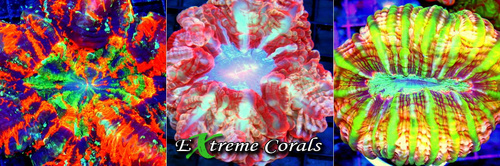
Among large-polyp stony corals, few animals generate as much fascination, and as much confusion, as Acanthophyllia, Indophyllia, and Cynarina. All three are solitary, fleshy, highly ornamental corals that occupy a similar visual category in the minds of reef aquarists: oversized tissue, strong coloration, and unmistakable showpiece presence. In local fish stores and across online coral listings, they are often grouped together under the broad umbrella of “meat corals” or “donut corals,” and that shorthand is understandable. But it also flattens the meaningful differences in structure, habitat, rarity, and aquarium behavior that make each one distinct.
For the reef keeper trying to decide which coral is right for a display tank, or simply trying to understand what they are actually looking at, those differences matter. They influence how the coral should be identified, where it should be placed, how much light and flow it wants, how it should be fed, and how much caution should be used when purchasing rare or high-end specimens.
This article takes a deeper look at the three corals side by side: what separates them visually, what they appear to share ecologically, why Indophyllia remains the most enigmatic of the trio, and how hobbyists can keep each one successfully over the long term.
Why These Three Corals Are So Often Compared
At a glance, the comparison makes sense. All three are solitary fleshy LPS corals with strong display appeal. All three are usually placed in lower-energy reef zones with moderate or gentler flow. All three benefit from stable chemistry, careful acclimation, and occasional direct feeding. And all three are the kind of corals that immediately draw the eye in a mature reef tank.
But they are not interchangeable.
Acanthophyllia tends to be the broadest, most uniformly fleshy, and often the most overtly “meat coral” in appearance. Cynarina typically has a more inflated, doughnut-like or vesiculated look, often with softer transitions between tissue zones. Indophyllia sits in the middle in some respects, but in truly distinctive specimens it carries its own signature: a more structured feel beneath the tissue, a different oral-disc presentation, and the patterned spotting that many experienced collectors use as a clue.
For the newer hobbyist, these differences can feel subtle. In practice, they become easier to see once you stop judging them primarily by color and start looking at body plan, inflation pattern, oral structure, and tissue architecture.
The Shared Ecological Story Behind the “Donut Coral” Group
One reason these corals overlap so much in hobby discussion is that they appear to occupy similar ecological space. Rather than behaving like high-energy reef-crest corals, these solitary forms are more commonly associated with lower-energy, non-typical reef settings—especially sandy bottoms, deeper reef slopes, and open substrates where a fleshy coral has room to sit, expand, and feed.
That ecological background explains a lot about how they behave in captivity.
These are not corals that want to be jammed into the brightest upper rockwork under aggressive, direct flow. Their tissue is too fleshy, too exposed, and too prone to irritation from turbulence or abrasion. In the home aquarium, they usually do best when treated as low-profile benthic showpieces: well supported, fully expanded, and given room to sit without constant mechanical stress.
That is also part of why they are so satisfying to keep. They read less like “background reef structure” and more like individual animals with a defined footprint and a strong visual identity.
Acanthophyllia: The Classic Solitary Meat Coral
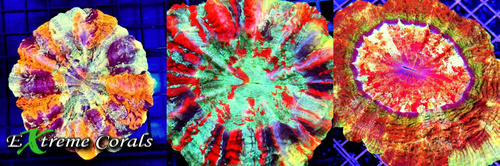
If one coral in this trio most fully embodies the hobby image of a premium solitary meat coral, it is Acanthophyllia. Healthy specimens are often broad, thick, and exceptionally fleshy, with tissue that drapes heavily over the skeleton and creates a luxurious, oversized look in the aquarium. The best examples combine dense inflation with strong color saturation—greens, reds, oranges, and multicolor combinations that appear almost painted under blue-heavy lighting.
In visual terms, Acanthophyllia usually appears the most massive and broad-bodied of the three. It often has a smoother, more unified fleshy presentation than Cynarina and a less pattern-driven look than Indophyllia. Its appeal tends to come from fullness, scale, and tissue mass.
Indophyllia: The Rare Outlier With a Collector’s Morphology
Indophyllia is the most intriguing coral in this comparison because it is both the least commonly encountered and the most frequently misidentified. Many reef keepers never see a true Indophyllia at all. Others see one, assume it is simply a particularly unusual Cynarina or Acanthophyllia, and move on.
That confusion is understandable. Indophyllia shares a great deal with the other two in overall life strategy and habitat type. But when a high-quality specimen is viewed carefully, its differences become clearer.
Indophyllia is often regarded as the rarest of the three corals commonly lumped into the donut-coral conversation. It has been associated with deep, sandy habitats and free-living life on open substrate. Morphologically, experienced observers often point to a more structured feel beneath the tissue, a differently organized mouth, and the distinctive spotted or “jaguar” patterning that can show through the tissue in top specimens.
In the best examples, those markings are the giveaway. While color alone can push an Indophyllia toward Cynarina-like territory, the patterned spotting and underlying structure often tell the more useful story.
Cynarina: The Inflated Doughnut Coral
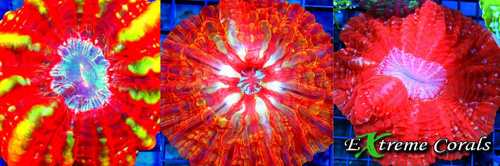
Cynarina is probably the easiest of the three for hobbyists to recognize when it displays its classic form. Healthy specimens often inflate into a rounded, soft, doughnut-like presentation, with bubble-like vesicles and a smoother, more swollen appearance than either Acanthophyllia or Indophyllia. This is part of what makes Cynarina so attractive in the first place: it looks almost unreal when fully expanded, as if the tissue is floating over the skeleton.
In shape and visual feel, Cynarina tends to read as softer and more inflated than the others. Where Acanthophyllia looks broad and weighty, and Indophyllia looks more patterned or structurally specialized, Cynarina often looks sumptuous and ballooned. This quality is especially pronounced in bright pink, red, and multicolor specimens.
Husbandry: Water Chemistry, Placement, and Long-Term Care
While these three corals are different in appearance, their general husbandry overlaps enough that they can be discussed together before getting into the finer distinctions.
Temperature
A practical temperature range for all three is 75–80°F, with many aquarists keeping them most successfully around 76–79°F. More important than the exact number is avoiding instability. Repeated swings are far more stressful than a slightly warmer or slightly cooler but stable system.
Salinity
They generally do best in a reef-standard salinity range of 1.025–1.026 specific gravity. Stability matters here as well, especially because large fleshy solitary corals can respond poorly to abrupt osmotic changes.
pH
Aim for a stable pH of 8.1–8.4. Chasing pH aggressively is rarely helpful, but avoiding chronic low-pH conditions and maintaining good gas exchange is beneficial.
Alkalinity
A practical alkalinity range is 8–9 dKH, with consistency being the key. These are not the kind of corals that reward aggressive chemistry swings. Large fleshy corals often look best when alkalinity is simply kept stable in a moderate range rather than pushed.
Calcium
Target 400–450 ppm calcium. Since these corals do still build skeleton even though their tissue is what usually gets all the attention, calcium should not be neglected.
Magnesium
A healthy range of 1250–1350 ppm magnesium helps maintain broader ionic stability and supports overall reef chemistry.
Nutrients and Water Quality
All three generally prefer clean but not stripped water. A sensible target would be:
- Nitrate: roughly 2–10 ppm
- Phosphate: roughly 0.02–0.08 ppm
Ultra-dirty systems can encourage tissue problems and algae issues, while ultra-sterile systems can sometimes leave fleshy LPS corals looking deflated or undernourished. These corals tend to do well in mature, stable reef tanks with reasonable nutrients and consistent export.
Lighting
All three generally prefer low to moderate lighting, especially compared with SPS corals. A practical working range is often somewhere around 50–150 PAR, though some well-acclimated specimens may tolerate a little more depending on the system.
- Acanthophyllia: often happiest on the lower end of that range
- Indophyllia: moderate but not harsh light
- Cynarina: moderate light with protection from direct intensity
These are not “blast them with light” corals. If in doubt, start lower and acclimate upward carefully.
Flow
All three tend to prefer gentle to moderate indirect flow. They should move slightly or remain clean, but they should not be folded, whipped, or blasted.
- Acanthophyllia usually likes the gentlest overall environment
- Indophyllia appreciates moderate but non-abrasive flow
- Cynarina needs enough movement to stay clean but not so much that its inflated tissue becomes stressed
Placement
The safest placement strategy for all three is:
- On sand or a broad, stable low rock shelf
- In lower to lower-mid areas of the tank
- Away from aggressive neighbors
- With room for full nighttime inflation
If tissue can rub rock, a plug edge, or another coral, eventually it often will. These corals need real space.
Feeding
All three benefit from feeding, even though they can survive largely on photosynthesis in stable systems.
Good food options include:
- Mysis shrimp
- Finely chopped marine meaty foods
- Small pellet or powdered coral diets
- Target-fed LPS foods
A practical schedule is 1–2 times per week for Acanthophyllia and Indophyllia, and occasional to weekly feeding for Cynarina depending on the system and the coral’s response.
The best rule is moderation. Feed enough to support tissue and growth, but not so heavily that the system becomes dirty.
Common Diseases and Pests That Affect Acanthophyllia, Indophyllia, and Cynarina
Like many fleshy solitary LPS corals, Acanthophyllia, Indophyllia, and Cynarina are less known for highly specialized obligate pests and more for stress-related tissue problems, bacterial/protozoan infections, and damage that begins after shipping, abrasion, or instability. In other words, the biggest threats usually come from injury plus poor conditions, not from the kind of species-specific pest pressure hobbyists associate with Acropora or Montipora. That said, these corals can still be affected by several common reef-tank problems, and because they are so fleshy, they often decline visibly and quickly once tissue starts to fail.
1. Brown Jelly Disease
Brown Jelly Disease is probably the most serious disease concern to mention for this group, especially for any fleshy LPS coral that has been recently stressed, injured, shipped, or damaged by flow or neighboring corals. Reef Builders describes brown jelly as a polymicrobial disease state associated with external stress, not a simple one-pathogen issue, which fits what many reef keepers see in practice: a compromised coral suddenly develops brown, slimy, fast-moving tissue decay.
What it looks like
- Brown, slimy, jelly-like mucus on the tissue
- Rapid tissue breakdown
- Foul-looking necrotic material around the mouth or damaged edges
- Fast progression, sometimes over hours to a day or two in vulnerable fleshy corals
Likely triggers
- Shipping stress
- Tissue tears or handling damage
- Abrasion against rock or neighboring corals
- Poor or unstable water quality
- Excessive direct flow or sudden lighting stress
Recommended treatment
- Remove the coral immediately from the display if possible
- Turn off flow briefly during removal so infected material is not blown around the tank
- Rinse or gently blow off the brown jelly
- Dip the coral in a coral disinfectant or iodine-based dip used appropriately for LPS corals
- If one section is already collapsing, cut away clearly dead or infected tissue/skeleton margins when practical
- Return the coral to a lower-stress recovery area with gentle indirect flow and stable conditions
- In persistent or severe cases, some hobbyists and researchers have explored antibiotic-based treatment, but protocols are still evolving and should be approached carefully and deliberately rather than casually.
For this article, I would phrase it conservatively: fast removal, cleaning, isolation, dipping, and correction of the underlying stressor are the first-line actions.
2. Tissue Recession and Damage From Mechanical Stress
In these three corals, plain old tissue recession is often just as important as any named disease. Because Acanthophyllia, Indophyllia, and Cynarina all have large exposed fleshy tissue, they are especially vulnerable to:
- rubbing on rock
- being blasted by direct flow
- collapsing onto rough substrate
- being stung by neighboring corals
- suffering handling damage during moving or acclimation
Once tissue is torn or chronically irritated, secondary infection risk rises sharply. That is one reason these corals should always be given stable placement, space, and indirect flow rather than being tucked into tight rockwork. Reef Builders’ Indophyllia coverage also reinforces their natural association with free-living sandy substrates, which fits the husbandry logic of protected, low-abrasion placement.
Treatment
- Move the coral to a safer, lower-stress location
- Reduce direct flow
- Keep tissue from touching rock edges or aggressive neighbors
- Maintain stable alkalinity, salinity, and temperature
- Feed lightly but consistently if the coral still shows feeding response
- Dip if recession appears infected rather than purely mechanical
3. Algae and Cyanobacterial Overgrowth on Exposed Skeleton
These corals can also struggle when damaged areas or exposed skeleton become colonized by nuisance algae or microbial films. This is usually not the original problem — it is more often a sign that tissue was already weakened or receding — but once algae takes hold, recovery becomes harder because the damaged margin stays irritated.
What it looks like
- Green or brown algae growing on exposed skeleton
- Tissue edge failing to regrow over previously damaged zones
- Detritus collecting around low-flow areas of the coral
Treatment
- Correct the root cause first: recession, excess light, unstable water quality, or poor flow
- Gently clean exposed areas without scraping healthy tissue
- Keep nutrients controlled but not stripped
- Improve indirect flow enough to keep debris from settling
- Use a turkey baster or gentle siphon during maintenance to prevent buildup
4. Flatworms and Other Generalist Coral Hitchhikers
There is not a widely recognized, famous “Acanthophyllia-eating pest” on the level of Acropora-eating flatworms or Montipora-eating nudibranchs. That is the good news. The less good news is that generalist pests and hitchhikers can still arrive on bases, plugs, rubble, or nearby corals in the same system. Reef Builders’ coral pest coverage stresses the broader point that dipping and quarantine matter because expensive corals move from tank to tank and pests often hitchhike unnoticed.
Potential nuisances include:
- flatworms on surrounding surfaces
- nuisance algae growing around the base
- irritating scavengers or opportunistic invertebrates attacking already compromised tissue
- vermetids or other nearby pests creating chronic irritation
Treatment / prevention
- Dip all new corals
- Inspect the underside and skeleton carefully
- Quarantine when possible
- Manually remove visible pests or eggs when found
- Treat the tank or quarantine system only when you are sure what the pest actually is
For this article, I would keep the wording broad and accurate rather than pretending these corals have a single signature pest.
5. Post-Shipping Stress and Delayed Decline
This is not a “disease” in the strict sense, but it deserves inclusion because it is one of the most common real-world causes of loss with these corals. Large fleshy solitary LPS corals often arrive looking acceptable, then decline several days later due to accumulated transport damage, osmotic stress, or bruised tissue that later becomes infected.
Warning signs
- poor inflation after introduction
- tissue wrinkling or pulling from edges
- delayed brown jelly appearance
- refusal to feed after the first few days
Best response
- stable acclimation
- low-stress placement from day one
- no harsh light blast
- no aggressive target feeding on a freshly stressed coral
- quick intervention at the first sign of active tissue breakdown
That kind of preventive handling is often more important than any medication later.
Prevention matters more than treatment with these corals. Acanthophyllia, Indophyllia, and Cynarina usually stay healthiest when they are quarantined before introduction, dipped on arrival, placed on stable low-abrasion surfaces, protected from aggressive neighbors, and kept in stable water with moderate nutrients, gentle indirect flow, and careful feeding. In most cases, once these corals begin to fail, the real key is to identify the original stressor quickly rather than treating the visible symptoms alone
How to Tell Them Apart in Practice
For aquarists who want a more practical field guide, the easiest way to distinguish these corals is to focus on overall silhouette, tissue texture, mouth presentation, and pattern.
Acanthophyllia
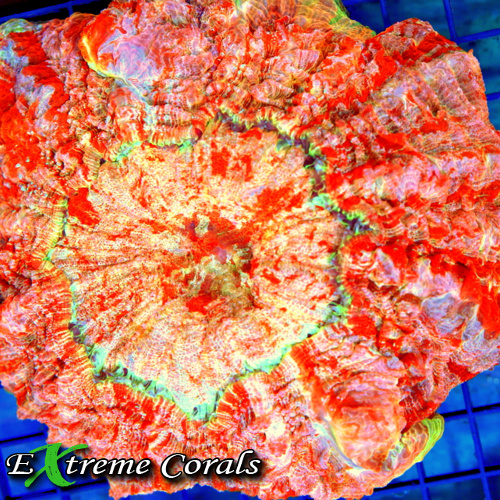
Think broad, massive, fleshy, and heavy-bodied. It often looks like the most substantial “meat coral” of the three.
Indophyllia
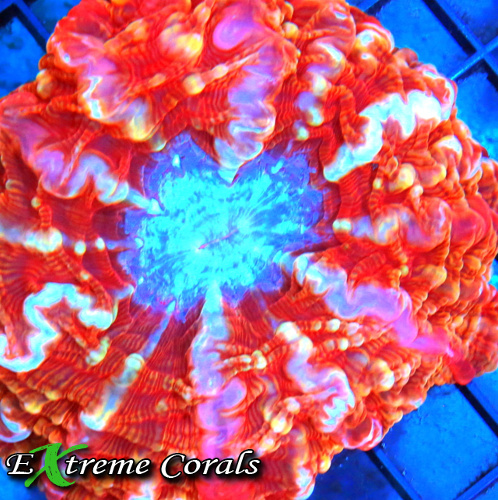
Think rarer, more structured, and often marked by distinctive spotting or jaguar-like patterning. In top specimens, it carries a visual personality that does not quite match classic Cynarina or classic Acanthophyllia.
Cynarina
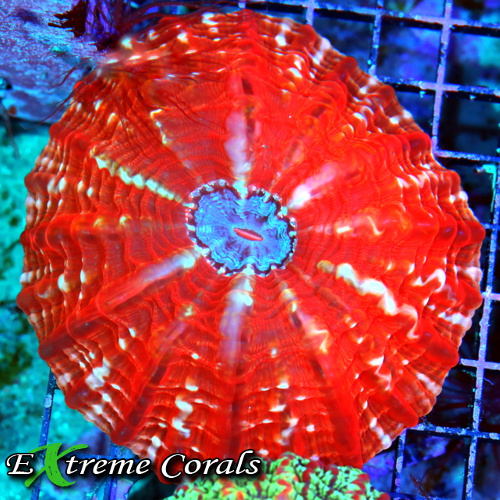
Think inflated, rounded, vesiculated, and doughnut-like. It usually has the softest, most ballooned appearance of the group.
Once you start identifying them by body plan instead of color names, the distinctions become easier.
Which One Belongs in Your Tank?
That depends less on prestige and more on what kind of reef you are building.
Choose Acanthophyllia if you want a classic oversized meat-coral centerpiece with broad fleshy mass and strong coloration.
Choose Indophyllia if you are a collector who values rarity, subtle structural differences, and the patterned look that makes true specimens so compelling.
Choose Cynarina if you want one of the most inflated and elegant solitary corals in the hobby, especially if you appreciate soft rounded form and strong fluorescence.
Each coral can be extraordinary. The best choice is not the most expensive one—it is the one whose structure, placement needs, and husbandry profile actually fit your tank.
For aquarists who want to compare examples visually, one helpful reference point is browsing dedicated categories like <a href=”https://www.extremecorals.com/category/featured-corals.html”>featured corals</a> or established LPS collections from vendors who photograph individual specimens carefully.
Final Thoughts
Acanthophyllia, Indophyllia, and Cynarina belong together in conversation, but not because they are the same coral. They belong together because they tell a larger story about one of the most compelling coral niches in the reef hobby: solitary fleshy LPS corals from atypical reef environments that combine showpiece beauty with subtle biological differences.
For the reef aquarist, learning to distinguish them is more than an academic exercise. It leads to better purchases, better placement, better care, and a deeper appreciation of what makes each one remarkable.
Acanthophyllia offers mass and extravagance.
Indophyllia offers rarity and patterned mystery.
Cynarina offers inflation and elegance.
Understanding those differences is what turns a collector into a keeper.