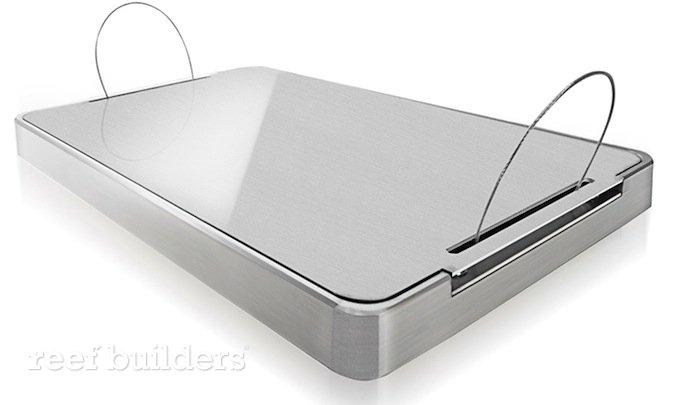
E-Lite 3 from Elos features replaceable LEDs and customizable tops

By on May 09, 2012

elite3 led

The E-Lite 3 from Elos is the third generation of LED lights from the famed Italian aquarium company. Looking as delicious as ever, the Elos E-lilte 3 features interchangeable tops for easy color matching with your room or aquarium decor and better yet, user replaceable LEDs. Elos has made the E-Lite 3 so accessible that you could even change out the fan if you wanted to. 

The Elos E-Lite 3 follows up on other InterZoo releases like the E-Lite XP and the E-Lite Color which we saw in 2010. Whereas those LED lights from Elos were an incremental upgrade to the classic Elos E-Lite, the E-lite 3 is a big change from the philosophy that Elos has had with previous products, allowing the E-Lite 3 to become as nimble as other LED lights on the aquarium market, even while retaining a healthy lead in the style department.

Stay tuned for more details on the Elos E-Lite 3 LED light as we get them.

elite3 led

Posted in Reef News |
Search More:  
   
  • http://www.facebook.com/profile.php?id=555379745 Christopher Jung

    Does it suck in air from the bottom?

  • Clive Bentley

    Seems that way, based on the orientation of the fan.
     
    Looks like there is mounting provisions for secondary optics on the MCPCBs (small holes surrounding each LED).

  • http://www.facebook.com/people/José-Alberto-Marí-Escandell/1082652515 José Alberto Marí Escandell

    A fan putting wet air and salt in to the circuits?

  • http://www.facebook.com/profile.php?id=100001443324671 Patrick Jewell

    IMHO, this is going to cause nothing but trouble. All it takes is for one day a sump pump or a powerhead, to start aspirating air and sucked in by the fan; laying delicate fine mist of saltwater all over the PCB’s. Mmmm. 

    It makes you wonder if the Engineers who design this ACTUALLY OWN AN AQUARIUM. 

  • http://www.facebook.com/profile.php?id=555379745 Christopher Jung

     It looks really bad when i post, but i have to. If you look at the airflow from the first video, you see that the boxed fan provides SOME isolation from salt creep. That fan is going to go out regularly if you are in a humid environment.

    In the second video, you see that the heatsink on top is poor to fair at best. its only 4 3/16 slots about 1/8 deep.

    From a style perspective, Elos is always cutting edge. From a functionality/price perspective, missing the boat.

    Being in the business, I try to remain unbiased and “call them as i see them”. This one is sexy but seems like airflow was a “half thought”.

    Cheers

    Chris

  • http://marine-engineers.org/ Michael Rice

    This sounds like the exact conversation that went on after the release of the Radion, and I’m yet to hear of a fan failing. I think the fact of the matter is, if the air on the underside of yours lights is moist enough to break a fan, than it’s safe to say the air one inch higher at the top of the fixture will do the same.

    Thay said, it’s amazing how similar the overall design of this light looks to the Radion. Props to EcoTech Marine for making a cooling system that Elos decided to use!

  • XD_1

    In the Radion I believe the airflow from the fan travels across internal heatsinks while the electronics remain isolated from the salty air.  These pictures sure make it look like the air circulates directly over the circuits which makes me a little uneasy.

  • http://www.facebook.com/profile.php?id=608040062 Ioannis Mylothridis

    Or so you would think. I have replaced 4 radions in a tank with 9 radions in total, mostly due to moisture ruining a PCB or a LED puck.

    To be honest, the customers tank does not have the best ventilation, yet the electronics in the Radion are not 100% isolated from salty air…

    Other than that its a great lighting unit but DO at all costs ventilate a closed aquarium at the best possible manner or be sorry you never did

  • http://marine-engineers.org/ Michael Rice

    Check out the video that shows how the changeable top plate works. When it’s shown taken off you can see that the fan pushes air to the back of the heat sink where it’s forced out the sides from between the heat sink and back plate.

  • XD_1

    Yeah, the air path does look a little better in the video, but it still seems like there isn’t a lot of effort made to isolate the electronics.

  • http://marine-engineers.org/ Michael Rice

    I have to agree with you there. Hopefully there will be some kind of additional seal around the fan casing.

  • http://www.facebook.com/profile.php?id=555379745 Christopher Jung

     Hi Michael

    The main difference you are confusing is the concept of relative humidity versus salt splash.

    In situations where the fan sucks in from the top, the likelyhood of salt creep is minimized from the fact that salt does not vaporize at atmospheric pressure.

    When you are inducing air from the bottom of a light fixture, you would think that the bouyant forces would be an advantage, but its staunchly met with the reality that you are now introducing salt spray into the airflow system.

    Neither system is perfect and all actively cooled LED systems should have some preventative maintenance, but there is a distinct advantage to having a fan on top vs. the bottom.

    my 0.02

    Cheers

    Chris

  • http://www.facebook.com/profile.php?id=100001443324671 Patrick Jewell

    I think you misread me. I agree completely with you. You analysis is dead on.