

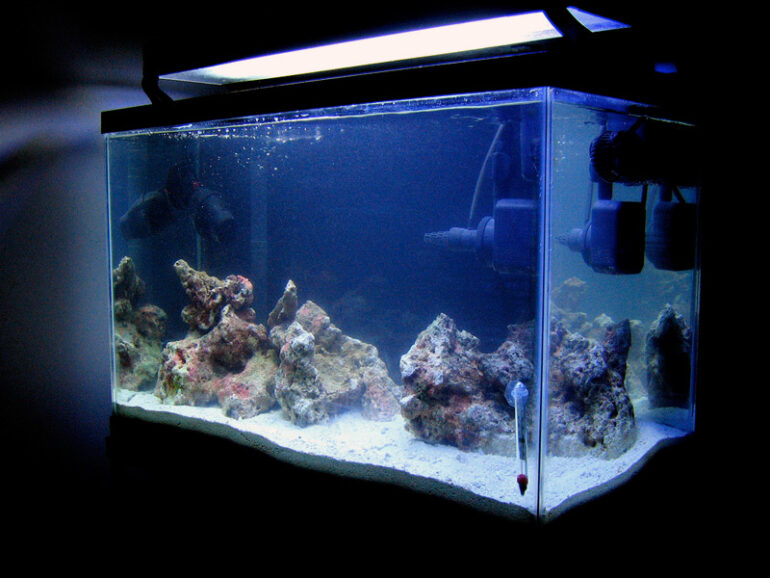
Before any aquarium can support livestock, whether fish or invertebrates, it must be completely “cycled”—another way of saying that biofiltration must be fully established in the system.
Sounds good, but what on earth does that mean? A system is considered cycled when it has been colonized by beneficial bacteria that convert deadly ammonia—produced through the waste and respiration of fish, the decomposition of organic matter (e.g., fish food), etc.—to less harmful byproducts.
One form of bacteria converts ammonia to nitrite, which is still deadly to marine livestock. Then, another form converts the nitrite to nitrate, which is relatively harmless in lower concentrations. Partial water changes must be performed on a routine basis to prevent nitrate from accumulating to harmful levels.
But how does the cycle get started?
Cycling is not simply a matter of allowing an aquarium to operate for some predetermined amount of time before adding fish or invertebrates. You can operate a new aquarium from now until doomsday (which, given the fact that Here Comes Honey Boo Boo remains on the air, is clearly close at hand) and get no closer to establishing a biofilter—unless you somehow introduce ammonia.
One such method is adding pure household ammonia (containing no dyes, perfumes, or other additives) or to the system. Another is feeding the tank—literally adding fish food on a daily basis and allowing it to decompose, thereby producing ammonia. There are also ammonium chloride solutions specifically targeted at aquarists.
In the past, it was common practice to add a few very hardy fish—typically damsels—to jumpstart the cycle with their waste products. This method is not only inhumane to the damsels, but also completely unnecessary when there are very effective “fishless” alternatives to cycling.
Live rock cycling is best
However, here at Saltwater Smarts, we encourage the concept of cycling with live rock, preferably the aquacultured variety. Live rock provides everything you need to get the cycle going in one convenient package, including:
- The beneficial aerobic nitrifying bacteria (live rock also contains anaerobic bacteria that convert nitrate to free nitrogen gas, but that’s a topic for another post)
- The perfect porous substrate to allow bacterial populations to flourish
- A built-in ammonia source
Ammonia from live rock? How so? When you introduce live rock to your system after it has been cured (that is, after the inevitable die-off of some encrusting organisms has been allowed to progress under controlled conditions), a limited degree of additional die-off will still occur. This additional die-back and subsequent decay will produce enough ammonia to get the cycle started.
What do I do during the cycle?
All you have to do is monitor the process with quality ammonia, nitrite, and nitrate test kits. As the cycle progresses, you’ll measure spiking and declining ammonia and nitrite levels followed by the appearance of nitrate.
How do I know when my tank is cycled?
When ammonia and nitrite are no longer measurable and nitrate is beginning to build up, the system is considered cycled and it’s safe to start adding livestock very slowly and incrementally.


You’ll want to top off any water lost to evaporation on a daily basis using purified fresh water. Remember, when water evaporates, all the stuff dissolved in it gets left behind. So If you don’t compensate for evaporation or you top off with salt water instead of fresh, your salinity will continuously rise.
There’s no set amount of fresh water that you need to add daily because that’s going to vary considerably based on the rate of evaporation, which is affected by humidity, air movement, etc.
It’s a good idea to place some sort of mark (even a piece of tape will do), either on your sump or on your display tank, at the desired water level and then top off with fresh water to that mark each day.
Yes, I forgot the zero. 🙂 i wasn’t compensating for the evaporation. Should I be adding fresh water everyday? Like a cup or something?
Hi Angie! Do you mean the specific gravity is 1.030? (I think a zero is missing.) To bring the salinity level down, you’ll need to remove salt water and replace it with an equal volume of purified fresh water. You definitely don’t want to add any more salt at this point. Are you compensating for evaporation using salt water or fresh water?
Hmm, I suppose it’s possible, but to go through both the ammonia and nitrite spikes and begin accumulating nitrate at such a high level within four days strikes me as unlikely.
Hi, I need some help. My 29 gal salt is high. 1.3…I’m doing a 5 gal water change. How much salt should I add to make the level go down?
Hi Jeff. Thanks for the quick response! I’ve gotten my specific gravity down to 1.026, so I think I’m doing okay there (I’ll still work on getting it to 1.025). I asked an employee at the local fish store about not detecting any ammonia or nitrite and she thought it was possible that the nitrification process had already been established in the first few days and I just missed it because I didn’t test until day 4. This struck me as unlikely. Does that seem possible to you?
Hi Chris! Your high nitrate level strikes me as odd since that’s the end product of nitrification and shouldn’t be appearing if you haven’t registered any ammonia or nitrite yet. I wonder whether it’s being introduced in some other way–in your source water perhaps?–or your test kit is potentially outdated and giving faulty measurements.
On the other hand, I’m not really surprised that you haven’t started measuring ammonia or nitrite yet, as it’s only been four days, and the process can take several weeks. Keep testing for a while, and you should see spikes in these compounds. If that doesn’t happen for some reason, you can always add ammonia to the tank (e.g., in the form of decomposing fish food) to get the cycle started.
Also, you’ll want to keep working on bringing your specific gravity down. It should be closer to the vicinity of 1.025.
Keep us posted on your progress or if you run into any further snags.
Hello – I started a 65 gallon tank 4 days ago. So far I’ve added sand, salt water (mixed with instant ocean salt) & 62 lbs of pre-cured live rock from a local fish store. My salinity levels were initially too high, but I’ve gotten them down to 1.028 so far by taking out saltwater and adding RO fresh water. My question comes in regard to the cycling process. I tested the water today and did not detect any trace of ammonia or nitrite, however the nitrate level is around 40 or 50. I would have expected the ammonia levels to be high at this stage. Any recommendations or insight would be greatly appreciated!
Hi Jeff! It’s no bother at all! Essentially, your bioload has gotten ahead of your biofilter here. Remember, even when using pre-cured live rock, additional die-off occurs that continues to produce ammonia. In fact, as I mention in the post above, I often take advantage of that die-off to cycle new systems. However, it still takes upwards of a few weeks or more before I’m testing zero ammonia and nitrite. Anyhow, the ammonia you’re measuring can be attributed to tentative biofiltration coupled with that continued die-off and the premature addition of livestock.
At this point, you need to allow the biofilter to catch up. So you definitely don’t want to add any more animals and should feed very sparingly, if at all. You might also want to explore the possibility of adding a product that contains live nitrifying bacteria, such as Bio-Spira, to help the cycle along. I’ve never used these types of products myself, and not all of them are worthwhile, but Bio-Spira has a pretty solid reputation in the hobby. Just something to think about.
Hi sorry to bother you but I’m having some issues with a new set up and can’t figure out exactly what to do. I purchased some live keys sand and (pre-cured) live keys rock along with bagged aragonite. I made a mistake and listened to some people who said that the tank would cycle in a day and also ordered several blue leg hermits, detritus eating snails, 1000 pods, and macro’s all of which arrived at the same time. My first problem was a sand storm in the tank that didn’t resolve for a week. After this, I apparently had a significant die off which caused my ammonia to go sky high. Everything was proceeding at that point. Ammonia came down, nitrites went up. About a week ago I began to notice the tank clouding up again. At this point my nitrites began coming down and my ammonia was low, although not zero, about 0.25. This turned into a full algae bloom. I tried a 48 hour blackout which did not help. Yesterday the lights came back on and I retested. The ammonia is still low at the same level but not zero. Nitrites are down to 0. Nitrates are about 5. I use RO water, and have been feeding very sparingly. The remaining inverts and macros are doing well. My pods are reproducing, etc. Not sure where the ammonia is coming from or how to get rid of the bloom. I have a 54 gallon corner bow front. Please advise. Thanks, Jeff
I added a filter block on the middle, I saw a post where some people have hem there.i don’t currently have a heater, I live in Phoenix and thought I may be okay weather wise.
My pleasure, Angie! You definitely don’t need (or want) to use bioballs along with live rock. The rocks will provide all the biofiltration you need (assuming you’ve got enough of them, of course).
As far as the middle chamber is concerned, perhaps you could use it for your heater or chemical filtration media, such as activated carbon. I’m picturing the biocube from memory (never actually used one), so perhaps some other folks out there who currently have the system could chime in here?
Your 500GPH pump should be sufficient, though makes and models vary considerably in efficiency and reliability. What type of pump is it?
Thank you so much for your response Jeff. So I have a question regarding the back compartment. I’ve read many for him so it’s a bio balls are not needed if you have live rock which I do so what exactly do I need to make sure that I have back there? Right now I have a skimmer in Chamber 1. This is of course turned off since it’s still cycling. I have nothing in the middle chamber and I have the pump and chamber three. I do have a 500 pH powerhead in the tank attached to the glass. Do you think that’s enough for circulation.
HI Angie! Unless you want to have a mixed substrate for some reason, there’s no need to add sand on top of your gravel. At this point, I would just get everything running as it will be when the tank is stocked (with the exception of the lights–they aren’t necessary right now), making sure there’s good water movement in the system and that the salinity and temperature are in the desired ranges. Then start testing the water. I usually test two or three times per week when I’m cycling a new system. Once both the ammonia and nitrite levels have spiked and fallen back to zero, it’s safe to begin stocking–albeit very slowly and gradually. Remember, it’s very easy to overwhelm a tentative biofilter by introducing too many specimens or adding them too quickly!
Hi! I set up a 29g bio cube today and I’m hoping you can help me out. I am a newbie and want to get this right. I have live rock and gravel right now in the tank. Should I add sand? What do I do now? How often should I check levels?
Thanks for your question, Brett! You’ll definitely want to add salt to the appropriate salinity level before attempting to cycle your tank.
Do you have to cycle a new tank with salt added? Or can it be added after you get the appropriate parameters?
Hi Shawn! When setting up a new tank, I always run everything as it will be when the system is stocked, with the exception of the lights. The coralline algae should come back as long as you’re maintaining proper water parameters (calcium/alkalinity, etc.).
Hello everyone, got a couple questions here I have a 36 gallon salt water tank gonna get a reef tank goin I have added the live rock and and crushed coral just wondering if I’m supposed to have my filter on i do atm. And also I had a lot of purple on the live rock I had but it is mostly turning green and dying off will it come back? There is still some purple left but I havnt seen much action other then that goin on and havnt done any tests yet since I’ve been working to much lol ..
Hi Jacqui! I’m sorry to hear about your frustration! The algae, while unsightly, won’t harm your water in any way. It’s just taking advantage of dissolved nutrients.
As far as filtration is concerned, it’s most important to have good biological filtration in place–meaning the tank is fully cycled and there’s no measurable ammonia or nitrite–before any livestock can be safely added. Assuming the original tank was torn down and moved expeditiously and proper water flow, temperature, and chemistry are being maintained in the new location, it shouldn’t take all that long to get the biofilter re-established. Still, you’ll want to monitor the ammonia, nitrite, and nitrate levels to be sure before reintroducing the fish.
Does the system come with a protein skimmer? That’s the one piece of filtration equipment the tank really must have in my opinion.
Keep us posted on the tank’s progress, and if there are any more questions we can help with, just let us know.
Hi I need your help. We inherited a huge marine tank when a restaurant next to ours closed down. As I have no clue when it comes to marine tanks ( but I have kept tropical tanks all my life) I contacted a marine care ” specialist ” to assist with the move from the restaurant to our home. The process has taken much longer than anticipated due to their frequent stalling and many excuses.
Nevertheless We now have the tank at our house. They filled it with saltwater and bacteria on 23 December and we were told it needs to cycle for 2 weeks and they would come back on 6 January to complete the installation ( at this stage there is plenty live rock, water and wave makers in the tank – nothing else). They have again stalled by saying the will come “tomorrow” with every call I make and are now not answering my calls.
My problem is I am becoming very concerned as there is no filtration system in place, the tank has huge amounts of brown algae growing and I am really worried that we are going to loose the 2000 litres of water.
The tank was a fully functioning operation at the restaurant so all the equipment is there but I have no idea how to set up the filtration system. How much damage can that algae do to the water?
They also have all the fish at their establishment that were originally at the restaurant and have been ” babysitting them” for almost three months.
I need to get this tank up and running ASAP.
The really came highly recommended so I am in utter shock
Thanks Jacqui
Hi Jessica! At this point, you’ll just need to wait while the population of nitrifying bacteria catches up. Remember, it can take several weeks for the cycling process to run its course.
Set up a 26 gallon hex tank a little over a week ago. I have live rock from a friends sump and I have been adding bacterial supplement to the tank. All my reading are great except for the ammonia , it is reading 0.50. I did a 10 gallon water change and added some more live rock last night with a sample bottle of a kick start tank cycler. I was told to wait 24 hrs and test again. Results are exactly the same. Nitrite and nitrate 0.0. PH 8.2 and ammonia 0.50. Any ideas on how to get it to go down?
Not a stupid question at all! I would go ahead and add the heater and set it for the temperature you plan to maintain long term.
My pleasure, Lindsey!
Thanks for your help!!
Hi LIndsey! You’ll want to make sure your tank is fully cycled before adding any livestock. That means the ammonia and nitrite levels should be zero and the nitrate level should as low as possible. Since you plan to keep invertebrates, I would shoot for a specific gravity of 1.025 and pH somewhere between 8.2 and 8.4.
I wouldn’t recommend trying to keep an anemone in a tank that size, especially with corals or other sessile invertebrates (anemones wander and can easily sting/get stung by neighbors in such close proximity) No worries, though. Clownfish do just fine in aquariums without a host anemone.
Hi I am new at this saltwater aquarium stuff but I have a 25 gallon tank and I test ny water my ph is still low and nitrite getting better what are the test results I should have for nitrite salt nitrate and ph? Also when I can start what corals can I have with sea anemones that will get along together with clown fish? Sorry so many questions just really excited.
Week one of cycling is over now going into week 2. Here are my readings for today:
PH 7.6
KH 3.9
Ammonia .4
Nitrates 5
Nitrites 0
Salinity 1.025
Lots of brown algae on sand, rocks and glass of aquarium.
Am I doing ok?
By any chance, do you have the nitrite and nitrate readings reversed in your list? I ask that only because at this stage of the game, it would be more likely to see some nitrite and 0 nitrate. Apart from that, just keep doing what you’re doing until both ammonia and nitrite are undetectable. Then, if you have nitrate accumulating, you can perform a water change to bring it down and then start stocking very slowly and gradually.
As far as the diatom growth is concerned, you can go ahead and scrape it from the glass if you like, but I’d just wait it out on the rocks. Brushing them off at this point would likely just disrupt the cycle that’s becoming established. It’s definitely unsightly, but it should run its course and start to wane.
During the cycling process, should I scrape the brown algae off the glass or rocks?
Also, here are my readings today for my tank that I am cycling:
PH: 8.2
KH: 4.3
Ammonia: .4
Nitrates: 3
Nitrites:0
Temp: 78
Salinity: 1.025
Am I doing ok? My tank is 120 gallons with live rock and sand. Been cycling one week
Nope, it’s just a normal part of the process. Every tank I’ve set up has gone through a diatom bloom in the early stages. You might also go through cyanobacteria and hair algae blooms, but again, they’ll gradually dissipate as whatever is fueling them gets depleted.
Not fun. So is there anything that I am doing wrong or not doing yo cause this?
The brownish growth is probably a diatom bloom, which is normal after a new system gets up and running. It’s not harmful and should eventually wane on its own–though it is rather unsightly and may necessitate some glass scraping. I like to equate diatoms in a new system to stepping in a mud puddle with a brand new pair of tennis shoes.
Thanks. I have started seeing some brownish stuff on the sand. Is this algae? How do I get rid of it? Is it harmful or normal during the cycling process?
Hi Charlotte! The only physical things you might want to keep an eye out for at this stage of the game are, perhaps, Aiptasia spp. anemones appearing on the rocks or any other nasty stowaways (e.g., crabs or mantis shrimps) that make their presence known, Apart from that, you’ll just want to monitor the progression of ammonia to nitrite to nitrate so you know when it’s safe to begin stocking.
Not to sure how to answer your question but if your on Facebook there are loads of marine groups that offer advice on almost anything u need to know I use them for anything am not sure about
Hi. Just started cycling my 120 gallon tank today with live rock. Are there any visible physical changes that I need to be looking for in the tank? I am aware of all the chemical changes but have not read anything about physical changes. Will there be anything growing that I need to be looking out for?
Hi Wayne! No need to run the skimmer/filtration prior to the addition of live rock. As long as you’ve got good circulation and proper water parameters, you should be in good shape.
Hi Jeff,
I have just bought a 4ft x 1ft x 2ft tank, and have added dead rock and 35 gallons of salt water from my LFS. Should I have the skimmer/filtration systems working before I add live rock, or are they ok to be off now and just move the water around with a pump?
Thanks,
Wayne.
My pleasure, Pat! Thanks so much!
Thank you. Love your website!
At this point, I think I’d just feed the appropriate amount for the fish, keep up with the weekly partial water changes, and keep a close eye on your ammonia, nitrite, and nitrate levels. With the fish in there, ammonia is being produced, so it may be that there’s enough biofiltration going on to convert what’s present. But again, stay vigilant against a potential ammonia spike and after a while you should be able to proceed very slowly and methodically with further livestock additions.
I did a 10% water change before adding the fish.and all param’s were good-am ,ni, na were still zero. Went on vacation for 1wk grandkids fed fish for me. All param’s good except Kh dropped from 12 to 10 – am, ni, na still zero and green hair algae is on the rocks. I started to feed a little more food in hopes of allowing some decay to increase ammonia that way. Any other suggestions? Is this ok?
Hi Pat! With two clownfish and their food in the system, you have a source of ammonia, so you really should be measuring some by now unless the tank had already cycled with the live rock. But in that case I would expect that you’d start to measure nitrate (unless you already have really efficient denitrification going on, which is questionable in such a young tank).
You might want to test with a different kit or ask your LFS to test the water to make sure you’re not getting faulty readings. Also, what sort of water-change regimen are you following? If it’s really aggressive and your tank isn’t cycled yet, you might be removing any ammonia before nitrifying bacteria can get a foothold. On the other hand, if the tank was already tentatively cycled with the live rock, you could be diluting nitrate to an unreadable level. Just a possibility to explore.
Also, keep in mind that cycling with fish is always problematic because now you have to strike a very delicate balance between poisoning the clowns with their waste products and getting the cycle established. Clownfishes and other damsels are generally tough enough to endure this exposure, but even they have their limits, so you’re always more or less working at cross purposes when cycling with fish.
At this point, one option is to continue monitoring ammonia, nitrite, and nitrate very closely with a quality test kit and be prepared to change water to dilute ammonia to a safer level if it spikes. The tank will eventually cycle in this manner (if it hasn’t already), though the process may be painfully slow. And, of course, any further ilvestock additions should be made very slowly and methodically.
Alternatively, you could temporarily rehome the clowns (e.g., by asking your LFS to hold them for you) and then introduce ammonia to the system by adding fish food to the tank daily and allowing it to decompose.
Sorry. I have 29G Biocube
My tank has never had ammonia,nitrate or nitrite levels above zero! My fish store recommended I add two “nemo” fish after a month of cycling with live rock and sand etc. after 2weeks with fish and feeding all para’s remain at zero. What should I do???
Hi Shal! There’s really no set time frame for cycling since there are so many different factors that can affect the rate. I’ve seen the whole process take anywhere from just a few weeks to a month or even longer. As long as you’re providing an ammonia source, good oxygenation, and substrate to colonize, the bacteria will kick in and do their job. Adding the food shouldn’t prolong the process. In fact, just the opposite should be true.
Hey,
I got a 50G tank and its been cycling about a week with live rock and cultured sand, however the ammonia reading is low, I have been putting fish food in it to decompose and to get the ammonia going. How long can I expect for the ammonia to go high and the cycle to start? Will this prolong the process of cycling?
Hi jeff, I’m pretty new to this hobby .I bought a 28gal nano-cube that was already established, all parameters looked fine for about a month ,then I noticed the ammonia levels getting high .I performed several 5% water changes , with no success of bringing the level down.i proceeded to do a 10 gal water change which I’m pretty sure put me in a cycle. Right now my parameters are Ammonia =8.0 Nitrite=5.0 Nitrate=160ppm . Is there anything I can do or will this straighten out with time?
Hi Darren! You can add live rock after cycling, but in that case, you’ll need to make sure any die-off takes place in a separate vessel before the rock is moved to your display tank. Otherwise, you may get an ammonia spike in your display to the detriment of any inhabitants.
Can u add live rock after cycling ?
I’m afraid not, Karthikeyan. The nitrifying bacteria that provide biological filtration in a freshwater system wouldn’t survive the transition to salt water. Not to mention, you’d probably want to change other aspects of a freshwater tank before making the switch, such as the substrate, tank decor, etc.
Hi there this question may be thoughtful
Can I use a cycled freshwater tank to change into saltwater tank and just add fish?
Good morning! Keep in mind that adding that damsel could lead to compatibility issues when you begin to add more livestock. Many of the damsels are highly territorial and will claim an entire aquarium (especially a small one) as their own. Thus, they’ll be inclined to attack any newcomers. You might need to remove the damsel if you plan to add more fish. Though, again, with such a small system, you don’t have a lot of leeway in this regard.
As far as the lights are concerned, 6 to 8 hours per day is just fine for a FOWLR system. As you note, with photosynthetic invertebrates, a longer photoperiod is necessary–typically between 10 and 12 hours per day. Of course, high-intensity reef-quality lighting is also essential if you plan to keep photosynthetic corals or other invertebrates.
G’day JEss
I added one Damsel to fish salt water tank and fingers crossed 🙂
Hopefully this will speed up the tank cycling process
Just want find out do I need to keep lighting on all the time. I guess lighting more required if I have corals in the tank
Is it ok to running lighting probably 6 hrs per day in FOWLR system?
Yep! You’ve got the right idea! Remember, when salt water evaporates, all the stuff dissolved in it stays behind, so fresh water must be used to compensate for evaporation.
In contrast, when you physically remove water (for example by siphon) during a water change, all the dissolved stuff goes with it, so you need to replace the water you’ve removed with salt water of the same salinity/specific gravity.
Here’s a link to a post we did on mixing saltwater that might give you some helpful insights:
http://www.saltwatersmarts.com/guide-to-mixing-saltwater-517/
As with all water parameters, you definitely want to keep the salinity stable and test it regularly with a good hydrometer or refractometer. And it is very important to check your parameters before adding livestock to ensure all the levels are where they should be.
hi Jeff
I have another thing to clarify . I found that “water will evaporate from the tank and need to be replenished. The water that evaporates is freshwater and needs to be replaced with freshwater. You should never use saltwater for makeup water (unless you want to increase the salinity of the tank). ”
Is this correct? I am confuse now. So does this mean when I see that water has been evaporated after two or three days I need to refill with freshwater.
What about when do water change ? I guess I have to use salt water
G’day Jess
Other than keep eye on mmonia , nitrites,PH and nitrates how do I check suitable salinity on salt water tank
I am already using salut water got from local aquarium
Do I still need to test salinity before I introduce first fish ?
Thanks Jeff
Cheers
My pleasure! You can begin adding corals as soon as the cycle is established and as long as your dissolved nutrient level is sufficiently low. Of course, with such a small system, you’ll definitely be limited in the number and size of corals you can introduce. Our friends at Live Aquaria have a section devoted to nano-sized corals at the link below that you might want to check out.
http://www.liveaquaria.com/product/aquarium-fish-supplies.cfm?c=597+2790
Thanks for your valuable feedback Jeff
Also at what point I should add some corals . I have heard about different types of corals Ex soft corals
What’s you you suggest for 65l nano type tank
I always set the temperature where I plan to maintain the system long term–usually somewhere between 76 and 78 degrees F.
I don’t usually perform water changes during cycling, but there are varying opinions on that. Some hobbyists perform them during the process to prevent excessive ammonia from killing critters in the live rock. However, most of the live rock I’ve used for cycling has undergone very minimal die off, so the ammonia level never gets particularly high.
If you plan to add significantly more live rock, I would suggest doing so now. Otherwise, the consequent die off that will occur on the new live rock could cause another ammonia spike down the road, which would be problematic once you’ve begun to introduce livestock.
hi Jess
Thanks you so much for prompt feedback. What sort of temperature level should I set it up the tank while it’s cycling ?
Also do I need to do 10%-35 water change weekly while it’s cycling ?
Also is it ok to add more live rocks ?
Hi PrazAU,
Unless the air temperature where you live makes it unnecessary, I would go ahead and add the heater. With respect to water testing (not a stupid question at all!), you’ll need to use the saltwater kits to monitor your parameters.
I would advise against adding a fish to speed the cycling process along. Some amount of die-off will occur on the live rock, which should provide enough ammonia to get the cycle established. If you begin testing, you should detect a rise in the ammonia level soon, which will then drop as it’s converted to nitrite. The nitrite will then spike and drop as it’s converted to nitrate. Once you get readings of 0 for both ammonia and nitrite, you can go ahead and start adding fish–slowly so the nitrifying bacteria can keep pace with the increasing bioload.
Hope this helps!
hi Jeff
I setup 65 Saltwater Tank live rocks,sand,protein skimmer adn filter media yesterday .
Do I need to add heater to get this process?
Also may be stupid question . Can I use my API fresh water kit to check water parameters ?
Or should I get API salt water kit ?
Also is ok add one fish to speed up the process ? If that ok what fish?
Thanks very much
Hi Matt! That really is a sky-high nitrate reading. Are you certain that’s accurate? To bring the level down, you’ll need to perform a major water change (using source water that isn’t high in nitrate to begin with–ideally RO/DI-purified water) or utilize some type of nitrate-adsorbing filter medium or nitrate reactor. But it might be helpful if you can provide more details about your system–size, how you cycled it, etc. Also, are you sure the test kit you used is fresh (as in not expired) and of a reliable brand?
At the end of the cycle…ammonia and nitrites at zero, nitrates through the roof…160.
Will nitrates eventually come down over time?
You’re welcome, and good luck with your aquarium!
Perfect. Thank You.
Hi Matt – There is no need for lighting during the cycle. Any light usage would be purely cosmetic and for your own enjoyment. So, it’s up to you. 🙂
Should the tank lights remain on during cycling?
Great post. Thanks for sharing and keep posting.