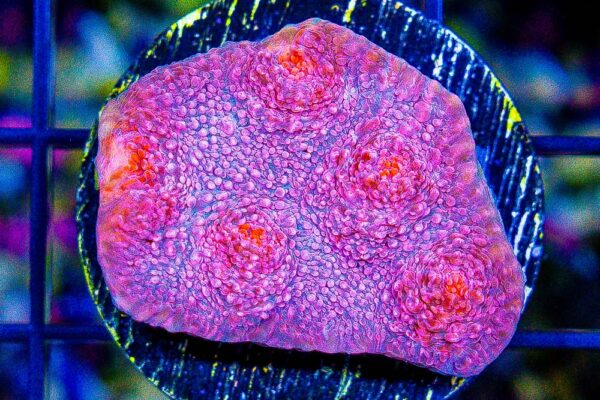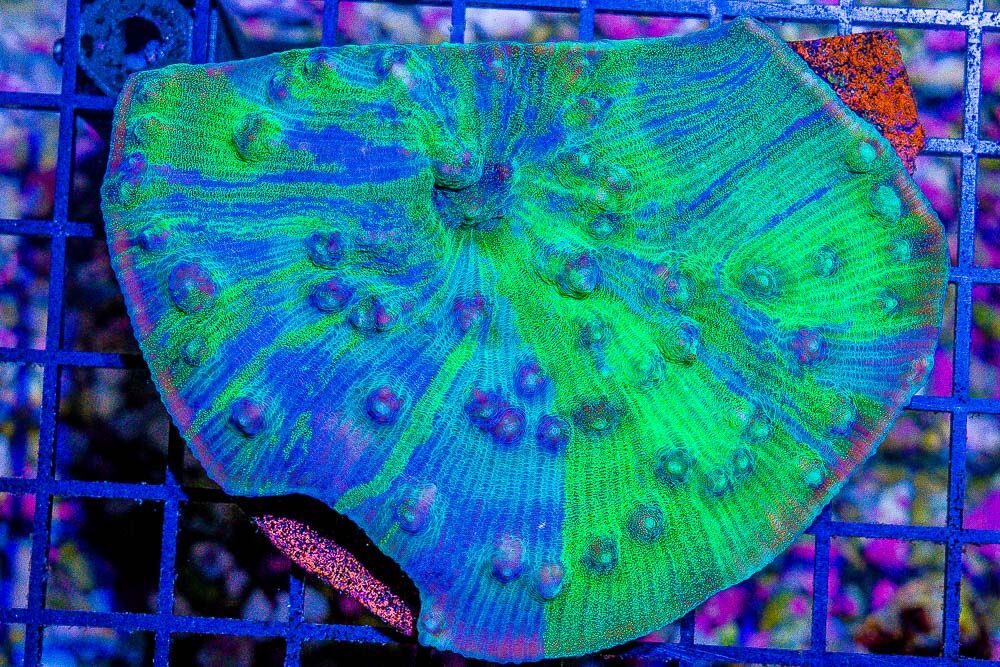
?Chalice Corals are some of the most well known Large Polyp Stony (LPS) corals out there! They come from several different countries in the central Indo-Pacific region, where they are usually found on shallow reefs. “Chalice” is a broad name encompassing several different genus of corals!
How To Tell The Difference Between Chalices
The 3 main genus of corals that fall under the “Chalice” name are Mycedium, Oxypora, and Echinophyllia. While there are other genus that are also considered Chalice corals we will focus on these three for the remainder of the article.
Mycedium are typically smooth in texture with bumpy “eyes.” These chalices tend to grow in a large plating fashion, similar to Monti caps, and with time and the right conditions, can begin to curl upwards at the edges, beginning to cup. These chalices have prominent polyps or “eyes” and are very easy to care for. Some common strains of chalices that are Mycedium you’ll find are Avatar and Space Invader.
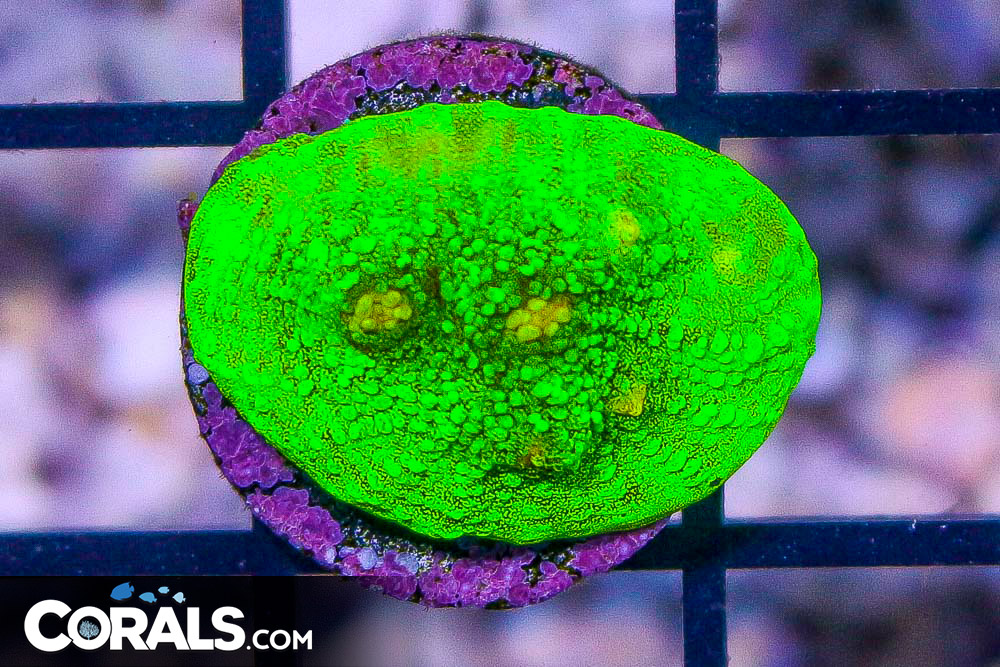
The “Space Invader” chalice – a very bright Mycedium
In contrast to the smooth look of Mycedium Oxypora, they tend to be quite jagged with small, sharp bumps and ridges appearing across their growth. Some Oxypora have obvious eyes like Mycedium, while others have eyes that blend into their body, making them appear very small and disprate.
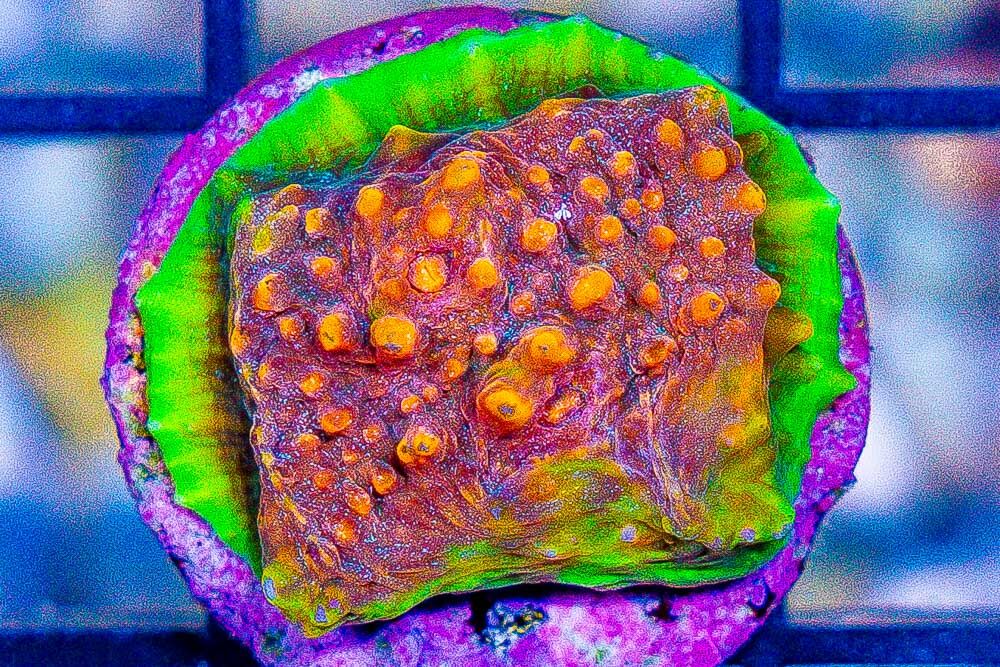
Here’s an example of a likely Oxypora: Notice the shark protrusions and difficulty differentiating the “eye” from the body.
Echinophyllia are some of the most popular chalice families in the hobby. Many rainbow chalices are Echinophyllia, as are popular strains such as mummy eye and watermelon. Echinophyllia tend to have bold contrast and very bright “eyes.” Under proper care, they can grow very rapidly and become prime candidates for propagation. Echinophyllia tend to have small bumps across their body, and when viewed up close, this can make them appear bubbly.
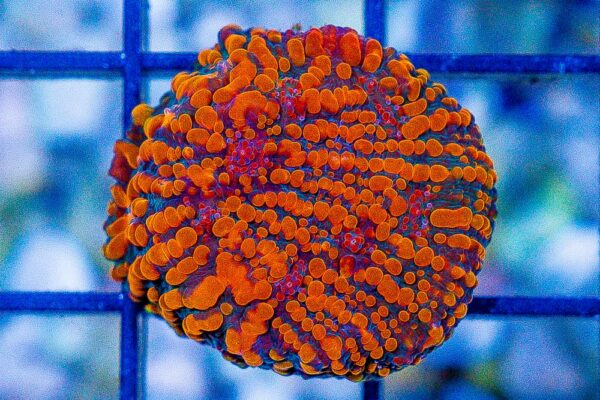
A likely Echinophyllia – the CC Cloudberry chalice is a stunning piece.
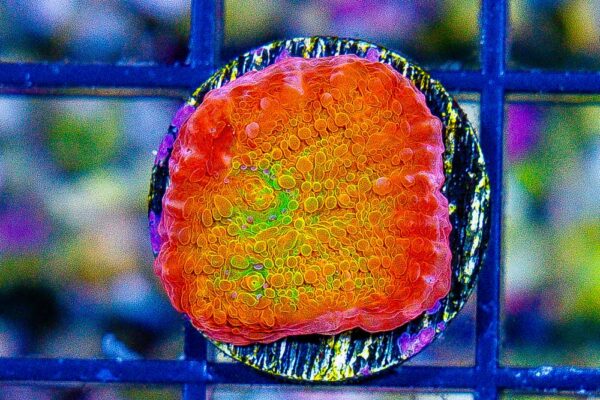
Each has its own unique characteristics and appearance, that vary between the multiple different species under each genus. However, overall their most prominent characteristic is, by far, their coloration. Chalice range from vibrant shades of green, red, blue, and purple to pinks, golds, yellows, and oranges. Almost every color you can imagine! They also can have incredible, intricate patterns and markings, dependent on their species. Which can make for an insane blend of colors that is highly desired by Reefers!
Chalice Coral Care
In the home aquarium, Chalice corals can be relatively easy to care for, making them one of the more popular choices for Reefers. They need stable water parameters, as well as lower-moderate lighting, around 100 PAR. Although some deeper water species have been found to prefer even lower levels of light. Moderate to lower flow is common, but it’s essential to provide them with enough water flow to prevent anything settling on top of them, and damaging their tissue. It should be known that Chalice corals can be aggressive. They can have long sweepers that attach and sting other nearby corals. Use caution and give them some space when placing near other corals on your reef!
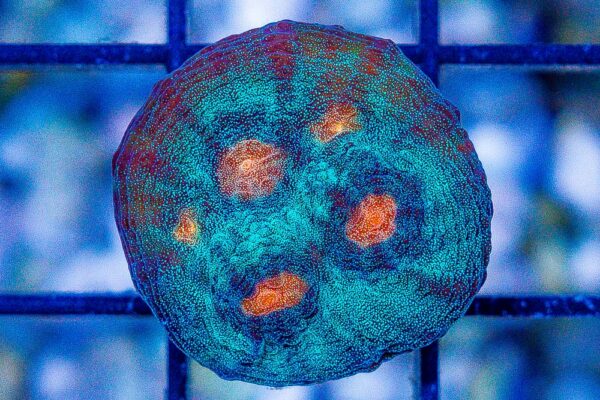
Like most LPS Corals, Chalice are primarily photosynthetic, and get most of their nutrition through their zooxanthellae. However, they can also benefit from occasional spot feeding with small meaty foods, such as mysis and brine shrimp. However, be aware that they are extremely slow eaters. They do not have huge mouths or fleshy polyps like other LPS corals, so they do take some time to mucus or slime up and retract spot fed food.
When making Chalice Frags, be sure to keep a few things in mind. Note the location of the chalice eyes and ensure you get at least one eye per frag and avoid cutting through an eye when possible. It’s crucial that there be a mouth to feed in each of your frags. Also, keep in mind the mix of colors. Try and create frags that have as many of the colors represented in your frag. In other words, shoot for as many colors as possible so that when the frag grows out, you’ll be left with a beautiful coral full of colors! Lastly, do an iodine dip upon completion of cutting your frags as the cut edges can be prone to bacterial infections during their healing time, which can be slow.
When selecting a chalice for your aquarium, take a close look at the tissue on the edge and throughout the coral. Shoot for chalice that have complete and healed edges. Ensure the mouths are not gaping open as this can be a sign of underlying stress and future health issues. Look for complete tissue across the coral as well, best to pass on a chalice if you notice any tissue is starting to pull away from the skeleton. Take coloration into account too, look for bold, deep and vibrant coloration. Chalice that lack color or are bleached looking, can be a real challenge, so unless you are a more experienced reefer, stick to specimens that are well cared for by their appearance alone. If there is a lot of skeleton sticking through the tissue, chances are the chalice is not yet settled in and may require a lot more care initially until tissue grows back over.
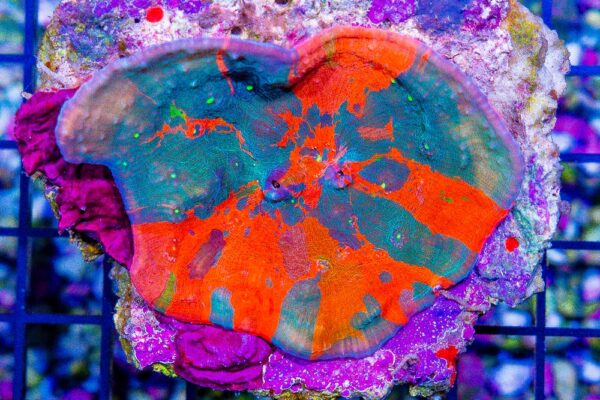
Chalice will thrive best in salinity of 1.026, calcium of 450 ppm, magnesium of 1350 ppm, alkalinity of 9 dKH and tank temperature of 78 degrees fahrenheit. Keeping your parameters steady and stable is key to their long term health.
Another likeable characteristic of Chalice is their ability to have rapid growth, given the right conditions! This allows for fragging and propagation of some of the most stunning Chalice strains for everyone to enjoy. Making them one of the best candidates for Aquaculture. There have been, easily, hundreds of different Aquacultured strains of Chalice over the years that Reefers have grown and shared amongst our hobby!
With proper care and attention, Chalice will thrive and add a unique and beautiful addition to any reef! Making them one of the most prized corals in our hobby, for any level of Reefer!