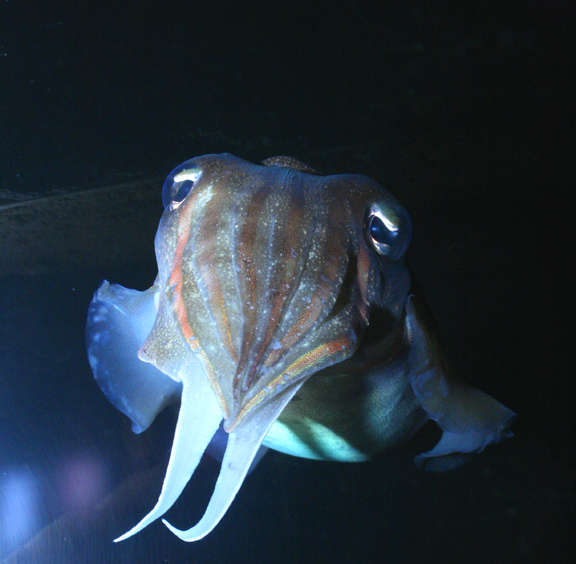

Mantis shrimp are not the only marine organisms to take advantage of polarized light in communication and defense; in fact, it can be argued that the cuttlefish pulls even more amazing stunts—camouflaging itself from predators while sending colored light signals invisible to everyone except other cuttles—all while only being able to see the color green. So how, and more importantly why, do they accomplish this?
Cuttlefish skin, like that of other cephalopods, has evolved to be able to display an incredibly wide range of appearances, both in color and texture. Texture is accomplished through fine muscle control of the actual flesh, allowing the cuttle to match a gravelly bottom, for example, by making the skin bumpy. Color displays are created by chromatophores and iridophores which are able to react quickly in response to stimuli. Chromatophores are simply packets of pigment in skin cells in layers (yellow to the outside, brown to the inside and red between) which can expand or contract. If red expands and the others contract, you have a red cuttlefish. An all-red camouflage might work if the cuttle resided on Sesame Street, but in the ocean patterns and hues are much more complex, and the cuttle matches this by varying the amount of each chromatophore it shows, and in which location. Interestingly, the goal of the cuttle is not to match the environment exactly, and this has been proven in experiments putting cuttlefish in tanks with pure black and white stripes. To match this precisely in a moving body of water would be nearly impossible. Instead, the goal of the cuttle camouflage is to break up lines and to break up the background, making the cuttle not a perfect match, but difficult to pick out. Predator eyes are trained to recognize movement and clear lines in unusual places; by staying still and breaking up the straight smooth lines the cuttle is passed over.
Iridophores create the blues, pinks and purples of the cuttle repertoire, not by pigments, but by reflecting ambient light back at different wavelengths. Where chromatophores absorb light, iridophores use proteins like microscopic prisms to bounce back light—green light falling on the cuttle may be reflected as pink, for example. The combination of these two techniques allows cuttlefish to create some of the most stunning displays in nature.
Cuttles use these displays not only to blend in, but also to communicate with other animals. A flashy bright display can warn a predator to stay away, and it is theorized that some of the “moving stripe†patterns mesmerize prey, allowing the cuttle to slip in for a good meal. But if a predator is seen, how can a cuttlefish tell its fellow cephs that danger is near without drawing attention to itself? The answer is similar to the mantis: using polarized light. More on this, and how an essentially colorblind animal can be so color-savvy, in another installment…