

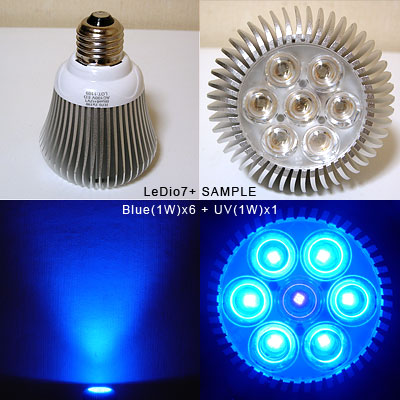
Ultraviolet LED light from VolxJapan now in development for the Grassy LeDio spotlights
5 Comments
The UV spectrum is a segment of light which is notably absent from the range of LED lights now widely available for the aquarium market. VolxJapan (maker of the LeDio LED spotlights) and Eiji at 1.023World are colaborating to develop a true UV LED lamp. What Eiji received from VolxJapan is the Prototype UV LED combined with Ledio7. This Ledio7 with UV is re-designed from original Ledio7 because it should have more protection for Human eyes from the UV. Ledio7(DeepBlue)+UV has 3800lx from 30cm and the value of UV is 0.01mW/cm2. Â This light angle is 60 degree, so this light can emit enough UV to many corals, but the spot light effect will not be as pronounced. The UV and 420nm wavelength neighborhood of light has been an important spectrum for the keeping and coloring of SPS corals and we look forward to seeing more LED lamps delivering these important wavelengths of light to aquarium corals. Ultraviolet light includes a wide range of wavelengths and of course we are talking about the mild UVA spectrum, not the skin cancer causing and germicidal UVC spectrum.
Via 1.023 World


Now I know the ocean water doesn’t completely block out UV light, and I doubt our 2 foot deep pieces of the ocean will do much either, but what is “safe” UV? I’ve experienced first hand a cracked shield on a DE MH bulb and know that’s far from being safe (maybe too much intensity?) and I remember ages ago when I started in the hobby that black lights were a no-no as well due to their UV. So what’s different about this?
Also is there any danger to people? I’d hate to slowly get glaucoma because I like to look at my tank too much
December 14th, 2009 at 5:36 pm
This lamp is intended to emit a small amount of long wave UV light from the 315-400nm wavelengths. The kind that only shallow water corals would receive.
December 14th, 2009 at 5:42 pm
Long Wave = UV-A = 400 nm–315 nm = blacklight = mostly harmless, almost 99% of what hits the earth’s surface is UV-A. Halides put out a good deal of UV-A, esp the 10,000Kish ones. Some T5′s can as well (some, like the G-man true actinic were designed to). This is the only UV spectrum that has been proven beneficial to some corals… VERY FEW, and some clams. Dana Riddle’s research in this area will tell you which species.
UV-B = 315 nm–280 nm = “tanning beds”, stimulates Vitamin D production, insulin secretion (diabetics need more sun?!), treats psoriasis and vitiligo, but also harmful if in large amounts and linked to cancer.
Short Wave = UV-C = 280 nm–100 nm = the killer stuff, germicide, used to make recent gen microprocessors (deep UV photolithography), counterfeit ID/currency detection.
December 14th, 2009 at 11:05 pm
I have theorized for a while that long wave UV is a missing element in LED setups for while now also. It’s still a contested requirement, but I have been following along with Dana’s research. Sadly, the LEDs that are required from a wavelength and power standpoint are horrifically expensive.
The “UV” LED used in those lamps is not UV at all if it has a 420nm peak. It most likely has a +/- 10nm band width, so it doesn’t even touch into the UV-A spectrum. It’s a purple light basically.
@Mike: The UV glass on a MH bulb still lets through a decent amount of UV. UV-C is almost entirely blocked, while UV-B and UV-A are only reduced by a small amount. Most UV emitted by MH bulbs is in the 330-390nm range, which is still relatively safe in appropriate intensities, like Jon had mentioned.
December 15th, 2009 at 11:02 am
we need U.V. LED BULBS
February 8th, 2010 at 9:01 am