

Boost your color with green light, an additional source of fluorescence excitation

24

Green lights as part of an aquarium lighting system

For years and years we’ve seen a hobby dominated by white lights, with blue actinics.  Be it halide, pc, vho, led, or anything else; the usage of a bright white light with the enhancement of blue light (about 420 to 450nm) has been the staple of this hobby.  The idea of running the actinics earlier in the morning and later at night, for a blue glow of “sunrise” and “sunset” has been the norm for well over a decade.  The use of blue light to serve as an actinic source has been well known and well documented.  What about other actinic lights?  Maybe the hobby has been so caught up in the status quo that we’ve completely missed out on what could be the next big thing… GREEN!

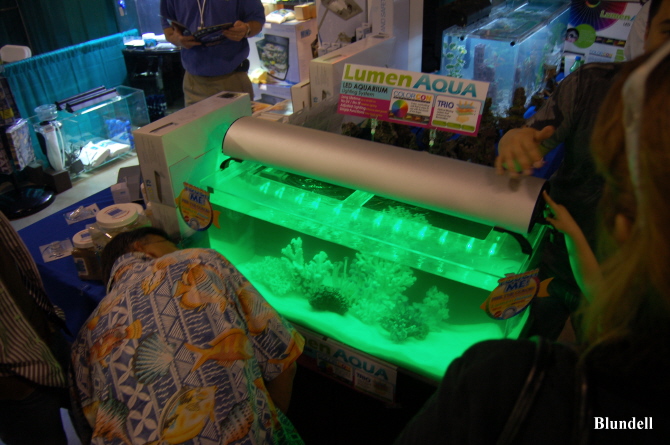
If you were to do a search for green aquarium lights you’d find many hits for the other form of green, the practice of environmental responsibility.  Green lighting is almost always thought of low energy, high efficiency lighting usage (such as led fixtures, water clarity, aquarium depth, reflectors, etc).  What I want to do in this article is to introduce the readers to the concept of using green light!  Green light can be a tool used to get brilliant colors from corals.  As you see in the picture above, some light fixtures are now equiped with green lights.  Some of the corals in your tank get their amazing colors due in part to the green light they receive.  This green light can stimulate many proteins (namely DsRed fluorescent protein) to produce an array of potential colors.  The most common color produced by this fluorescence that I’ve found is the red and some red-orange.

Shown here are a couple of examples of corals that exhibit red fluorescent emission energy when given a green source of excitation energy.  The enhanced colors seen on these corals when placed in aquariums, is due in part to the green light they are receiving.   Light of about 510nm (green) will cause some proteins to emit light at around 584nm (yellow-orange) and 650nm (red).  With this particular protein the red fluorescence can be about 100 times more powerful than the green fluorescence when excited by a standard 480nm blue light source.

Green light has not been shown to produce biological effects in terms of energy usage and growth.  In other words the coral may not be getting anything useful from this light and it may not help the coral grow in any way.  However, green light does produce a biological effect in terms of color.  Using green light is completely for aesthetics at this point.

Rose Anemone- as seen under standard aquarium lighting

Rose Anemone- as seen with enhanced green lighting

Rose Anemone- filtered to show just the fluorescent red light produced by a green excitation source

Chalice Coral- as seen under standard aquarium lighting

Chalice Coral- filtered to show just the fluroscent red light produced by a green excitation source

Adding green light to your tank may be one step in increasing the aesthetics and the fluorescent colors.  The actinic effects of green light are still not known.  Currently, this type of effect is still very small compared to the effects of blue light, but documented here is evidence for further investigation.

Special thanks-  Charlie Mazel for his ground breaking work and continued support, Glen Mansker for his technical help and services, and Brad Syphus along with the WMAS for allowing us the opportunity to educate other hobbyists.

Blundell, A. (2010), “Going Green With Lights- not total energy usage, but as excitation fluorescent energy”, ReefBuilders.




Top Related Stories:

  • pickle

    This must be the reason for the advice to generally keep red LPS prefer lower light levels because are typically found in turbid lagoons that are frequently clouded with green plankton. I guess the red pigmentation must be some sort of color response to maximizing photosynthesis in green water.

  • pickle

    This must be the reason for the advice to generally keep red LPS prefer lower light levels because are typically found in turbid lagoons that are frequently clouded with green plankton. I guess the red pigmentation must be some sort of color response to maximizing photosynthesis in green water.

  • Gresham

    OK I don’t claim to be a lighting expert, but how in the heck would a green light boost your CRI – Color Rendition (Rendering) Index? I think you grabbed the wrong term Adam… http://en.wikipedia.org/wiki/Color_rendering_index

  • Gresham

    OK I don’t claim to be a lighting expert, but how in the heck would a green light boost your CRI – Color Rendition (Rendering) Index? I think you grabbed the wrong term Adam… http://en.wikipedia.org/wiki/Color_rendering_index

  • http://www.reefbuilders.com Adam Blundell

    Gresh… not my title… Jake’s ;)
    Adam
    ps- but his title is better than mine

  • http://www.reefbuilders.com Adam Blundell

    Gresh… not my title… Jake’s
    ;)
    Adam
    ps- but his title is better than mine

  • http://coralidea.com Jake Adams

    I changed CRI to color to avoid any more confusion. Great topic Adam.

  • http://coralidea.com Jake Adams

    I changed CRI to color to avoid any more confusion. Great topic Adam.

  • Gresham

    I’m not confused by CRI, but it does seem like you were Jake :P

  • Gresham

    I’m not confused by CRI, but it does seem like you were Jake :P

  • Matt Wandell

    So where the heck do we buy green lights that look like that? Should I head down to my local head shop and peruse the “trippy visuals” aisle?

  • Matt Wandell

    So where the heck do we buy green lights that look like that? Should I head down to my local head shop and peruse the “trippy visuals” aisle?

  • http://coralidea.com Jake Adams

    Yes Matt. I think you should go to your regular head shop and tell us what you find.

  • http://coralidea.com Jake Adams

    Yes Matt. I think you should go to your regular head shop and tell us what you find.

  • http://www.reefbuilders.com Adam Blundell

    Matt-
    yes you can get regular aquarium lights with green. I’ve seen some led fixtures that had some green bulbs. The fixture shown in that pic is one of the lumenaqua lights.

  • http://www.reefbuilders.com Adam Blundell

    Matt-
    yes you can get regular aquarium lights with green. I’ve seen some led fixtures that had some green bulbs. The fixture shown in that pic is one of the lumenaqua lights.

  • Craig

    I have a couple of color changing LEDs over my tank. The blues, reds, purples and pinks mostly all look great. The four shades of green are all quite wretched. (http://www.dealextreme.com/details.dx/sku.2710)

  • Craig

    I have a couple of color changing LEDs over my tank. The blues, reds, purples and pinks mostly all look great. The four shades of green are all quite wretched. (http://www.dealextreme.com/details.dx/sku.2710)

  • chris

    don’t forget that all mercury based light sources, mh, t5, cf all have that characteristic green spike on a spectro, so green isn’t new.

    it’s funny you posted this cause I thought about that recently. on the flight vak from Denver the people next to me were asking why some lights appeared to I’ve a green tint to them.

    chris

  • chris

    don’t forget that all mercury based light sources, mh, t5, cf all have that characteristic green spike on a spectro, so green isn’t new.

    it’s funny you posted this cause I thought about that recently. on the flight vak from Denver the people next to me were asking why some lights appeared to I’ve a green tint to them.

    chris

  • Jeremy

    Yellow is the next green…

  • Jeremy

    Yellow is the next green…

  • Wingo

    I experiment a lot of different colors with corals and I personally feel yellow light is the worse kind to view a coral. Green when used properly can be quite interesting. Solaris had used green to make the tank look brisk(hope I am using the right word) and striking in one of their series long time ago.

  • Wingo

    I experiment a lot of different colors with corals and I personally feel yellow light is the worse kind to view a coral. Green when used properly can be quite interesting. Solaris had used green to make the tank look brisk(hope I am using the right word) and striking in one of their series long time ago.