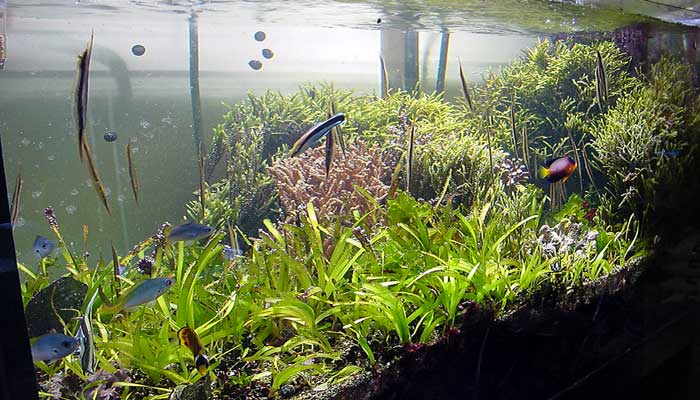
Marine planted aquarium are compellingly beautiful too

28

In my humble opinion, the diversity in marine aquarium types is at an all-time high. I’ve always been turned on by the idea of biotope aquariums. The freshwater folks have certainly embraced aquarium themes,  even beyond the biotope or species tanks. They base their tanks on various inspirations, including famous terrestrial landscapes or beloved paintings. With the rise of NPS systems, we are seeing deviations from the typical mixed reef or sps-dominant aquarium.  Minimalist Aquascapes are also on the rise, and I’ve even seen my share of cold-water tanks.

Another trend that is gaining popularity is the Marine Planted Aquarium. People have dabbled with macroalgae in displays since the 80′s, and seagrasses have been tried by hobbyists for years. But now, there is enough agitation that people are amassing collections of unique macroalgaes and devoting systems to them. While they are certainly great systems for seahorses and pipefish, they also offer an interesting live backdrop for less reef-friendly fish such as butterfyfish and other corallivores. It might break the biotope mold to add corallivores, but a heck of a lot more interesting than just a FOWLR.

Jon Roehrig's 180-gallon is a nice example of housing butterflies in a marine planted reef

Macroalgae are available in a variety of species, shapes, and colors. There are plenty of vendors who offer them during the warm seasons. Many are very attractive. You may not have room to devote a whole system, but you may discover the opportunity to turn an existing refugium into a display of it’s own.

Japanese Marine Planted Reef with Butterflyfish, courtesy of Takaaki Kuramitsu

I have been growing a variety of Caulerpa in one of my reefs, alongside corals. I haven’t experienced any ill effects from terpenoids or overgrowth. I do my best to prune the algae regularly, and find it a welcome addition to the tank. Recenty, a friend sent me some turtle grass seedlings to try. The seedlings are so much easier to start out with, since they root themselves and appear to adapt quickly to captive conditions. They do not share the delicate nature that full grown turtle grass transplants are reputed to have. I hope such seedlings become readily available to hobbyists in the future.

More Sea Grass Goodness, courtesy of Takaaki Kuramitsu

Hardy Turtle Grass seedlings rooting themselves in Mark's office tank.


Top Related Stories:

  • Anonymous

    very cool.  I’ve been tempted to try this in the past, but didn’t have time to do the necessary pruning so I couldn’t stand the idea of letting macroalgae choke out all my corals.  Definitely a good idea for a second tank.

  • Anonymous

    Jake you are absolutely right – in order to do a marine planted tank right the corals would be absent or selected very specifically. 

  • http://twitter.com/AwItsLinnikins Linny

    I spy with my little eye a Cleaner Wrasse – for shame!  Ruins the tank imo.

  • http://twitter.com/AwItsLinnikins Linny

    I spy with my little eye a Cleaner Wrasse – for shame!  Ruins the tank imo.

  • Anonymous

    Everyone makes mistakes.. I made the same mistake, luckily my cleaner wrasse lived to be over 9 years old before it kicked the bucket. During the time I had it I learned much more about them and I would never add another to a tank, but I think mine lived a happy long life from what I have read about their lifespans in captivity. I wouldn’t say it ruins the tank because the tank itself is pretty impressive. I know how hard it is to grow some of the harder types of sea grasses and they make SPS corals seem easy.

  • http://twitter.com/AwItsLinnikins Linny

    Regardless of how long they live, they are an important piece to the wild reefs and, IMO, taking them away from their habitat is, in a way, destroying it.  No questions asked – most people know this anyway (or at least know they are hard to care for – get a neon goby instead!). For being “biotopes,” these tanks didn’t really buy fish that are found naturally with macroalgae (and cleaner wrasse are not one of them).

  • http://twitter.com/AwItsLinnikins Linny

    Regardless of how long they live, they are an important piece to the wild reefs and, IMO, taking them away from their habitat is, in a way, destroying it.  No questions asked – most people know this anyway (or at least know they are hard to care for – get a neon goby instead!). For being “biotopes,” these tanks didn’t really buy fish that are found naturally with macroalgae (and cleaner wrasse are not one of them).

  • Mark van der Wal

    From article:
    “While they are certainly great systems for seahorses and pipefish, they also offer an interesting live backdrop for less reef-friendly fish such as butterfyfish and other corallivores. It might break the biotope mold to add corallivores, but a heck of a lot more interesting than just a FOWLR.”

    As far as ethics in keeping any wild fish in glass boxes, let’s not go there. I certainly respect your concern. Not all cleaner wrasses are the same, when it comes to regional collection and survivability. And in regards to environmental impact, we could make the same assumptions about removing algae grazers like tangs. It’s a debate that takes away from the original goal of this post….Which is to look at other interesting Marine aquariums other than reef tanks.

  • http://www.facebook.com/people/Matthew-Tibbits/8640355 Matthew Tibbits

    In a large tank with a ton of fish, they can do ok.  Also, some do eat prepared food (rare, but it happens).  Not something I would do or advocate, but they can work.

  • http://twitter.com/AwItsLinnikins Linny

    I understand the original part – there are some corallivores that would be nice in a non-reef tank.  However, they do not belong in a BIOTOPE: a biological, naturally found community.  These fish are corallivores because, well, they eat coral – not macroalgae!  These are “planted aquariums” – not biotopes.

    As for the “ethics” of keeping wild fish in glass boxes, it is hardly debatable that cleaner wrasse are not suitable for the aquarium trade.  While it’s true some are more hardy and willing to eat, the truth of the matter is that there are few that live long-term.  Tangs are found in HUGE numbers – in the case of Hawaii, many say that the Yellow Tang population has had a very little, if any, drop because of the aquarium trade (for the record, I only keep fish with small territory requirements – not ones that swim for miles, so I don’t even support keeping tangs in all but the largest of tanks).  Cleaner wrasse perform a MUCH more important role as individuals – it has been proven that areas without them have far fewer fish.  While some may keep them long-term, it is just supporting the capture and selling of these beautiful fish, many of which will not fare well in captivity – that’s indisputable.  IMO, keep them in the WILD.  That’s all I’ll say about it.  The tanks are nice, but the first one is ruined by the cleaner wrasse and the others are hardly “biotopes.”

  • http://pulse.yahoo.com/_3PQR2S2EAZUDJKVYUCKLCWJ37Q Micheal

    Sweet, although I see couple species that are illegal in my state.

  • http://twitter.com/AwItsLinnikins Linny

    Read my post: they sure can work, but this is 1.  Not large enough of an aquarium to satisfy the Cleaner Wrasse without it pestering the other fish and 2.  Supports the sale of Cleaner Wrasse

  • Mark van der Wal

    It isn’t about biotopes. I mention them in passing, but I also mention NPS tanks, coldwater tanks. The subject is Marine Planted Aquariums. I don’t know of any wild biotopes called “Marine Planted …”. I also acknowledge the addition of corallivores would break a biotope mold(if you were striving for, say, a seagrass community). I’m sorry if you disagree with the fish selection.

  • http://twitter.com/AwItsLinnikins Linny

    I’m glad we can agree to disagree :)

  • http://www.facebook.com/people/Barry-Geller/100000556227218 Barry Geller

    Mark where do you get the turtle grass, no one has it around here or can get it. 

  • Mark van der Wal

    There are some online vendors that carry it in the warmer months. 
    http://live-plants.com/ is one source. Unfortunately, it’s December. :-( I think most vendors sell adult plants, which is a shame. Hopefully, we can convince them to start selling seedlings when they are available.

  • Mark van der Wal

    There are some online vendors that carry it in the warmer months. 
    http://live-plants.com/ is one source. Unfortunately, it’s December. :-( I think most vendors sell adult plants, which is a shame. Hopefully, we can convince them to start selling seedlings when they are available.

  • Mark van der Wal

    There are some online vendors that carry it in the warmer months. 
    http://live-plants.com/ is one source. Unfortunately, it’s December. :-( I think most vendors sell adult plants, which is a shame. Hopefully, we can convince them to start selling seedlings when they are available.

  • Mark van der Wal

    There are some online vendors that carry it in the warmer months. 
    http://live-plants.com/ is one source. Unfortunately, it’s December. :-( I think most vendors sell adult plants, which is a shame. Hopefully, we can convince them to start selling seedlings when they are available.

  • Mark van der Wal

    There are some online vendors that carry it in the warmer months. 
    http://live-plants.com/ is one source. Unfortunately, it’s December. :-( I think most vendors sell adult plants, which is a shame. Hopefully, we can convince them to start selling seedlings when they are available.

  • Mark van der Wal

    There are some online vendors that carry it in the warmer months. 
    http://live-plants.com/ is one source. Unfortunately, it’s December. :-( I think most vendors sell adult plants, which is a shame. Hopefully, we can convince them to start selling seedlings when they are available.

  • http://www.facebook.com/people/Barry-Geller/100000556227218 Barry Geller

    Thank you, alot of Hosting anemones that keep their foot in the sand are found in grass beds and amazing. 

    Picture a Red haddoni surrounded by turtle grass with a pair of clowns!

  • Mark van der Wal

    That would make for an incredible display!

  • Mark van der Wal

    That would make for an incredible display!

  • Mark van der Wal

    That would make for an incredible display!

  • http://www.AdvancedAquarist.com Leonard Ho

    Cleaner wrasses should not be removed from the reefs not only because of their poor survivability but because of their immense impact on recruitment of fish to coral reefs.
    http://www.advancedaquarist.com/blog/just-how-important-are-cleaner-wrasses-to-reef-ecosystems

    But yeah, I agree we’re veering off topic.  Just wanted to point this information out.

  • http://www.facebook.com/people/Barry-Geller/100000556227218 Barry Geller

    Ive tried to find sea grasses from indo pacific but no one ever brings them in and considering you can get them into cali, it doesnt look likely. 

  • Anonymous

    I did a version of this a few years ago with a pair of melanistic clarkii, a large long-polyped Sarcophyton that looked remarkably like a S. gigantea anemone when fully open (placed between two rocks on the sandbed so that only the crown showed) , and Caulerpa prolifera standing in for seagrass (I wanted easy-to-care-for species). It looked really good and was surprisingly realistic.