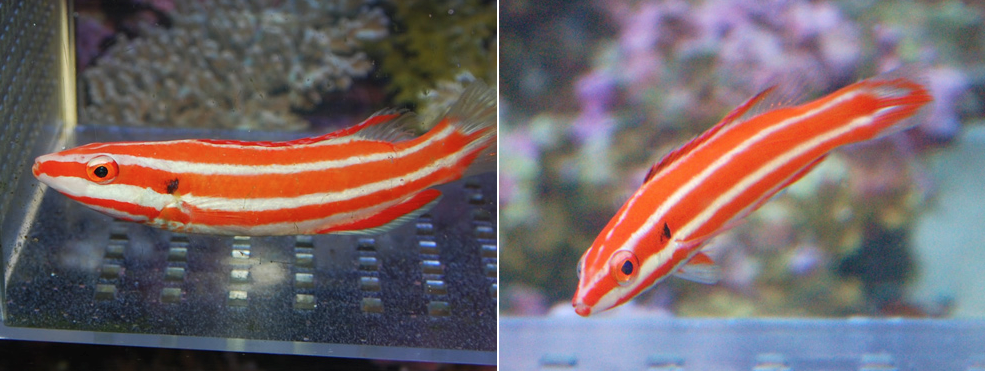
The elusive Bodianus neopercularis and its near perfect clone
The elusive Bodianus neopercularis and its near perfect clone
Bodianus neopercularis, a Pacific ocean species. Picture taken by Hisayuki Ohnuma, from Rudie Kuiter’s book on LABRIDAE Fishes
The genus Bodianus has got to be one of the the favorites amongst reefers and fish lovers alike. They’re robust, hardy, have so much personality and not to mention beautiful. Here at ReefBuilders, we’ve already covered many of the rarer members of this genus such as B. masudai, B. paraleucosticticus and B. sanguineus.
Bodianus opercularis and Plectranthias pelicieri from Mauritius, Indian Ocean. Notice the thinner red band on the anal fin of B. opercularis as compared to B. neopercularis on the top right. Picture by BlueHarbor
While both are equally rare and highly sought after in the trade, they’re not impossible to obtain and a few specimens have entered the aquarium trade in the past.
Two highly sought after species from the Mauritius, Indian Ocean. Centropyge debelius and Bodianus opercularis. Picture from Kiyoshi Endoh’s Angelfishes of the world.
Of course, almost all specimens captured have made their way to Japan, as seen by the picture above from BlueHarbor. Both species may look identical at first glance, but they can be differentiated from the anal fin and the tail. B. neopercularis has a thicker red band on the anal fin while B. opercularis has a thinner one.
While the difference between the two is minute, it just goes to show how little it takes to warren the differentiation of two species. We don’t know how different the two species are genetically, but based on appearance, its safe to say that they’re almost carbon copies of each other.
Kai is a systematic ichthyologist at The Australian Museum, Sydney. His research interests combine the use of cutting-edge next generation sequencing techniques with traditional methods of morphology to better understand the evolutionary history of coral reef fishes. He is a legacy ReefBuilders contributor, having previously written close to give hundred articles under his pseudonym LemonTYK.