

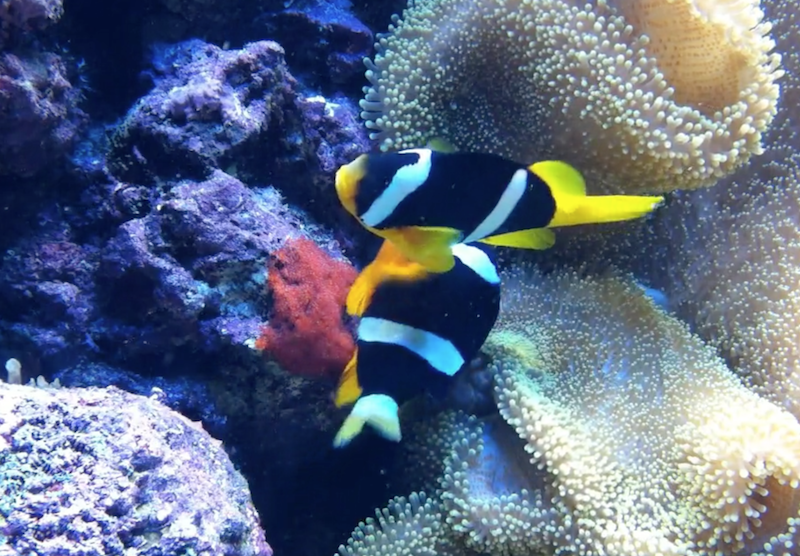
Unique video shows the clear difference between clarki and true sebae clownfish

By on Mar 22, 2012

The true sebae clownfish, Amphiprion sebae, is a very unique anemonefish that looks significantly different from the clarki clownfish which often borrows its name. We love true sebae clownfish and we’ve been in love with the perfect specimen on display at the Denver Downtown Aquarium for many years.

We recently had the good fortune of catching the true sebae clownfish spawning with its clarki clownfish partner, both of which are large adult specimens of just under four inches long. Having two similar fish species dance around each other while spawning was the perfect opportunity to document how differently these fish look when their adult color is fully developed. As you can see the true sebae clownfish is much more striking with its solid yellow posterior so the next time you see Amphiprion clarkii being sold as ‘Sebae Clownfish’, tell the LFS staff what’s up.


Posted in Reef News |
Search More:  
   
  • http://www.facebook.com/people/Barry-Geller/100000556227218 Barry Geller

    Both fish have the body of a clarki complex clown. Im not sure i see Saddleback complex there. , but the mertens carpet they host is 100 unreal!!!!!!!

  • TeaYK

    I’m hearing some familiar voices!

  • W T

    I agree with Barry, it looks like a clarkii and not a sebae. Can you explain why you think it is a Sebae Clownfish? The striping does not appear to go into the dorsal fin.

  • http://www.facebook.com/people/Barry-Geller/100000556227218 Barry Geller

    I believe those are just two different clarkis that were collected from different regions. Can i have the “What is a Nice Mertens” for 100 Please Alex

  • http://twitter.com/clownfishman Hubert CLOWNFISHMAN

    Sorry this article is totally WRONG, both are A.clarkii.   There is actually a color morph of clarkii around the Japan and surrounding area that have sexual dimorphism (the male/female have white/yellowish tail).  
    A.sebae has a saddleback body shape – both of these are just clarkii complex. 

  • lakshwadeep

    “True sebae”???!!!! This whole “true” naming scheme needs to stop with the “true percula;” although, even that should be questioned since ocellaris clowns have a much wider natural distribution than perculas.

  • Junkai Ong

    +1. The body shape of the clown shown on video is too broad, does’nt really match the body proportions of Amphiprion sebae. Sebaes usually have the bottom 1/4 of the body in yellow, not just the fins.

  • http://twitter.com/clownfishman Hubert CLOWNFISHMAN

    the word “True” does not refer to the population distribution, it refers to what is the real species  since so many industry people incorrect name species of clownfish

  • lakshwadeep

    Yes, I know the logic behind “true percula,” but IMO, it is only based on the random chance that perculas (possibly by being near Australia) were described first. Of course, A. percula is a “real species,” but so too is A. ocellaris. At least now, most reefkeepers are realizing each species has a name, and the sooner they start using the taxonomic names, the better. This only highlights the problem with using common names. Interestingly, there may actually be three species, with A. percula split into two groups:
    http://webdoc.sub.gwdg.de/ebook/dissts/Bremen/Timm2008.pdf

  • http://www.facebook.com/people/Matthew-Carberry/9424326 Matthew Carberry

    Hubert’s right, very nice clarkii pair