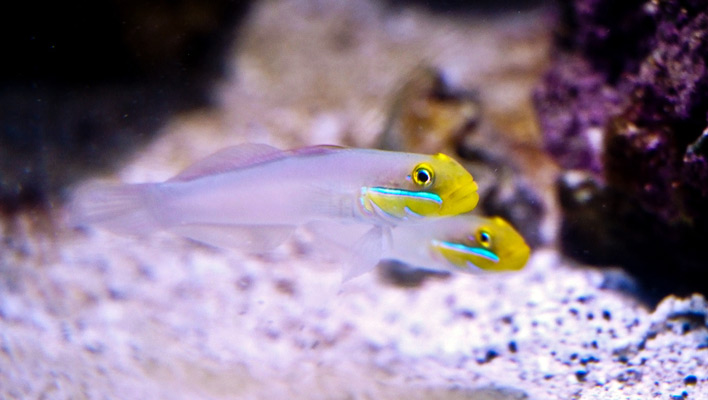
Though not the most chromatically gifted species, the yellowheaded sleeper goby (Valenciennea strigata), is interesting to observe and can serve a utilitarian purpose in marine aquaria—regularly overturning and oxygenating the top layer of the substrate with its sand-sifting feeding behavior. However, for reasons I’ll soon elaborate upon, this same behavior can make V. strigata somewhat challenging to keep.
Physical appearance
Potentially reaching about 7 inches in total length, this Indo-Pacific species has a slender, cream-colored body with a yellow head and a thin, blue horizontal band extending from the corner of its mouth to the margin of the gill cover.
Behavior
V. strigata is a burrowing species, so it’s important to secure any rockwork or décor that could be toppled if undermined. It feeds by repeatedly taking in mouthfuls of sand, sifting out tiny benthic invertebrates, and expelling the sand from its gill openings. Small fish and fish eggs are also on its natural menu. In the wild, this species is usually found in pairs, and it can be kept as such in aquariums if a known bonded pair is acquired.
The feeding challenge
To loosely paraphrase the Melancholy Dane, therein lies the rub! Owing to its constant sand-sifting behavior, V. strigata can easily deplete the resident microfauna in an aquarium substrate and is, therefore, highly vulnerable to starvation in captivity if efforts aren’t made to ensure live foods are replenished. Small, non-live meaty foods, such as mysis shrimp and finely chopped seafoods, should be offered, but do be aware that not all specimens will learn to accept substitute food items.
Proper setup
An aquarium for V. strigata should be well established with a deep bed of live sand and, ideally, a productive refugium to promote healthy populations of microfauna. A tank size of at least 55 gallons is recommended for long-term keeping, but the availability of open bottom space is a more critical consideration than overall tank volume. Also, be sure to cover the tank well, as V. strigata is a jumper.
Tankmates
Most relatively peaceful species that aren’t prone to gobbling up goby-sized fish will make good tankmates for the yellowheaded sleeper goby, but it’s wise to avoid species that are likely to compete with V. strigata for the same food source, such as dragonets, or for the same burrowing real estate, such as jawfishes.
In the reef tank
V. strigata won’t pick at or eat corals or other sessile invertebrates, so it’s generally considered a good candidate for inclusion in reef systems. However, there is one caveat to consider: Invertebrates positioned on or near the substrate will likely have sand continually showered down upon them as the goby sifts the substrate for food.