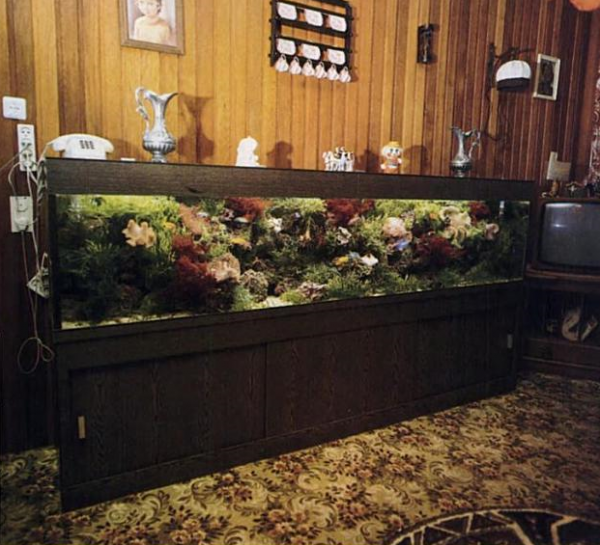

After 30-something years in the hobby, you see a lot of trends come and go. Fads and “new” ideas show up and subsequently vanish back into the mists of time. Some of these “fads” do stick around a while, yet many quickly disappear after we move on to the next big thing.
You need only look back in recent reef hobby “history” to see examples of what I mean: A few years back, Acanthastrea was all the rage. If you had one, it didn’t matter how ugly it was…you were the coolest thing this side of ORA! People were downright proud of the big bucks they dropped on “designer Acans.” Much has been written about that topic, so I’ll leave it at that. Then came the Micromussa, and suddenly, we were into a whole new coral phase, with a similar madness…inflated prices and trendy names! This one stuck around a lot longer…and with good reason in my opinion, at least Micromussa are actually attractive! It’s really fun for me to follow these trends and how they arise, I tell ya!
Sitting around one night, I was looking at the sexy new equipment I’ve been accumulating for my new system, and I thought about some major trends and fads from over the years to see what impact they had on the hobby. How they impacted us and…for that matter…how they actually stuck around. I settled on two items that really fit the bill. Here are my rants on both:
The “Wet-Dry” Trickle Filter
Where would the hobby be without this invention? Originally derived from sewage treatment technology, the “wet-dry” trickle filter worked very well, and when entrepreneur George Smit unveiled it in America in 1986, a virtual revolution occurred. Suddenly, interest in the marine hobby skyrocketed. Because of the wonderful biological processing capabilities of the trickle filter, it became possible to maintain very high water quality and keep live corals and invertebrates with success never before enjoyed by earlier generations of hobbyists. As so often happens when things get “trendy” and a quick buck can be made, all sorts of people got into the “trickle filter business.” Suddenly, anyone with access to acrylic, glue, and one of Albert Theil’s books was a player in the hobby. If you look back in a magazine…say, FAMA from 1987-88, there were literally dozens of “filter manufacturers,” ranging from a guy in his garage to some pretty large companies that saw a good thing and hopped on the wet-dry train! Each one was out there promising optimum performance and results from their filter. Interestingly enough, almost none of these smaller guys are around today.
And of course, the folks who made plastic biomedia were having a field day! Just about anything, from extruded plastic noodles to hair curlers (“Mom, do you have any…? was a refrain often heard at my house when I was a kid) were employed as “trickle filter media” . You could actually judge how cool a hobbyist was by what kind of biomedia he was using in his trickle filter–I’m serious! Dupla Bio Balls were the Elos products of their day. Your friends would literally drive to your house to see your trickle filter full of blue bioballs (OK…don’t even go there…I know a few of you are feasting on the innuendo). It was very serious back then, but absolutely hysterical to look back on now.
Trickle filters for reef systems hung on well into the 90s, and are still used today in freshwater systems and…for that matter… in some marine systems, too. The biggest downfall was the resulting accumulation of nitrate that occurred in trickle-filtered aquariums. So efficient at removing ammonia and nitrite, trickle filters fell short on harboring bacteria that consumed nitrate. Once the “Berlin” movement came around in the 90s, people began yanking their biomedia, and suddenly the concept of the “sump” was born. The “filter” in the traditional sense had morphed into a reservoir that served as the nexus of your water processing system: The “filter”, er…sump…now contained your protein skimmer (in many cases), reactors for various chemical media, and even macroalgae. This configuration is still the gold standard to this day. It’s safe to say that the trickle filter never really died…it just–evolved. Good technology changing with the knowledge of the times.
Sandbeds
Talk about controversy! There were many serious disagreements among hobby “experts” and main-street hobbyists alike about the merits of sand in the aquarium. Full-on, knock-down drag-out fights occurred on the message boards, in the hobby media, and simply between hobbyists in person! In the early days of the so-called “Berlin” method, it was agreed that you wouldn’t use sand in the aquarium, You were adding copious amounts of kalkwasser for topoff, which was to maintain alkalinity and calcium levels. Sand was less relevant. Eventually, Berlin subscribers decided that their tanks were lacking something–SAND! So back in to the tank the sand went. Suddenly, interest in living sandbeds and the beneficial creatures that lived and worked there exploded. Thanks to the work of authors like John Tullock, Ron Schimek and others, sand was not just stuff that you threw on the bottom of the tank. It was an adjunct to your filter system…a biological compliment to your tank.
Interest in sandbeds grew, and it was discovered that biological processes were taking place in deep sandbeds that assisted in the processing of nitrate and other substances that could degrade water quality. Then came the plenum, a man-made “assist” to the biological process. It was discovered that if you set one up right, you could create a “void” space that would really help the sandbed function even better. Man assisting nature! However, the plenum never really caught on that well, and users of the plenum swore by it, while detractors claimed all sorts of tank disasters could be attributed to it–in fact, the detractors of plenums also led to a backlash against all sorts of sandbeds. Suddenly, hobbyist message boards were filled with hateful jabs. Hobbyists claimed that deep sand beds (with plenums or otherwise) caused their tanks to “crash,” corals to wither away, their sex life to evaporate, etc. Some geniuses decided that keeping your tank bare of sand was the ticket! The only way! In fact, it was advised that you use “cutting board” (Starboard) at the bottom of your tank for both aesthetics and practical purposes rather than evil sand. You needed to keep detritus in suspension…Detritus = BAD! According to some bare-bottom fanatics, detritus caused the Vietnam War, AIDS, Global Warming, the rise of Al Queda, etc. Besides, the ocean bottom is filled with cutting boards, right?
The war against detritus was on! Powerful pumps were employed to keep it in suspension, and aquariums that looked like lab experiments were the thing. I distinctly remember the furor a hobbyist caused on the message board when he used BLACK starboard–“OMG- where do I get this stuff!” was a common refrain. Nice!!! Had we gone mad? Cutting board was an aquascaping statement? A dark cloud settled upon reefkeeping land. There was earnest advice to “cook” your rock by scrubbing it to nothingness, swishing it in water, and banishing it to an unlighted container for weeks and weeks, until it emerged bleached and dead, and allegedly “nutrient free”. Nutrients were bad…sterility was good! You were actually looked down upon for having sand in your tank, because, according to proponents of bare bottom systems, it was only a matter of time before the stuff accumulating in your sand bed would sink your system. Sterility ruled. “Hyper husbandry” (a sort of paranoid, extreme form of the “Berlin method” ) was created. I am probably forever exposing myself to the wrath and hatred of the rigid, die hard adherists to this “methodology,” but I’m okay with that..I’ve been around the block a few times–I can take it!
As time went by, hobbyists seemed to get bored of looking at tanks without sand, at cutting boards sitting at the bottom, and driving their protein skimmers to produce useless watery clear skimmate (another “methodology” that supposedly helped achieve higher water quality). Someone set up a beautiful tank with sand posted pictures of it on the message boards and all was forgiven. Water changes and regular attention to husbandry and natural biological processes, rather than “ultra-sterilization” and paranoia became cool again. Sanity began to return. It was once again okay to have sand in your tank, although some of the barebottom folks still admonished you to watch for the signs of the apocalypse. It wasn’t a matter of “if,” it was a matter of “when!” To this day, bare bottom aquariums are abundant, but the owners seem far less dogmatic and arrogant than they were back in the day, citing a much more plausible and logical reason for forgoing the substrate: They keep stony corals that require obscene amounts of flow, and they are tired of sand blowing all over them! Thank you! Hey, I can buy that. Many beautiful tanks have been set up bare bottom for just this reason and the owners don’t preach doom to those hobbyists that still like sand! You can feel the love.
It’s very interesting to look at the rise, fall, and evolution of aquarium trends. I hope this little rant has provoked you to think a bit about how we have evolved in the hobby and about how much more we have to learn. By looking at the past, we can hopefully create a brighter future for ourselves and the animals we cherish. Who knows what the next “revolution” in reefkeeping will be and how it will evolve into a hobby mainstay–or not!
Till next time,
Stay wet–
Scott Fellman