

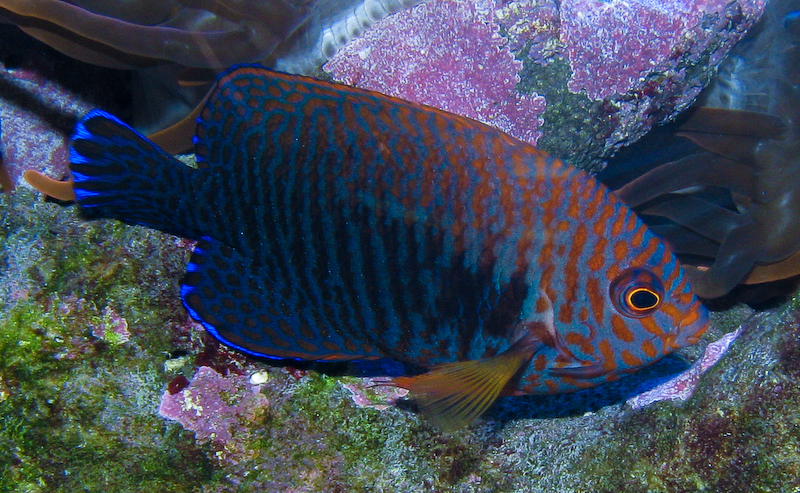
Pygmy Angelfishes can get really dark under intense lighting
12 Comments
Pygmy angelfish of the genus Centropyge can change color and appearance dramatically from juvenile to adulthood. Like most marine fish, their adult coloration can also change quite a bit depending on their captive aquarium environment. In the past when aquarium fish food and nutrition was relatively poor and little understood, many Centropyge and other marine fish would fade and become less colorful with age and duration in captivity. Now that the marine aquarist has access to a wide range of quality feeds, fading of reef fish colors is much less of an issue but with more Centropyge growing old in brightly lit reef tanks, Pygmy Angelfish owners are witnessing that many Centropyge can become much darker under high intensity reef aquarium lighting. The video above shows an average male Centropyge potteri which is a resident of a 1500 gallon reef tank that was installed and is maintained by AquaticArt Inc. of Denver Colorado. After less than a year living in this aquarium that is lit with multiple 1000 watt metal halide lamps, this fish has quickly developed a much darker c
oloration than we have ever seen for a potter’s angelfish. By contrast another C. potteri living in a very dimly lit 900 gallon fish aquarium also maintained by AquaticArt has a much paler coloration than a typical fresh-caught potter’s angelfish. Kyoshi Endo’s great book Angelfishes of the World also documents the darkening of A Centropyge multicolor: before and after images of a specimen clearly demonstrates the development of a yellowish tan dorsal body color where the body used to be white after this fish was kept in a brightly lit reef aquarium. This image of a multicolor angelfish on Vivid Aquarium’s website shows a specimen which is clearly way darker than a wild specimen would be, probably from living in a brightly lit, shallow water reef tank. The darkening of Centropyge Pygmy Angelfish may not apply to all species but there is a strong record of certain species changing color due to intense lighting conditions.


I wonder if it’s like getting a tan ?
Have you guys seen the “blue potter’s” ?
January 7th, 2010 at 5:25 pm
You know when I first saw this fish it made me think of the blue potters, most of which reverted back to a normal coloration after just a few weeks in captivity. Perhaps the blue potters are specimens which carry a gene for skin that is extremely sensitive to strong light.
January 7th, 2010 at 5:28 pm
Simply because the Potters Angel in the brightly lit tank changed to a deeper coloration and another one kept a lighter coloration in a more dimly lit tank maintained by the same company is supposed to create some kind of causal link?
Out of curiosity could you provide the references, be they journal publications or simply hobbyist anecdotes, for the “strong record of certain species changing color due to intense lighting conditions” ? I’d be interested in seeing if this really has anything to do with lighting or if it’s more likely a function of the fish’s genetics and the color change is being falsely attributed to the intensity of the lighting.
January 7th, 2010 at 8:17 pm
Having witnessed this phenomenon happen over and over with certain Pacific angelfish species including flames, multis and potters I can tell you it’s real. I highly doubt that scientists could care about fish darkening in a home aquarium.
January 7th, 2010 at 10:58 pm
They may not care about darkening in a home aquarium but from the 6 or so peer reviewed articles I looked at tonight (some more thoroughly than others) pigmentation changes in adult fish have been attributed to numerous variables including potassium rich saline, treatment to alkaline conditions, hyper versus hypotonic solutions, etc.
Come on Jake. You’re supposed to be a scientist. You’re making a pretty big leap by suggesting the change in coloration is due to light intensity in the presence of so many confounding variables, the lack of control, and above all else peer-reviewed literature indicating that pigment has been documented to change with numerous other variables.
January 7th, 2010 at 11:33 pm
Jake, the “blue potter’s” are found in deeper water, correct? If it had something to do with light levels, it would be a phenomenon working opposite of the above examples, where higher light levels would actually make the fish revert to normal color.
January 8th, 2010 at 12:16 am
Hey Chris you’re right about the depth of the blue potter’s angelfish, and what you said is an agreement with the intention of my original statement. I will have to ask Jim at Old Town in what kind of light conditions he kept his specimen.
And Andrew, you could be right about some other factors, or combinations thereof which could be more responsible for the darkening of certain pygmy angelfish. I’d like to think I am a scientifically trained aquarist but I never make claims to be a full on scientist. As such I will still continue to be critical about the causes of my observations in aquaria and perhaps this post would have been better framed as strong suggestive evidence and not fact. My bad.
January 8th, 2010 at 12:40 am
No problem Jake. And I apologize for jumping down your throat about it (definitely came across that way in hindsight). I’ve just been dealing with a lot of really bad interpretation of science with some patients as well as colleagues lately so I’ve found myself being quick to criticize specious interpretations and inferences.
January 8th, 2010 at 1:18 am
Jake, please do! This is an interesting case because I believe some have reverted while others have not. At least, I have read anecdotal evidence of one in Japan which was able to keep its color for at least 3 years.
Trying to mimic a deepwater environment may be the key for maintaining this fish.
January 8th, 2010 at 1:33 am
FWIW Jake, my joculators have both darkened over time being in my display. When I added the second one, the contrasting yellow was more pronounced; and after time, it has shifted more to a yellowinsh orange. I receive my second one from a true angelfish nut and under less lighting it was more yellow. There may be other variables suchas diet, but I just wanted to share my experiences with you.
January 8th, 2010 at 7:08 am
Darker potters (“dirty”-is what I call them) do show up from time to time. As I remember, several years ago Old Town had a potters that was almost all blue, after a few months the price droped and I think it was becoming more ‘RED’….
January 8th, 2010 at 7:38 pm
Kengan Water will differ your water exchange your life. we chance anyone who could take it free water for a month and in that time you will see your body quit suffering and be taken back to what God intended for it to be.
great job for wiriting a great post i think i will subscribe to your rss feed.
May 12th, 2010 at 6:07 am