

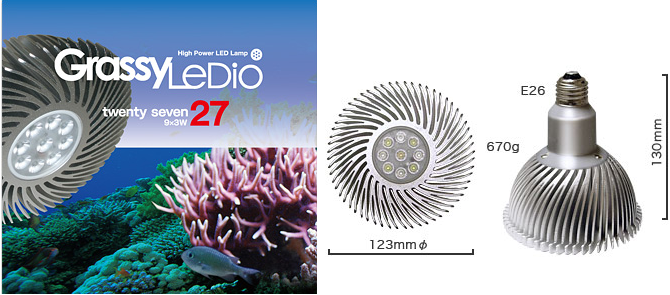
New Grassy LeDio 27 watt LED spotlight

6

The Grassy LeDio line of LED spotlights from VolxJapan just got more “oomph” with the new Grassy LeDio 27 version in two reefing flavors recently. The new lamps feature 27 watts of output via nine Cree Xp series LEDs running at 3 wats each. The Ledio 27 watt comes in either a Reef White or Reef Blue combination and feature a newly designed 60-degree optic lens instead of the 50-degree lenses on the other LeDio models. The previous iterations of the Grassy LeDio lamps featured seven, nine and 21 watt configurations and the addition of the new 27 watt version gives a variety of lamps for your exact lighting needs. An interesting observation on the Reef White version is the addition of one amber LED to the mix of four white and four blue LEDs to add a slight bit of color and richness in the yellow/orange spectrum to balance out the crispness of the white/blue combination. According to the company’s literature the Reef Blue lamp has a lux reading of 36,960 at 30 cm and the Reef White lamp is cranking 36,130 lux at the same distance. We will hopefully have some hands-on information output reading from these lamps shortly from our Japanese reefing correspondent Taka Kamata to compare with the other LeDio lamps and similar products on the market. Images with spectral analysis after the break.





Top Related Stories:

  • http://coralidea.com Jake Adams

    I love the idea of having the amber/yellow LED in there to help balance out all that cool white and cool blue color. Although this is the first aquarium spotlight rockin XP series LEDs I am a little bummed to see all the LEDs so closely spaced but, at least it will give better color blending that way.

  • http://coralidea.com Jake Adams

    I love the idea of having the amber/yellow LED in there to help balance out all that cool white and cool blue color. Although this is the first aquarium spotlight rockin XP series LEDs I am a little bummed to see all the LEDs so closely spaced but, at least it will give better color blending that way.

  • Brian Blank

    Definitely a tradeoff Jake. As the technology progresses, I’m sure we’ll see innovative ways to get both spread and color blending out of them lil ol diodes.

    I do applaud the addition of other colors of LEDs beyond the white and blue. While the crisp white and blue add pop to the colors, I think we miss a lot of the other colors in the tank that could really pop including reds, yellows and oranges. I’m a big fan of a solid color blend that can help get the max out of all the colors in the tank. With LEDs, we have the chance to vary the color mix throughout the day to get some excellent “WOW” factors rolling.

  • Brian Blank

    Definitely a tradeoff Jake. As the technology progresses, I’m sure we’ll see innovative ways to get both spread and color blending out of them lil ol diodes.

    I do applaud the addition of other colors of LEDs beyond the white and blue. While the crisp white and blue add pop to the colors, I think we miss a lot of the other colors in the tank that could really pop including reds, yellows and oranges. I’m a big fan of a solid color blend that can help get the max out of all the colors in the tank. With LEDs, we have the chance to vary the color mix throughout the day to get some excellent “WOW” factors rolling.

  • jon hahn

    Can you do a total incidental PAR reading? That is the only way to compare efficiencies… noting the output at a single point is a bit like trying to judge the size of an army by looking at one soldier.

  • jon hahn

    Can you do a total incidental PAR reading? That is the only way to compare efficiencies… noting the output at a single point is a bit like trying to judge the size of an army by looking at one soldier.