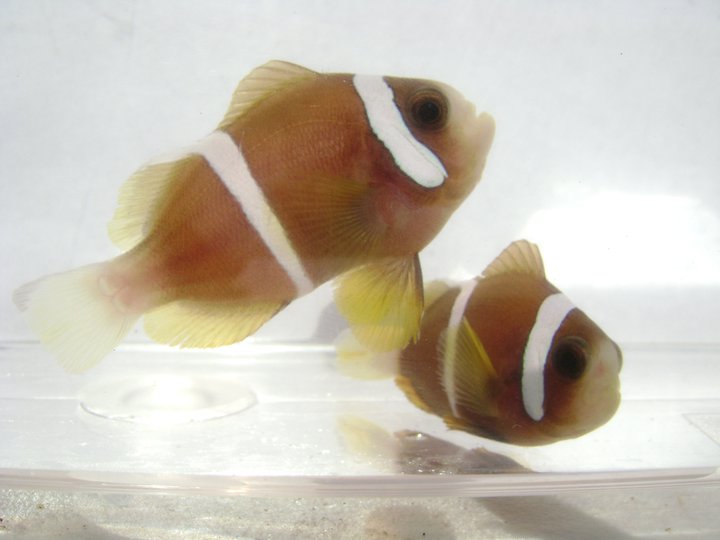
Today, Proaquatix announced their release of captive bred Great Barrier Reef Clownfish, Amphiprion akindynos. This species only rarely enters the hobby, normally as wild caught specimens. Depending on the size and quality, they can fetch upwards of $250 for a male female pair. Some Akindynos clownfish mature to simply be tan and white or even brown and white, while others can mature to be a more honey-orange color, sometimes with blue-tinged stripes. No doubt, environment, diet and genetics all play a factor. Juvenile Akindynos, while perhaps more robust are seldom imported due to their somber coloration.

Beyond the normally available clownfish varieties (Ocellaris, Percula, Tomato, Cinnamon, Clarkii, Saddlebacks, Pink Skunks and Maroons) there lies a whole host of clownfish species less available but every bit as desireable. Often times, species like Blue Stripes, Black Foots, Allardis, Latezonatus and others are only available as wild caught clownfish, and sometimes these clownfish are prone to disease, especially Brooklynella, upon import. In a classic chicken vs. egg conundrum, people are prone to avoiding such fish due to the risks they represent, and in turn, lower demand means even less chances to encounter these species and higher prices when we do see them.
We’ll be curious to see how these captive bred Akindynos Clownfish do. While there may be limited demand given the lack-luster juvenile coloration (a problem shared by juvenile Blue Stripe Clownfish, A. chrysopterus), there is also pent-up demand and a limited supply – it’s been probably a few years since the last time I saw anyone offering captive-bred Akindynos. We suspect that these fish will be a bit more affordable than their wild caught counterparts – certainly they will be more robust. I’d encourage all hobbyists looking for a Clarkii-type clownfish to investigate these further…there are many other related fish to Clarkii (why should it get all the attention!). For those of you who’ve been collecting all those Aussie corals and are doing a “biotope” setup, this is your chance to get the appropriate clownfish species for your aquarium!