Zero Reef East- less is more when setting up a nano coral tank

By on Dec 17, 2011

Joining the revolution

I like to think of myself as a progressive hobbyist. Despite being in the hobby for more than three decades, I always try to push myself to keep up on the state of the art in marine aquarium practice, and to incorporate the newest techniques into my aquarium systems wherever applicable. I’ve been around the block a few times and it takes something pretty different to completely enthrall me these days.
When I heard about Jake Adam’s “EcoReef Zero” concept last year, I immediately realized that this approach was philosophically unlike anything I had ever attempted before. This approach was developed to focus on creating an excellent environment for corals, providing them with everything that they needed to assure growth and health, and nothing that they didn’t, while keeping things as simple and uncomplicated as possible- aquatic minimalism, if you will.

While in principle the concept of the Zero Reef is ridiculously simple and fairly mundane, if you follow the history of modern “reefing” technique, it’s downright “revolutionary” from a philosophical standpoint. So much energy and effort has been expended in recent years attempting to keep corals in high biodiversity, multi-faceted “reef” systems that anything else seems on the surface to be almost heretical!  I think a proper description for the approach would be something like  “Minimal Diversity Coral Husbandry”.  Jake calls it “Reduced Ecology Reefing”. It’s sort of  the “anti-reef” approach, if you will.
The Zero Reef approach essentially distills coral keeping down to its most basic and simple elements, and utilizes minimal technology and energy to achieve success.  The premise is simple:  Do away with the unnecessary “distractions” of conventional reef aquaria- live rock, sandbeds, large fish populations, “cleanup crews”, extensive equipment, etc., and focus solely on the coral, with the bulk of the biomass in the system being contained in the coral tissue itself. What I only half-jokingly refer to as “revolutionary” is really the mindset you need to adapt- a reliance on your intuition, a trust in the most basic of skills as a marine aquarist. This differs from the modern convention significantly, because this philosophy really focuses on one element of marine aquarium keeping. While there is nothing “wrong” with traditional approaches, by their very nature, they tend to shift focus off of the true “stars” of the aquarium- the corals.

What you want in the Zero Reef approach are the beneficial bacterial populations to help break down metabolic waste products, without a huge diversity of other life form to burden the system in any way. In essence, what you’re looking at is a “Petri dish” for coral culture, or the equivalent of a flower in a vase – totally different than any other saltwater experience I’ve ever had. It is to a conventional reef aquarium what haute couture is to ready-to-wear clothing in the fashion industry: An individual, special aquarium conceived to experiment with simplified coral husbandry. It’s not “your father’s frag tank”. And, it has been pretty interesting from an aesthetic standpoint, too!

Setting up a Zero Reef was a radical change for me! Hell, I’m known for talking about aquascaping and biotope aquariums, for goodness sake!  I LOVE fishes and I LOVE diversity! This was way out of my “aquatic comfort zone”. On the other hand, thinking about and embracing outside-the-box technique is what I’m all about.  This approach is irresistible and it’s radically simple. So simple that you feel like you simply have to tweak something, add another piece of equipment, or add another procedure somewhere.

But you don’t.

And I was amazed at the initial, rather skeptical reactions of my co-workers- all very experienced reefers- when I first set up this aquarium: “That coral is dead in two weeks. TWO WEEKS!” or “Seriously, a reef with no live rock and sand?”   My smart-ass response was, “It’s not a reef tank. It’s a coral tank.”  By far, the favorite reaction from a co-worker was, “Why?”

Well, why not?

The Equipment- Off the shelf, and Outside the Box

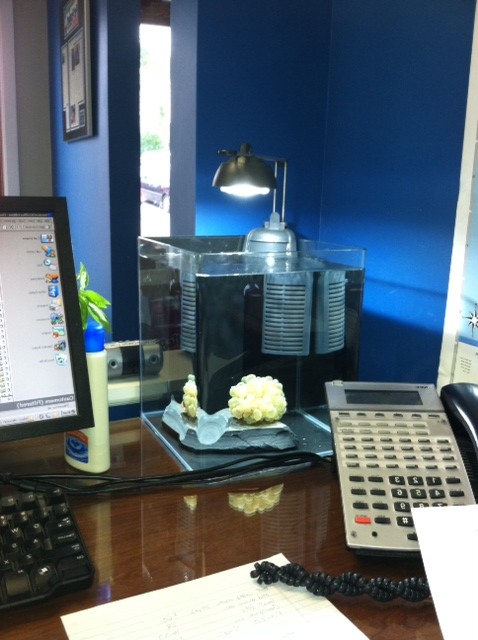
For my “Zero Reef”, I decided to utilize a 4- gallon Eheim “Aquastyle” aquarium, with one side and  the bottom painted flat black for aesthetics. My Eco Reef is located on my desk in my office, where I can enjoy it all day, every day! The aquarium is equipped with a simple internal filter with activated carbon, a sexy Fluval 25 watt heater (Can a heater be “sexy?” Yup!), and seven paltry watts of 6700K LED lighting that came with the “Aquastyle”.  The setup of the system could not be easier. Literally pour water in the aquarium, plug everything in, and you’re under way. I did “marinate” the filter media by throwing it in a sump in a healthy, established aquarium to establish a nitrifying bacterial population, but that’s about it.  The coral specimen is mounted on a single piece of slate.

Slate is used because the Eco Reef  “philosophy” postulates that the porosity of live rock, coupled with the “on board” life that accompanies it, places an excessive burden on a system solely designed to grow coral, and thus detracts from the needs of the corals in the aquarium. Slate has minimal pore structure, primarily on the surface, and does not provide a matrix of nooks and crannies for detritus and nutrients to accumulate. It’s essentially inert, and has little, if any measurable impact on water parameters. Quite frankly, I could have just placed the coral right on the bottom of the aquarium, but the slate does provide a bit of aesthetic interest. I mean, I can’t totally depart from my principles, right?


Livestock

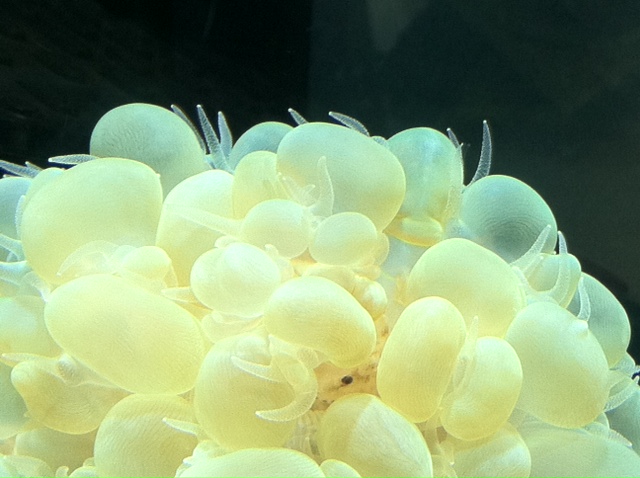
Probably the most difficult decision of the whole project was deciding what coral to use to serve as the primary inhabitant for the aquarium. The candidate coral had to be one that is fleshy, voluminous, and can safely be placed in a system without sand or rocks. After much consideration, I decided upon a specimen of Green Bubble Coral (Plerogyra simplex) for my test subject.

The piece of coral was approximately 4 inches in length when I started the experiment.  Bubble Coral has a reputation for being relatively easy to keep, yet it’s not without its challenges, too. Although Jake recommends Euphyllia, various Faviids, Wellsophyllia, and other corals for this type of system, I forged ahead with Bubble Coral for the simple reason that I like the way it looks!

I pondered the idea of creating a community of corals in the aquarium, but for my first foray into this approach, I kept the theme of ultimate simplicity and just used a single specimen of one species of coral. Future versions of this system will depart from this “monospecific” approach and house multiple specimens of coral, albeit those which are more or less “compatible” with each other.

System Management

It really doesn’t get any easier than this: I topped off for evaporation (mere ounces in this 4-gallon aquarium) as needed, and changed 100% of the water every Thursday. The maintenance process literally takes 5 minutes, and most of that is consumed by putting a towel around the aquarium so I don’t spill on my desk! I fed the coral small quantities of frozen mysis every Tuesday and Wednesday, or when I had chance.  The coral’s feeding reaction was immediate- and impressive! This feeding schedule is consistent with the protocol that Jake and I discussed: Feed the coral a couple of days before a water change. This allows the coral to process and eliminate waste products during that time period, and for me to export as much of the metabolic waste as possible, as quickly as possible.

Being a habitual water changer and nutrient export fiend since my early days in the hobby has been a huge asset to me with this approach. Water changes are of critical importance, because they not only export metabolites from this system, but they “reset” the trace elements, minerals, etc. that the coral needs for long-term growth and health. I don’t dose anything, not do I test, which is another radical departure from my habits developed over the decades. Rather, I let the coral “talk” to me, and observe its health carefully.  Despite my religious approach to water testing, I’ve long believed that corals will tell you when they are happy, and this approach has validated my belief. I can honestly say that I’ve never developed such an intimate “relationship” with an individual coral before!

Without the “distractions” of complex equipment, live rock, “cleanup crews”, fishes, etc., the focus has been solely on the needs of the coral. With light, food, and total trace element replenishment weekly, in theory, this system should sustain coral growth indefinitely, limited only by physical space. In theory, of course! Interestingly enough, I noticed a virtual “explosion” of tiny copepods in the aquarium after the first month. I believe that the copepods arrived in the aquarium attached to the very small fragment of rock that the coral skeleton was encrusted over, and multiplied rapidly in the absence of predators. I suppose “zero” diversity is virtually unobtainable, even in a system such as this- despite the “Zero” incorporated in the name. Hence, it’s more appropriate to attach the moniker of “Minimum Diversity” to the approach.

Challenges…and Tragedy

Did I experience any real problems maintaining my Zero Reef thus far? Well, yes and no!  I have had had a minor algae issue, but it was a by-product of utilizing source water that was a bit sub par (expired RO/DI membranes). The problems subsided quickly (in one water change!) when the membrane and cartridge were replaced. An aquarium with minimal nutrient import and maximum export should grow very little nuisance algae, one would think.  Thus far, this has been the case, although the system lets me know when it’s time for a water change by actually growing algae on the un-colonized glass surfaces.

By far the biggest challenge that I have faced with this system is mental: Resisting my natural reefer’s desire to “mess with it” and add more stuff to the aquarium. It took all of my discipline to stick to the plan and keep the aquarium population limited to just the single specimen of Bubble Coral!

Thus far, I can safely report that this is the easiest saltwater aquarium I’ve ever maintained. It’s not quite “set and forget”, but it’s darned close. Care is so easy- almost too easy, really, that I have to remind myself that this is a “legitimate” system. As far as the coral- it was not only more colorful and healthy than the day I added it to the aquarium- it increased in mass in a noticeable fashion…right up to the point where tragedy struck.

Upon returning from a speaking engagement, a water change was performed on the system with water that, unbeknownst to me, had a specific gravity of 1.030…and the result was predictably tragic.  I lost my coral very quickly. Although tragic, I was able to take some small comfort that the coral’s untimely demise was not the result of any shortcomings in the methodology.  Rather, it was the result of an external “operator error”. Shame on me for not testing the water that was prepared in advance. A very basic lesson re-learned, painfully.

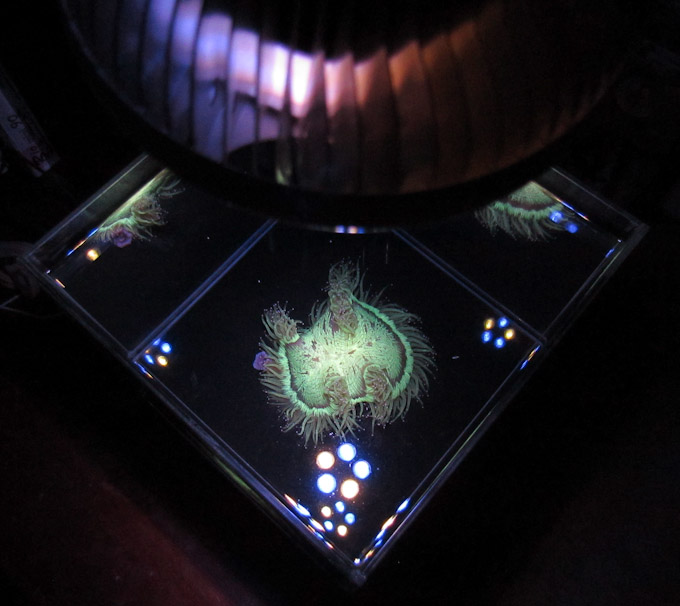
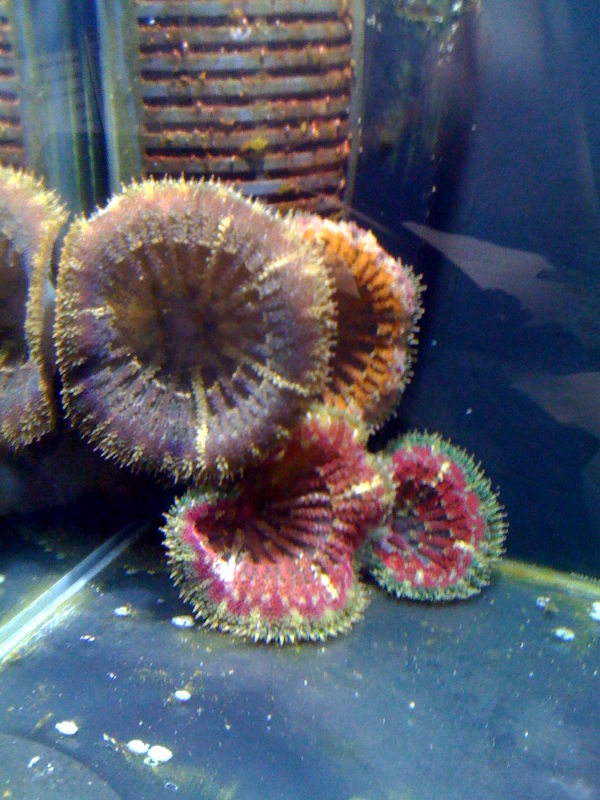
What do you do when disaster strikes? You get back up, dust yourself off, and start over again. That’s exactly what I did, too! I began the search for my next coral subject for this project.  Meanwhile, my girlfriend returned from a trip to Los Angeles with a package from wholesaler ERI.  In it were several “Mini Maxi Carpet Anemones” (Stichodactyla tapetum) that were intended for another experiment.

However, until I located my next coral, I decided these might be interesting animals to focus on in the interim.  I acclimated them carefully, and let them do their thing. So far, so good!  They have displayed great color, a marked size increase, and the well-documented “social” aggregation behavior that these anemones are known for. In fact, one appears to be preparing to split, which is always a healthy sign with anemones.
Of course, with changes comes the opportunity to “tweak”.  I recently acquired an Aqua Illumination “Nano” fixture, and immediately, the internal debate started.: “Do I use the upgraded lights on this system, or does it conflict the “use off the shelf” mentality I started the experiment with? On the other hand, giving the coral everything it needs includes the best lighting that I can use, right?”   These are the things that haunt the mind of a true fish geek. I know you can relate. For now, I’ve just continued to forge ahead on the path I’ve started, using the components that I initially acquired for the system. It appears to be working fine. Besides, having a sexy new light system is just an excuse for another tank, right?

To the future

Sure, a system that’s been set up fairly recently cannot be hailed as a long-term success.  The point of this piece was not to try to laud this experiment as such.  Only a much longer period of time will prove that. It was intended to serve as a motivation to my fellow reefers to try experimenting with this type of “minimal diversity” setup. If a hardcore  “traditionalist” reefer like me can do it, so can you! I encourage all reefers to experiment with this approach and see where it takes you. I am working on several more concept aquariums to test this approach, and each one will be unique and interesting in its own right. At some point, the goal is to “scale up” and try this approach on a much larger system. However, for now, the “nano” aquariums suit both the experiment and my busy lifestyle, so I’ll continue my work with them for a while.

Perhaps most satisfying to me is the daily banter that has arisen around my desk regarding this aquarium. Comments went from, “Is it dead yet?” to “Damn, that tank is looking good”. In fact, the best part is that now I’m hearing my colleagues say things like  “I’m gonna get one of those tanks…”  Being in the “aquatic inspiration” business, I couldn’t ask for more!

Recently, there have been some truly amazing applications of the “Minimal Diversity” philosophy. Just recently on these pages, we featured the awesome XBOX 360 aquarium by Blue World Aquariums, which is a gorgeous example of applying a cutting-edge aesthetic idea with the progressive methodology of the “Zero Reef”. Still another nano aquarium that embraces some aspects of this philosophy was recently featured on these very pages.

Sure, the Zero Reef approach is not the single best way to keep every coral or anemone, and every bare-bottomed, low-diversity aquarium that comes along is not to be enshrined as an affirmation that this is the best way to keep marine life. In fact, it may not work for some species. The point is, it’s worth investigating and experimenting with. It’s always a good thing to try new technique, new avenues. No matter how simple, or how elementary the approach seems. This approach has injected me with a new level of enthusiasm and interest for the corals that we all seem to find so endlessly fascinating. Its my sincere hope that you will open your mind to the process of experimentation, and share your results with fellow hobbyists as you take your first steps into previously uncharted territory.

Keep pushing the limits.

And  stay wet.

Scott Fellman

facebook.com/scott.fellman


Posted in Reef News |
Search More:  
   
  • Anonymous

    Awesome Scott! I really wanna do up my Eco-Reef ninja now!

  • Anonymous

    You go, boy! It really is fun to experiment again. Even something so simple has taught me so much…and kicks my butt when I lapse at the fundamentals! Valuable lessons can be had everywhere that you go in this hobby!

  • Anonymous

    Do you have a black coral in mind?

  • http://www.facebook.com/people/Jon-Carvallo/551135810 Jon Carvallo

    Forgive me if I missed it, but what’s the clear/black object underneath the Plerogyra?

  • http://www.facebook.com/people/Jon-Carvallo/551135810 Jon Carvallo

    Forgive me if I missed it, but what’s the clear/black object underneath the Plerogyra?

  • http://twitter.com/ChrisATX Chris Maupin

    Seriously? This is a revolution now? You fanboys have really lost your mind. I was doing this as a professional coral aquarist 10 years ago. Primarily for Caribbean stony corals. And it wasn’t a new idea THEN!

  • Anonymous

    Hey Chris,

    As I mentioned in the article, this is not  being presented as “rocket science”…It’s not the wave of the future, the key to success in the hobby, etc. It’s just another way to keep corals. It’s far more about the mindset than the technique, really. It’s looking at the way we do things, and “deconstructing” it…distilling the keeping of coral down to its most basic elements.  Just the aquarist and the coral, with minimal technological props…The point of the whole piece was to show that even a long-time aquarist such as myself (yeah- I have to admit 4-plus decades in the hobby; flattering though it is, I don’t think I’m a “fanboy” any more…) can benefit from taking a different idea for a spin now and again. And presenting ideas for fellow hobbyists to try, critique, and improve, is a big part of what this site is all about.

    We are in the middle of what is arguably the most dynamic period in the reef hobby, with new technology and methodology coming at us all the time. This is just taking a step back..a deep breath…Putting away our controllers and test kits once in a while can get us a bit more in touch with the art of keeping corals…And it can also bite you on the rear, as I can attest to! I’m not suggesting that we ditch our valid methods, equipment, and technology and break out the undergravel filters, slap a new tag on it, and present it as “technique”. I AM suggested that we-just occasionally-stray off the path and look the other way for a bit. THAT is revolutionary.

    Different directions and philosophies are a big part about what the hobby is all about. They have been what has pushed the hobby in the past…and will project it forward in the future. Sometimes, progress occurs from seemingly mundane, previously-played concepts. Water changes, for example, are the most basic, absurdly simple husbandry technique you can embrace. Yet every day, I talk to people having problems with their aquariums that can be rectified so easily if they would just embrace the ancient art of  conducting small, regular water change. To them, the concept of a water change is a game changer. It’s not always just the idea. It’s what you TAKE from the idea that counts.

    With that being said, I’d love to hear more about the Caribbean stony corals!

  • Anonymous

    Hey Chris,

    As I mentioned in the article, this is not  being presented as “rocket science”…It’s not the wave of the future, the key to success in the hobby, etc. It’s just another way to keep corals. It’s far more about the mindset than the technique, really. It’s looking at the way we do things, and “deconstructing” it…distilling the keeping of coral down to its most basic elements.  Just the aquarist and the coral, with minimal technological props…The point of the whole piece was to show that even a long-time aquarist such as myself (yeah- I have to admit 4-plus decades in the hobby; flattering though it is, I don’t think I’m a “fanboy” any more…) can benefit from taking a different idea for a spin now and again. And presenting ideas for fellow hobbyists to try, critique, and improve, is a big part of what this site is all about.

    We are in the middle of what is arguably the most dynamic period in the reef hobby, with new technology and methodology coming at us all the time. This is just taking a step back..a deep breath…Putting away our controllers and test kits once in a while can get us a bit more in touch with the art of keeping corals…And it can also bite you on the rear, as I can attest to! I’m not suggesting that we ditch our valid methods, equipment, and technology and break out the undergravel filters, slap a new tag on it, and present it as “technique”. I AM suggested that we-just occasionally-stray off the path and look the other way for a bit. THAT is revolutionary.

    Different directions and philosophies are a big part about what the hobby is all about. They have been what has pushed the hobby in the past…and will project it forward in the future. Sometimes, progress occurs from seemingly mundane, previously-played concepts. Water changes, for example, are the most basic, absurdly simple husbandry technique you can embrace. Yet every day, I talk to people having problems with their aquariums that can be rectified so easily if they would just embrace the ancient art of  conducting small, regular water change. To them, the concept of a water change is a game changer. It’s not always just the idea. It’s what you TAKE from the idea that counts.

    With that being said, I’d love to hear more about the Caribbean stony corals!

  • Anonymous

    A piece of black slate.

  • Anonymous

    A piece of black slate.

  • Anonymous

    A piece of black slate.

  • http://twitter.com/ChrisATX Chris Maupin

    That’s a perfectly reasonable response, Scott. I don’t object to the concept at all. It’s the semantics and phraseology in much of these articles that makes my BP rise. Things like: “Jake Adam’s “EcoReef Zero” concept last year”. The concept is not Jake’s to claim, plain and simple. It was taught to me in 1998/99 by the best professional coral aquarist you’ve never heard of, a humble low profile guy whose job was and still is to keep corals alive and healthy, not generate website traffic and obtain advertisers. 

  • http://www.facebook.com/BoomerMn Boomer William Wing

    OH, for sure Chris, like back in the late 60′s at UMD, where Dr. Krogstad, myself and a couple of students tried to keep Christmas Tree worms alive housed in Porite’s coral. 1- 10  gal tank and 1 250 W MV 5900 K bulb. It was Bare bottom for the purpose of cleaning up all the overfeeding we where doing for the worms. This tank sat in the Bio-Dept. hall way where all the labs where. The contractors made us a  2′ x 4′ shelf that was made in the hallway wall 5 ‘ up from the floor with a glass viewing window.

  • Anonymous

    I agree with you Chris, how this is so drastically different from a low tech frag tank is beyond me. How scandalous can you get. FISHING FOR FAME, WORKIN GOOD SO FAR ECOREEF.

  • Anonymous

    I agree with you Chris, how this is so drastically different from a low tech frag tank is beyond me. How scandalous can you get. FISHING FOR FAME, WORKIN GOOD SO FAR ECOREEF.

  • Anonymous

    Agreed Chris…It’s not “Jake’s concept”. It has been recently heralded and presented by Jake. We are all merely experimenting and sharing…

  • Anonymous

    Agreed Chris…It’s not “Jake’s concept”. It has been recently heralded and presented by Jake. We are all merely experimenting and sharing…

  • Anonymous
  • Anonymous
  • Anonymous
  • Anonymous
  • http://twitter.com/AwItsLinnikins Linny

    This is ridiculous!  Things like live rock are “distractions”?  I think you would be hard-pressed to have guests over who find your single coral or anemone more interesting than a reef tank filled with color and variety…not revolutionary either, IMO as species tanks have been around (at least for fish) for a long, long time.

  • Anonymous

    So much negativity in this thread. To each their own. I am actually thinking of doing something like this now for my desk at work, so even if it isn’t a new idea, showing new designs is helpful to show other people different setups. I wouldn’t have even considered it if I hadn’t seen Jake’s tank look so nice. Now with Scott’s addition I can see something that would be better suited on my desk at work. I was thinking of putting a “Portal” on it as well to magnify the coral viewing.

  • Anonymous

    Linny,

    I appreciate the critique, as this is the basis of change in the hobby. This tank was never presented to be an aesthetic wonder, or a counterattack on a “conventional” reef system. It’s not a reef system. Rather, it is an experimental platform designed to study an individual specimen-or specimens- of coral. Trust me, the beauty of a single healthy coral specimen is quite unique. It is NOT comparable to a diverse reef system in any way, nor was it presented to be an aesthetic alternative. Rather, the idea is to provide a simple, practical basis for studying coral husbandry. I LOVE that this is generating critical comments.

    Are there people who find this attractive…Well, yes there are…I’m quite frankly shocked by the numbers of positive responses the aquarium gets from visitors. Is it as visually spectacular as a full-blown “reef” tank…of course not! Are there people that find this less than appealing…absolutely, as you assert. Regardless, the concept of this aquarium is not to challenge the diversity of a reef system. It’s to deconstruct the husbandry of coral. 

    In this experiment, indeed live rock and sand ARE “distractions”! The purpose was not to embrace diversity in this system.  I have set up tons of diverse and beautiful aquariums over the years. This is not an attempt at one. It’s an attempt at showing what can be done by catering to the needs of just the coral. 

    I am a big fan of the Amano systems, and have set up a few myself. They are as different from “conventional” planted aquariums as this is from a “reef tank”. 

    Is this boring? Perhaps to some. I find great satisfaction in watching a single specimen of coral each day at my desk. Would this be the only system I’d want to keep? Absolutely not. However, as a foray into a slightly different husbandry challenge, I have found fascination and interest. The things I am learning with this system will provide the basis for success with other, more “conventional” systems in the future, as well as fuel my interest in trying other experiments. I hope it inspires others to try different directions in the hobby now and again! Let’s just take it for what it is!

  • Anonymous

    anemonarium,

    I’m not really sure what the “standard” definition of a “low tech frag tank” is…Call it what you want, really.  The “difference”, and the bottom line, is it’s an experimental tank designed to study an individual coral and it’s needs. If that’s what your “frag tank” is, we’re on the same page.

    “Scandalous” it’s not. And as for “fame”…no need to go there.

  • http://twitter.com/ChrisATX Chris Maupin

    So if you have colon polyps, do you owe Jake royalties every time you take a dump? Ecoreef ™ Throne. It’s a bare bottom tank with 100% water changes, after all…

  • http://twitter.com/ChrisATX Chris Maupin

    So if you have colon polyps, do you owe Jake royalties every time you take a dump? Ecoreef ™ Throne. It’s a bare bottom tank with 100% water changes, after all…

  • Anonymous

    Thanks for seeing it the way it’s supposed to have been seen, Cali. 

    I think critical discussion is really important- and welcomed. However, I don’t take this tank-or myself- nearly as seriously as some people seem to be. The reason we present different tanks here on RB is for precisely the reason you mention: To give hobbyists ideas. Ideas which can be dissected, critiqued, built upon, and improved. 

    Even if a hobbyist pulls one idea out of something presented on these pages, one of the primary missions of Reef Builders has been accomplished.


  • Anonymous

    Don’t give him any ideas, Chris! Things are expensive enough these days!

  • http://twitter.com/AwItsLinnikins Linny

    “I like to think of myself as a progressive hobbyist,” “I always try to push myself to keep up on the state of the art,” “this approach was philosophically unlike anything,” “it’s downright “revolutionary,” “from a philosophical standpoint,” “embracing outside-the-box technique is what I’m all about.”

    I’m not denying it’s successful or interesting (as a hobbyist I can see that it’s a little cool) – I’m just saying, it’s not the greatest thing since sliced bread, nor is it entirely revolutionary or pushing boundaries. Also, I’m not really sure how a barebottom tank without fish is “a simple, practical basis for studying coral husbandry.”

  • koraltek

    meh…
    revolutionary or not, IMO, it just looks drab and boring.
    not elegant or sexy because it’s minimal.

    to me art mimics nature, so i would want to incorporate natural looking sand and a comparatively bio-diverse piece of live rock under that coral, then it would look like a million bucks. the natural setting would augment not distract.
    and scince the tank already has a black back, i would also opt for a hob filter, not an unsightly internal filter.
    just my worthless 2 cents, ….certainly, do as thou wilst.

  • Anonymous

    Again, I appreciate your comments! 

    No one is presenting it as the greatest thing ever…but when you’ve been used to doing ANYTHING for so many years in certain fashion, “new” is really appreciated! It’s a practical basis for studying a coral because there are absolutely no other intentionally added competitors in the tank. A very focused approach. A mind set. And it’s been FUN.

    And it IS pushing boundries, because IS quite different than more “conventional” coral husbandry approaches, where the focus is on the overall system,support equipment, fishes, etc., as opposed to just the need of one animal. Keeping coral communities is interesting and exciting. No denying that at all. This is just another idea, another approach.

    When you’re focused on just one coral and distilling it down to the absolute most simple forms of husbandry (particularly water changes, which, if you have read my writings or attended my talks over the years, you’ll know are to me a huge component in successful aquarium keeping), you’re forced to keep a sharper focus. If nothing else, this experiment has shown me the adaptability and capability of corals, and trained me to really “listen” to my corals. Revolutionary? Perhaps. Different. To me, absolutely. It’s ridiculously simple…and in today’s reefkeeping world, that IS pushing boundries!

    I really encourage anyone to give this approach a thought, and see where it takes you. I truly believe that you will enjoy the experience. And above all, please share your experiences with the reefkeeping community.

  • Anonymous

    Absolutely great points..

    As far as the filtration, etc…I agree…I HATE stuff like that in the tank.

     If the experiment was designed to be truly aesthetic, I would have used different equipment approaches, for sure. The idea here was to use an essentially off-the-shelf product (ie; the Eheim Aquastyle) and no live rock. My home version that I will be playing with will have no visible equipment and be aesthetically radically different than the “testbed” you see here!

  • http://pulse.yahoo.com/_3PQR2S2EAZUDJKVYUCKLCWJ37Q Micheal

    Interesting little bit.  

    I do have to agree though, a bit too sterile for my tastes.  I do something similar with some zoas and LPS, basically a coral only nano, but I need rock in there just to give the vertical direction a little flair, otherwise there’s a lot of wasted space in the tank.  But no fish or any other critters in it, was very careful about the rock to make sure it was dead as dead can be with nothing on it that could slough off into the tank (its rather amazing how much crap is in rock!).    Thought about doing the same thing with sand, but I do notice that LEDs have a very nasty (for me) tendency to be excellent algae growers, regardless of how clean the water is.
     

  • koraltek

    well i forgot to add in my criticism that the tank is cool, and a interesting idea… :)
    i in fact am planning something similar,
    a 10g braceless/topless tank running just the “lee eng method”
    using only live rock, sand, a couple pieces of unique macroalgae and flow for filtration. lee eng used air stones in the 50′s for flow, i might use a powerhead
    to avoid salt creep. he also used normal output flourecent tubes if im not mistaken, which i will also forego and add leds instead. so ultimately it will be like the lee eng method on crack.
    my motivation is the the coral morphologic coral art displays and the ecoreef zero as well. with the same minimal, elegante look but with just a tad more landscape and occupants. i also cant stand seeing gear in a reef aquarium.

  • http://www.facebook.com/BoomerMn Boomer William Wing

    I think it would be Jake giving Dr. Krogstad royalties for prior art in 1968 :-)

  • http://pulse.yahoo.com/_INU5VHXOXFCJYIQNF7GVFCIJDU blain

    why is everything reversed in the pictures?  The numbers on the phone are backwards, images reversed.  Is this part of the “Zero Reef” mentality?

  • Sam Yost

    I saw that too and was just as confused

  • http://www.facebook.com/wally.do Walle Do

    needs a tang…

  • http://www.facebook.com/people/Mitch-Rico/1449982596 Mitch Rico

    To Scott: I’m having a hard time believing the salinity change killed the coral. I’ve done countless water changes without measured salinity. Not to mention my complete lack of “acclimating.” In my experience, acclimating usually stresses the fish even more. I agree with you in saying that this is a big change from what we reefers normally do. It seems so simple, that its easy to scream bullshit! But this is minimalism at its best. This could be a niche that some reefers could fill. I like how the coral itself is just the focus of the tank. But if you wanted to really get “minimalist” with this, you need an overflow. That filter inside the tank ruins the whole look. And from a scientific view, this would be the perfect way to study what certain corals need. Say for example gonipora. Anyways, good work, don’t listen to the people that are saying it’s ridiculous. This could be art in the right hands.

  • http://twitter.com/RimlessReef Sonny

    Why is it that every time someone posts up a “different” idea for a reef, it gets smacked down by a few “haters”? I think that Scott and the guys here on RB have been doing a great job in presenting these ideas to the general public. New ideas are sprouting up each and everyday. And its for the reefers in the public eye, such as the writers on RB, to test and implement these concepts.  I like the design that Scott has chosen to highlight. It works great as a simple desktop aquarium.

    Now, would I make a couple minor changes, yes. But, to each his own. I personally would add a single softball sized piece of rock, thin layer of sand, and a couple tiny designer clownfish. An LED on the bluer end of the spectrum would look great, allowing the corals to pop, while giving the setup and out of this world look.  The tank would consist of a single species of coral, perhaps a Ricordea. While this may be a depature from the Zero-Reef concept, its still would be simpler than a standard reef.

    With a large aquarium, corals often get lost in the mix. While I like my larger Rimless setup, I find myself gravitating towards smaller, species specific setups. In this way, one can focus on the species, allowing for the proper care of the creature, while enjoying it to the fullest extent. Whats the point of picking up that cool Pistol shrimp, if it simply gets lost in your massive display. ;)

    Don’t hate; innovate! :)

  • Anonymous

    While I love my big mixed reef tank, I do appreciate the “concept” of these tanks, especially to house & spot a single spectacular specimen of a particular coral.  

  • Anonymous

    There you are.  I thought I heard some mumbling coming from under the bridge.  

  • Anonymous

    There you are.  I thought I heard some mumbling coming from under the bridge.  

  • http://pulse.yahoo.com/_OABJFVWUMQWKZV6F4HZ6LTTWHM Brandon

    I liked this article it really helps to spotlight the corals themselves with no distraction. Scott can you get Jake to update his original ecoreef zero/c. jard reef article Id like to see update shots to show how that finicky coral has done with no substrate support/relying on feed and light only. Updates have been requested but I don’t think he’s seeing the posts