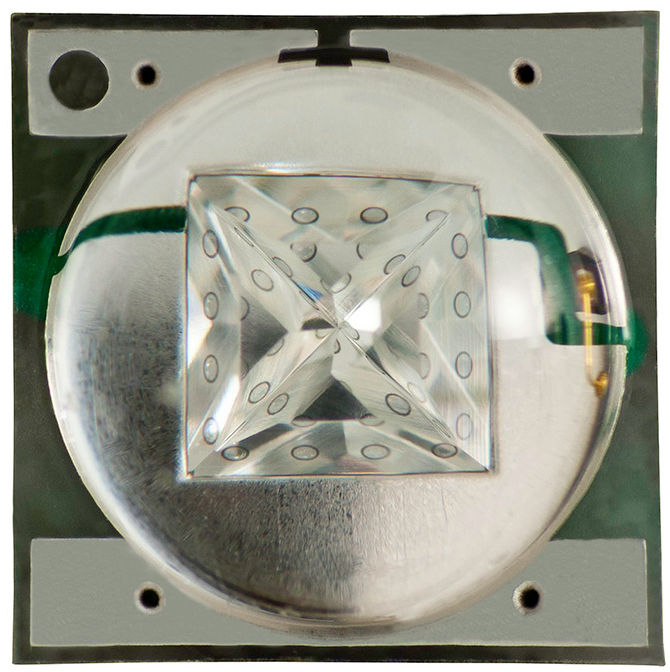
You may have begun to notice Cree XT-E blue LEDs being included on some newer aquariums lights and unlike previous advancements, this generation of LEDs is designed for more than simple brightness and efficiency gains. 
The Cree XT-E royal blue LED has been around for a little bit now, and is starting to get attention in the DIY community and some aquarium LED lights including the PacificSun Metis Hyperion. As with all things Cree, this LED is the next evolution in their product line, and is bringing some interesting advancements to both home builders and manufacturers. If you’ve been wanting to know more about the Cree XT-E blue LEDs here is some information about them and maybe some little nuggets of information that some of the more knowledgeable out there may have missed.
The obvious comparison for this LED will be against the current fan favorite, the XP-E. While the differences are fairly subtle, they are there, and are important in some respects. We will be talking strictly about the royal blue version of this series, as there is a recently introduced high voltage white XT-E, and didn’t want to confuse things.
The physical characteristics is where there are very few differences. The external footprint is the same as all the XP series devices, and has the same solder pad layout. This makes life a lot easier for those brave enough to try re-flow soldering at home for putting these LEDs on custom boards, or at least something different from the usual 20mm star. This also helps when it comes to making secondary optics fit. Many of the optics with mounting bases have tight tolerances on the opening for the LED. So much so, that even XP-G LEDs, which are only a hair larger, can sometimes be tough to make fit without modification.
There is a slight change in overall height though, going from the XP-E 2mm height, to the XT-E 2.36mm. It’s not a lot, and it won’t affect most people, but it should be known that the change in height will affect the performance of secondary optics. The average DIYer will never see a difference. This issue is more for manufacturers to deal with when trying to squeeze the most out of their product. For the aquarium world, that doesn’t seem to be that big of a concern right now, with most of the major manufacturers choosing to forgo TIR (total internal reflection) lenses in favor of either a lens free setup, or a simple reflector.
What most people instantly notice is the different die structure. This is really where the magic is with this LED. This is one of the first LEDs to use a three dimensional die structure. The reason behind it is to increase the viewing angle, and improve overall light distribution. This LED sadly wasn’t developed with us in mind. Cree is targeting this LED to the remote phosphor design set, where every little extra degree of viewing angle is of importance. The traditional flat die has limits on how wide it can project the light emitting from it before the use of primary optics. With that limitation, the primary optics can only do so much, and will typically be limited to 110-130 degrees, depending on the LED in question. With the three dimensional die structure, it’s now easier for the manufacturer to increase the viewing angle closer to 180 degrees. In this case, Cree has set the viewing angle to 140 degrees, but with a little work, could probably increase that angle a little more.
An extra 10-30 degrees more doesn’t sound like a lot, but there is more to it than that. Part of the difference comes into effect when you look at how the light is distributed through that range.


It’s pretty easy to see from the pictures above that there are some considerable differences in the way light is emitted from the LED. The XP-E has a pretty typical smooth curve, where the output tapers off at a predictable rate as you start to go off center. The XT-E keeps a higher average intensity over a wider angle. This equates to a little more even light over a larger area than the hot-spot characteristics of a typical LED. It’s a fairly small difference for us, but a huge difference for remote phosphor applications. This more even light distribution is more important to us aquarists than the wider viewing angle, as after a certain point, the light no longer is directed into the aquarium below.
So far, this hasn’t been all that big of a deal. It’s an LED that’s the same size as existing XP-E LEDs, with a little increase in height, and a little different light distribution. Where the bigger differences start to show up is in the electrical characteristics and the light output, which is what most of you are more interested in.
When talking about light output, the first thing to note is that Cree is rating all their newer generation LEDs (XT-E and XM-L, among others) with a die temperature of 85C. Originally, everything was rated at 25C, and became an industry standard. Unfortunately, 25c die temperatures are not very practical outside of the lab, so Cree, and a few other manufacturers like Philips Lumileds started to use 85C as the benchmark point. This is a lot closer to real world conditions, and a much better predictor of performance. As a result, you need to do a little more work when comparing the light output of the XT-E to the XP-E. Rated output for the top bin XP-E at 350mA and 25C comes in at a minimum of 500mW. To bring it to a level playing field with the XT-E, the output is derated to approximately 460mW (estimated to be about 92% of the rated output based on the data sheet). XT-E top bins are currently rated to 550mW at 350mA and 85C. Now that things are apples to apples, that’s a 19.5% increase in output at the same current. Not bad.
Electrically, things improve again. Cree is gradually forcing the forward voltage down on their LEDs, which helps to increase efficiency, reducing driver requirements, or letting existing drivers run more LEDs in a single string. While most incremental LED updates bring the forward voltage down a tenth of a volt or two, Cree has managed to get the forward voltage of the XT-E down 0.35v over the XP-E. That’s a pretty considerable drop. The current XP-E has an average forward voltage of 3.2v at 350mA, while the XT-E has managed to get it down to an average of 2.85v. Keep in mind that these are average voltages and your experience may vary. As a result, this makes for a 12.3% increase in electrical efficiency at the same drive current. And you know what that means; less heat.
The last thing to note about this LED is something that a lot of people overlook; thermal resistance from junction to solder point. Most people don’t need to really look at this, as the heat sinks that are used in most DIY projects are vastly overkill, and can easily keep die temperatures in check. It’s still interesting to note that Cree has managed to increase the ability for the LED package to get heat away from the die by almost a factor of two. Thermal resistance for the XP-E is 9C/W, while the XT-E is down to 5C/W
So that’s the XT-E for you. It goes to show that Cree has a lot of tricks up it’s sleeves for improving the LEDs that we know and love, and has managed to improve a great LED quite considerably when you look into the details. To top it off, the average price of the LED is actually lower than the XP-E, making this a fantastic LED to use, and certainly one that will be catching the attention of DIYers and manufacturers alike.
For more “light” reading, check out the XP-E and XT-E data sheets linked below