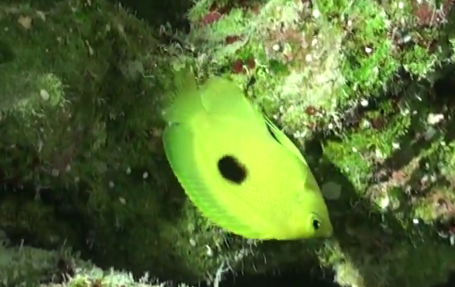
New video shows Narcosis and Peppermint angelfish together at Raratonga

By on Aug 10, 2012

narcosis angelfish cook islands

In case you haven’t noticed, there’s been a flurry of activity in the West Pacific Ocean this year and there’s never been a better time to be a fan of rare deepwater angelfishes. This year alone we’ve seen peppermint angelfish videos filmed in the wild, a peppermint angelfish live-collected and living at the waikiki aquarium, Narcosis angelfish going to Japan and just this week to the US and finally, we now have the first ever video of Narcosis and Peppermint angelfish sharing a habitat.

Filmed at 360 feet in Raratonga in the Cook Islands, this video is the first look at the behavior and interaction of Centropyge narcosis and Paracentropyge boylei in their natural habitat. It’s one thing to know that these two elusive angelfish species coexist in the same biotope and the same location but it’s another to see the two practically side by side, occupying a volume of space on par with larger home aquariums. Check out the Rich Pyle original clip after the break.

YouTube Preview Image
Posted in Reef News |
Search More:  
   
  • Darius Wright

    So this video begs the question. Wouldn’t there be some hybrids of these two species out there? What would that look like? What would it sell for?

    Probably easier to find a unicorn.

  • JakeAdams

    Good thinking but as you can see, the two species look very different and they belong to different Genera so their mating behaviors are likely to be divergent as well.

  • http://www.facebook.com/roy.ward.77 Roy Ward

    i don’t believe this video is taken at 360 feet. notice all the green algae? there is pretty much no light at 360 feet, thus no green (photosynthetic) algae.

  • http://www.facebook.com/profile.php?id=505655828 Benjamin Alldridge

    That’s depending who you use as your reference. Burgess purported that Paracentropyge was a full genus (with its current monotypic representative, P. multifasciata) along with Sumireyakko; currently both of the fish in question are properly classified as Centropyge (per Pyle and Randall).

    They are however from different groups amongst the genus, with C. narcosis being from the ‘colini’ complex (related closely to C. colini), and C. boylei coming from the Paracentropyge subgenus.

    That said, it wouldn’t be unheard of for congeners from different complexes or groupings to hybridise, and certainly not in the Pomacanthid family.

  • JakeAdams

    touché, Ben. You are completely right and it’s nice to see Reef Builders readers are up on their subgeneric classification of reef fish. Regardless of their classification, I doubt that narcosis and boylei would crossbreed on purpose, but there is the possibility of accidental fertilization by pairs of the two species spawning in close proximity to each other.

  • Richard Pyle

    Jake — thanks for posting the link to the video. Very briefly, the green is not algae; it’s sponge (I think). But I promise it really was about 360 feet deep. It’s debatable whether “Paracentropyge” is a legitimate genus, but I’m increasingly convinced that it probably is (I still put boylei in Centropyge mostly out of habit). But even if it’s not, these two species are pretty far apart, and I’d be extremely surprised if they ever formed a viable hybrid. But it would be an amazing fish if they ever did! Aloha, Richard Pyle

  • http://www.facebook.com/people/Doran-Figart/100002819917618 Doran Figart

    Dr Pyle,

    What distinguishes “Paracentropyge” from “Centropyge”? Assuming it is morphological, does DNA support it or has that not been investigated yet? (Please note my questions are based on information seeking, and not on challenging you.)

  • http://www.facebook.com/profile.php?id=505655828 Benjamin Alldridge

    If you don’t mind me asking Richard, has your position on the way Pomacanthids are currently classified changed since authoring your Systematic Treatment of The Reef-Fish Family Pomacanthidae in any other way than your stated view on Paracentropyge being a full genus?

    And even better… white with yellow stripes, or red with yellow stripes? :D