

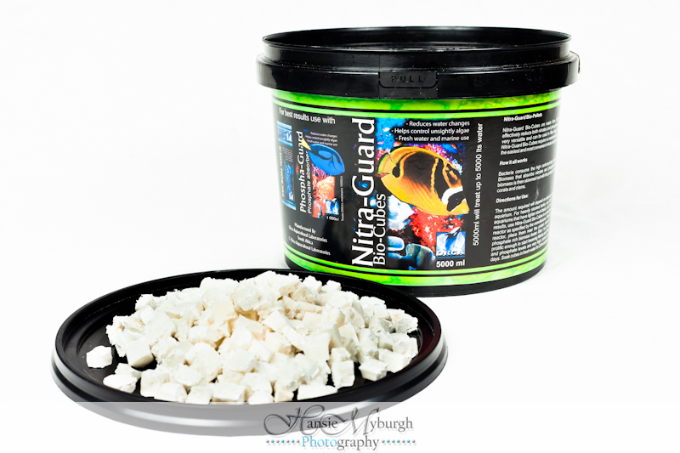
Nitra-Guard Bio-cubes from Orca Labs promises denitrification free of Redfield’s ratios

By on Sep 27, 2012

hm-photo-5-000ml-nitra-guard-display


Orca Labs Nitra-Guard Bio-Cubes are an interesting take on solid carbon dosing. A lot of our readers are likely familiar with biopellets and their assorted variations, but these appear to be completely different. Nitra-Guard Bio-Cubes  were originally invented in South Africa, and come in two variations; the Nitra-Guard Bio-cubes and the Nitra-Guard Bio-Cubes Titanium. The first of the two is the most similar to conventional bio-pellets, but is claimed to contain 400% more usable carbohydrates and is suppose to work much quicker (days vs. weeks). The Nitra-Guard Bio-Cubes Titanium is also a carbon source but it is a (the first)  Redfield ratio resistant carbon source, meaning that if your main problem is battling Nitrates with no Phosphates in the system the Bio-Cubes Titanium will still function properly. Like the regular Bio-Cubes the Titanium variation is also claimed to contain 400% more usable carbohydrates, and is likewise suppose to start working much faster.

For those that are not familiar with the Redfield equation, or its application to carbon dosing in aquariums, might be a bit confused about the exact difference between the regular  Nitra-Guard Bio-cubes and the Nitra-Guard Bio-cubes Titanium. The Redfield equation is the balance between carbon, nitrogen and phosphate in plankton and bacteria/yeast. The ratio is 106:16:1 with very small variations among different bacteria and plankton. Considering that plankton and marine bacteria get their carbon, nitrogen, and phosphate from the water column, the lack of one of these nutrients will stunt or stop growth. So if there is no Phosphate in the system, bacteria will not grow propely and absorb the nitrogen like intended. It might seem counter intuitive, but for nitrogen export there thus needs to be a small amount of Phosphate. In conventional carbon sources that is, the Nitra-Guard Bio-cubes Titanium somehow works even without the right balance of Phosphates in the system.
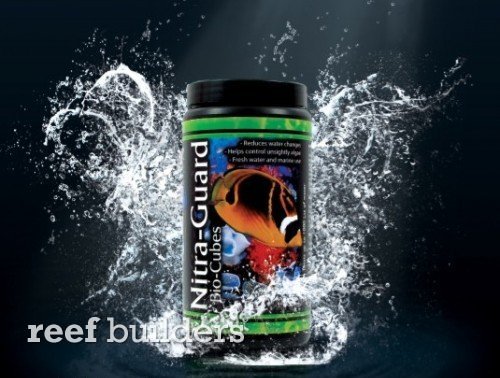
img_a_104208_b48c446dea1d66e07f4a2d83d5f8429d

Another cool thing about these cube-pellets beside their much higher amount of carbohydrates, is the way these Bio-Cubes are used. The Bio-Cubes do not require a reactor, and users are actually discouraged from using reactors unless they install a venturi for air intake. Instead these Nitra-Guard Bio-Cubes can be used by creating what the creators call a “bomb”, which is in essence just a media bag with an airstone and the Bio-Cubes. Each Nitra-Guard container comes with its own media bag, so you’ll just have to add the airstone and you can simply drop the bag in your sump. Top off the Bio-Cubes as needed every couple months, and you’re good to go (Orca Lab’s recommends four, but the exactly number obviously depends on your system).
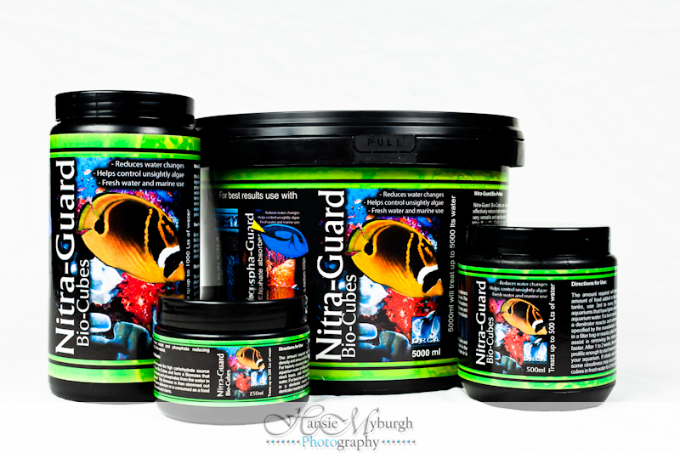
hm-photo-nitra-guard-range

What the exact pricing will be like is currently unknown since Nitra-Guard is still looking for a US distributor, but it seems in several other countries 500ml sells in the $55-70 dollar range so we expect the products to be priced around that pricepoint. Orca Labs recommends 1-4ml per liter (3.78 ml-15ml per gallon) so the product might seem a little bit expensive, but the products lasts for months until it needs to be topped-off rather than replaced, and doesn’t require a reactor. We should get our hands on some of the Bio-cubes in the next couple of months so stay tuned for a full run down.


Posted in Reef News |
Search More:  
   
  • http://www.facebook.com/people/Spencer-Shepard/100000684083622 Spencer Shepard

    So does the Titanium version contain phosphorus?

  • JakeAdams

    not sure how it works, but you’d think that would be the case right? Hopefully that isn’t the case but I’m pretty sure Dallas will chime in soon enough

  • http://www.facebook.com/people/Wayde-Milas/100000443842097 Wayde Milas

    Its got to. I hope its somehow bound so it doesn’t leak. If it is, this looks interesting.

  • http://www.facebook.com/people/Mathieu-Gagné/659241296 Mathieu Gagné

    Interesting! Who is going to try it first? :P

  • XD_1

    For what it’s worth I’ve never had issues with vinegar not working even when phosphates are undetectable. In fact, when I’m starting it on a tank I will typically draw it down with GFO first and I frequently keep running GFO even when carbon dosing. I suspect the bacteria in the water column consume the phosphate faster than the GFO use it.

    I concede that I have little experience with biopellets, so maybe they do require more phosphates to work correctly. May explain why I didn’t have much luck when I tried them.

  • Ivan

    Have been running it since dec 2011 and all I can say is it really works. On a bang for your buck basis, notuch comes close!

  • CaliReefer

    Currently use an ATS and in the past have tried bio-pellets. Both methods did nothing to remove phosphates on my systems (actually phosphates rise using both methods) but both drop nitrates to 0. If this product works outside of the redfield ratio does that mean this will remove phosphates better than the other methods? If so this may be the product I have been searching for.

  • Ivan

    The Original Cubes will remove PO4 according to the Redfield ratio, meaning you will get to a point where the Nitrates are ), yet there is still some PO4 left. This is due to the ratio in which we add N:P is skewed towards excess P. Nitrate thus becoming the limiting nutrient.
    The new version of cubes, i.e. titanium will remove nitrate even when the PO4 has become limiting. Unfortunately, in your case (as in mine) the opposite is true.
    A by-chance discovery I made whilst running the regular cubes, was that after a power outage, my PO4 (which had bottomed out at 0.08ppm due to NO3 limitation) had dropped to undetectable on a photometer…… Have discussed this with scientists and biologists, who suspect that I achieved something special in my tank, i.e. EBPR.

  • NemosJanitor

    @disqus_iqgR0ECs1v:disqus I see you have done a nice write up on your experiances here.
    http://www.marineaquariumsa.com/showthread.php?p=643351#post643351

  • Dallas

    I see my fellow SA reefers have started posting links, to recap here they are http://www.marineaquariumsa.com/showthread.php?t=37878 and http://www.marineaquariumsa.com/showthread.php?t=35134

    as for the pricing, they should retail more competitively than bio-pellets as currently they are about 60-65 pounds in the UK for 1000ml.

    the Titanium Bio-cubes are hot off the press and i will reply with a link on a more detailed post as i am not sure how much one can post here,

    We are aiming to have these in the USA for xmas

  • KillerWhale

    Where do you buy these in the USA?

  • Dallas

    We are working on getting the product there, real soon.

  • Dallas

    I have been using it since jan 2012 and stopped using zeovit

  • http://www.facebook.com/leslie.hempel Leslie Hempel

    I have ordered mine to try out… I have been watching the local response to this product and am very interested to see how it compares first hand…