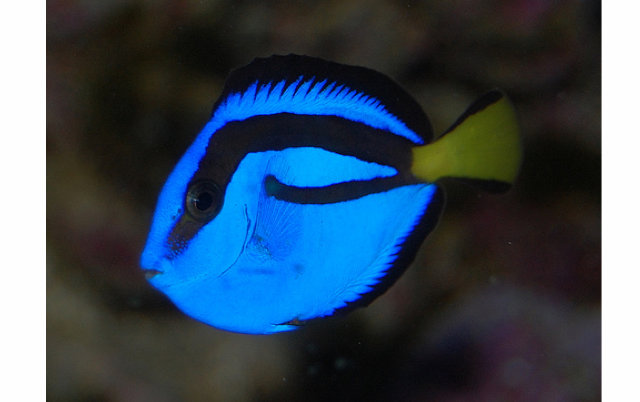
Captive reared regal blue tangs return to the aquarium hobby via Sustainable Aquatics

29

No doubt, the regal blue tang, Paracanthurus hepatus, is one of the most popular fish for the marine and reef aquarium. This species is imported by the thousands at a size of 1-2″ but these specimens often take a long time to acclimate to captive life, hiding and eating reluctantly. About 10 years ago the regal blue tang was available from C-Quest in limited quantities as a captive reared fish, a fish that was captured right after metamorphosing, in what is called a ‘post-larval’ state. These newly settled out, 0.25″ specimens are then raised in aquaria to a marketable size. After a long absence from the marine aquarium scene, captive reared blue tangs are now available again from Tenessee based Sustainable Aquatics. SA has been working for over a year with a Solomon Island exporter to fine tune the technique of raising fish that are caught post-larval and then bringing them to market. The captive reared regal blue tang is just the first of a slew of fish which are prime for captive rearing although it stands to remain one of the most sought after CR fish. Captive reared fish from Sustainable Aquatics should be on par with the average cost of wild caught fish although their value to the hobby and the environment is arguably much more than wild caught fish. Sustainable Aquatics will be exhibiting at the Denver Reefstock event where we expect we’ll see lot’s more captive reared fish from SA.

Photo by FlickR user sophos9


Top Related Stories:

  • Andrew

    How does pulling larval fish out of the ocean to rear them in captivity help with sustainability of these fish? Maybe you could argue that destruction of habitat by pulling larger specimens off the reef is less destructive but beyond that what’s the point in terms of environmental impact?

  • Andrew

    How does pulling larval fish out of the ocean to rear them in captivity help with sustainability of these fish? Maybe you could argue that destruction of habitat by pulling larger specimens off the reef is less destructive but beyond that what’s the point in terms of environmental impact?

  • Gresham

    The amount of larvae the actually make it to size is incredibly low and the amount pulled from the soup for this is also incredibly low. One just has to take a swim in the soup to see what Sustainable Aquatics is doing has a very low impact as opposed to the taking of productive adults.

  • Gresham

    The amount of larvae the actually make it to size is incredibly low and the amount pulled from the soup for this is also incredibly low. One just has to take a swim in the soup to see what Sustainable Aquatics is doing has a very low impact as opposed to the taking of productive adults.

  • Nauticac4

    I completely agree with Gresham. This is a great thing for the hobby rather than taking survivors of the “soup” or mature breeding population SA is raising something that would otherwise be lost in the abyss of the ocean. Wish our hobby saw more of this type of activity

  • Nauticac4

    I completely agree with Gresham. This is a great thing for the hobby rather than taking survivors of the “soup” or mature breeding population SA is raising something that would otherwise be lost in the abyss of the ocean. Wish our hobby saw more of this type of activity

  • Isurus79

    Upon settlement from the pelagic phase, post larval fish have mortality rates well above 90%. Taking fish from the ocean before this population bottleneck means that we are leaving the survivors to breed and continue the line of strong fish reproducing and replenishing the population. Don’t forget that these same post larval fish have shockingly higher rates of survival than adults taken off the reef due to the fact that they eat prepared foods almost right off the bat and are used to human presence around aquariums, thus greatly reducing stress related mortalities. Post larval collection is the next best thing to captive breeding.

  • Isurus79

    Upon settlement from the pelagic phase, post larval fish have mortality rates well above 90%. Taking fish from the ocean before this population bottleneck means that we are leaving the survivors to breed and continue the line of strong fish reproducing and replenishing the population. Don’t forget that these same post larval fish have shockingly higher rates of survival than adults taken off the reef due to the fact that they eat prepared foods almost right off the bat and are used to human presence around aquariums, thus greatly reducing stress related mortalities. Post larval collection is the next best thing to captive breeding.

  • Andy

    The method of collection (when and how) determines if this is a good method or bad. There has been a fatting operation going on for hippos for a while. If they are simply fattened up before export or fattened up after import that says nothing about the sustainability of the practice. If they are collecting the post-larvae pre-metamorphosis than this would a great development. Catching post-metamorphosis fish from a reef does not yield the benefits people would expect to see.

    This type of fishery, if done correctly can be far better than captive cultured fish, from a ecological aspect and a socioeconomic outlook.

    More info, more than a short blurb is needed to assess….

  • Andy

    The method of collection (when and how) determines if this is a good method or bad. There has been a fatting operation going on for hippos for a while. If they are simply fattened up before export or fattened up after import that says nothing about the sustainability of the practice. If they are collecting the post-larvae pre-metamorphosis than this would a great development. Catching post-metamorphosis fish from a reef does not yield the benefits people would expect to see.

    This type of fishery, if done correctly can be far better than captive cultured fish, from a ecological aspect and a socioeconomic outlook.

    More info, more than a short blurb is needed to assess….

  • Adam Blundell

    These fish are collected post metamorphosis… and this IS a huge benefit and sustainable. Gresham summed it up well. Even the survivability of post-meta fishes in the wild is very very low. Their chance of making it to market size or even reproductive size is minimal.
    It’s a great development and a very beneficial practice. Even fattening up fishes is a benefit, but this is a huge step forward.
    Adam
    ps- not exactly new… these fish from Sustainable Aquatics have been in some retail stores for many months now

  • Adam Blundell

    These fish are collected post metamorphosis… and this IS a huge benefit and sustainable. Gresham summed it up well. Even the survivability of post-meta fishes in the wild is very very low. Their chance of making it to market size or even reproductive size is minimal.
    It’s a great development and a very beneficial practice. Even fattening up fishes is a benefit, but this is a huge step forward.
    Adam
    ps- not exactly new… these fish from Sustainable Aquatics have been in some retail stores for many months now

  • Bill Crockett

    I visited a facility in Tahiti on the island of Tahiti that was doing exactly this. I don’t know what happened to that facility but it was interesting the process they went through. The had troughs of Miniatus Groupers in their backyard that were destined for the local food market. Their system was not very sophisticated but

    The biggest draw back was they never knew what they were going to get but said they could tell within a couple days of collecting what fish they had.

    I wish SA good luck and I hope they can expand their selection.

    Some other articles:
    http://www.informaworld.com/smpp/content~content=a909437078&db=all
    http://docs.google.com/viewer?a=v&q=cache:xN4QMQQ6xWcJ:www.spc.int/coastfish/news/LRF/17/LRF17_3_Lecaillon.pdf+university+of+moorea+post+larval+fish&hl=en&gl=us&pid=bl&srcid=ADGEEShMXF_31KCCzlD6dp2FWAXzhAA_Jif-K7RAn41SIe02aplZnSUmRfeGM9koMA2ZALSjxnZRUXxzF1G7Fnxd5sljKx9UnYoXKSTEgfZ91Ss9YESTNsahqnpT6x8gTq6y_pwJTqy_&sig=AHIEtbSXRBmRN4Hzt2HlehmSirQJ2OwOMg

  • Bill Crockett

    I visited a facility in Tahiti on the island of Tahiti that was doing exactly this. I don’t know what happened to that facility but it was interesting the process they went through. The had troughs of Miniatus Groupers in their backyard that were destined for the local food market. Their system was not very sophisticated but

    The biggest draw back was they never knew what they were going to get but said they could tell within a couple days of collecting what fish they had.

    I wish SA good luck and I hope they can expand their selection.

    Some other articles:
    http://www.informaworld.com/smpp/content~content=a909437078&db=all
    http://docs.google.com/viewer?a=v&q=cache:xN4QMQQ6xWcJ:www.spc.int/coastfish/news/LRF/17/LRF17_3_Lecaillon.pdf+university+of+moorea+post+larval+fish&hl=en&gl=us&pid=bl&srcid=ADGEEShMXF_31KCCzlD6dp2FWAXzhAA_Jif-K7RAn41SIe02aplZnSUmRfeGM9koMA2ZALSjxnZRUXxzF1G7Fnxd5sljKx9UnYoXKSTEgfZ91Ss9YESTNsahqnpT6x8gTq6y_pwJTqy_&sig=AHIEtbSXRBmRN4Hzt2HlehmSirQJ2OwOMg

  • Andrew

    So what is the mortality rate of the collected fish through the stages of collection, transportation and grow-out? I haven’t seen any numbers about Sustainable Aquatics’ mortality rates.

  • Andrew

    So what is the mortality rate of the collected fish through the stages of collection, transportation and grow-out? I haven’t seen any numbers about Sustainable Aquatics’ mortality rates.

  • Ziyaad

    i think its a great idea, but i really doubt we will get them in south africa

  • Ziyaad

    i think its a great idea, but i really doubt we will get them in south africa

  • http://chicagofishandcoral.com Keith

    our retail shop has gone through 3 shipments of these little buggers. As a retailer and former wholesaler, I steer away from 1-2 inch tangs sold as tiny or smalls. Mortality rates and sustanabiltiy of Regals is hit and miss and it is one of the fish I see starve out often. Not the case with these, eat prep foods within hours and rock solid for weeks at a time in my systems. I dont bother with the wilds from LA anymore.

  • http://chicagofishandcoral.com Keith

    our retail shop has gone through 3 shipments of these little buggers. As a retailer and former wholesaler, I steer away from 1-2 inch tangs sold as tiny or smalls. Mortality rates and sustanabiltiy of Regals is hit and miss and it is one of the fish I see starve out often. Not the case with these, eat prep foods within hours and rock solid for weeks at a time in my systems. I dont bother with the wilds from LA anymore.

  • Pingback: The Reef Aquarium as a Hobby | Coral Reefing - Reef Hobbyist

  • Pingback: The blue-spot butterflyfish that holds a lot of promise for the future of captive reared aquarium fish

  • http://www.aquality.co.za Liaquat

    It’s welcome back to more of the same…I believe that it’s the very outfit dealing with these P hepatus – were doing so IN the Solomon Islands..In fact, almost 10y ago, I consolidated more than a few imports of those AWESOME Solomon Island Percula(High Black %), and almost every size of Regal tangs… from VT(very tiny!!) upto T, S, SM

    when calling directly I was informed somewhat of their methods. SO, yeah, these have been available on and off to South Africa..at a bit of a premium, due to freight routes, intermediaries(middle-men)…

    Pity, though I saw something about Blue Planet Reef Farms closing due to an Indonesia facility/fish issue!

    aaah well, hopeful that their efforts do not go unnoticed

  • http://www.aquality.co.za Liaquat

    It’s welcome back to more of the same…I believe that it’s the very outfit dealing with these P hepatus – were doing so IN the Solomon Islands..In fact, almost 10y ago, I consolidated more than a few imports of those AWESOME Solomon Island Percula(High Black %), and almost every size of Regal tangs… from VT(very tiny!!) upto T, S, SM

    when calling directly I was informed somewhat of their methods. SO, yeah, these have been available on and off to South Africa..at a bit of a premium, due to freight routes, intermediaries(middle-men)…

    Pity, though I saw something about Blue Planet Reef Farms closing due to an Indonesia facility/fish issue!

    aaah well, hopeful that their efforts do not go unnoticed

  • Pingback: Regal Blue Tang reported successfully captive bred in Taiwan | The Depot of Talk

  • Pingback: This adult yellow belly blue tang looks wildly different from its Pacific counterpart | The Depot of Talk

  • Pingback: Video of the yellow belly blue tang shows off this perfect veteran aquarium fish | The Depot of Talk

  • Pingback: Sustainable Aquatics releases Dry Hatchery Diet in two pellet sizes | The Depot of Talk

  • Pingback: Regal Blue Tang can spawn successfully at home « Saltwater / Reef « The Depot of Talk