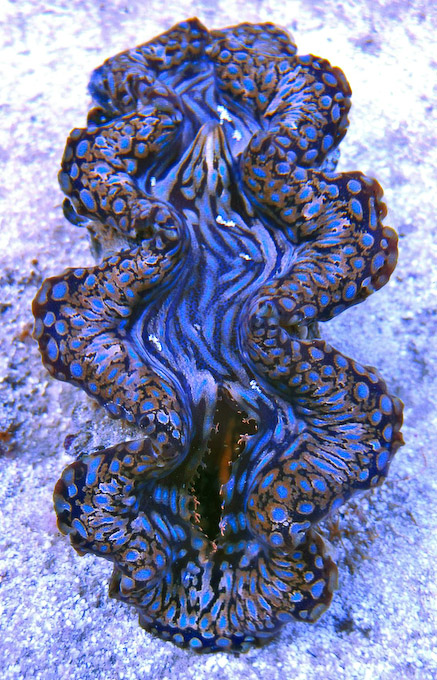
Sexy blue spotted squamosa clam from Vietnam appears at Reefkoi

By on Sep 15, 2011

If you needed any indication that the reef aquarium season is ramping up, other than the plethora of livestock posts we’ve published recently, then this blue spotted squamosa clam from Reefkoi ought to be a good indicator. Reefkoi’s been tanking this three and half inch blue spotted Tridacna squamosa for over two months now.

After enjoying it for that time, Chris has finally been able to convince himself that he can sell it. Some good news about Tridacna squamosa that have blue spots is that as far as we’ve ever heard, the blue spots always grow larger with age and eventually turn the whole mantle into a bright blue pattern. This particular specimen of blue squamosa is from Vietnam, and it definitely resembles the pattern and thinner profile of other Tridacna squamosa from Vietnam.

We love blue squamosa clams, we can recall every single one we’ve ever seen. Squamosa clams are super cool with huge projecting scutes that give the shell a lot of characterHowever, squamosa clams are fairly abundant but blue ones are not. Blue squamosa clams are out there but a really nice one comes along only a few times a year, no doubt this specimen will quickly find a good home.

[Reefkoi]

Posted in Reef News |
Search More:  
   
  • http://pulse.yahoo.com/_QSDPQ6KDZJ64Q25D2NVBTL2YTM wood

    BALL LIGHTNING

  • http://www.facebook.com/profile.php?id=704609972 Julian Wilson

    Very nice!

  • jake weston

    I agree that the blue-spotted  T. squamosa are very cool Tridacnids! Fatherree mentions them in his recent article about visiting an Indonesian clam farm. He covers their rarity stating, “They also had lots of blue Tridacna squamosa clams on hand, something not seen very often in the U.S. I was quite surprised when they told me that about 10% of the squammies they raise are blue, meaning they aren’t rare at all – just rare in the U.S. market.”

    I wanted to point out that while they may be rare for the US, these clams are likely not as rare as many commonly believe.

  • Anonymous

    While I respect Fatheree’s observations about blue squamosas at the farm, I keep tabs on livestock all over the world. No matter how you slice it dice it, blue Tridacna squamosa are rare in Europe, Japan and North America and most of the specimens I’ve tracked down have been inside the US.

  • Anonymous

    While I respect Fatheree’s observations about blue squamosas at the farm, I keep tabs on livestock all over the world. No matter how you slice it dice it, blue Tridacna squamosa are rare in Europe, Japan and North America and most of the specimens I’ve tracked down have been inside the US.

  • Anonymous

    While I respect Fatheree’s observations about blue squamosas at the farm, I keep tabs on livestock all over the world. No matter how you slice it dice it, blue Tridacna squamosa are rare in Europe, Japan and North America and most of the specimens I’ve tracked down have been inside the US.

  • http://www.facebook.com/people/Chris-Baskins/100000129120650 Chris Baskins

    While I agree that true blue Squamosa’s are rare in the USA and other parts of the world they were being farmed in Australia for a time and for all I know they still could be. They were very common the last I heard “which was about 2 years ago” in Australia, I know many reefers from there who had them and just loved to rub it in because I couldn’t get one…. I did hear that it was a university there that was farming them and the last I heard they lost a whole batch of them due to a power outage. They were available for approx $300 US for a 3/4″ clam but CITES laws restricted them from coming to the USA.

  • http://www.facebook.com/people/Chris-Baskins/100000129120650 Chris Baskins

    While I agree that true blue Squamosa’s are rare in the USA and other parts of the world they were being farmed in Australia for a time and for all I know they still could be. They were very common the last I heard “which was about 2 years ago” in Australia, I know many reefers from there who had them and just loved to rub it in because I couldn’t get one…. I did hear that it was a university there that was farming them and the last I heard they lost a whole batch of them due to a power outage. They were available for approx $300 US for a 3/4″ clam but CITES laws restricted them from coming to the USA.

  • Anonymous

    Good to know. Thanks for the response Jake. It’s helpful to know just how rare a species/coloration is in the Hobby. It seems everyone is eager to tout their animals as rare when only some truly are.

  • Anonymous

    I’ll add a little twist to this one… Though I haven’t seen this specimen firsthand, it looks to me like a hybrid between a teardrop maxima and a squamosa. Such a hybrid is likely to have a larger than typical byssal opening compared to squamosas of the same size, though that is not a definitive indicator. Maybe Chris can show us the underside of this clam.