

MaxSpect Razor LED details of specs and components revealed

By on May 09, 2012

maxspect razor led

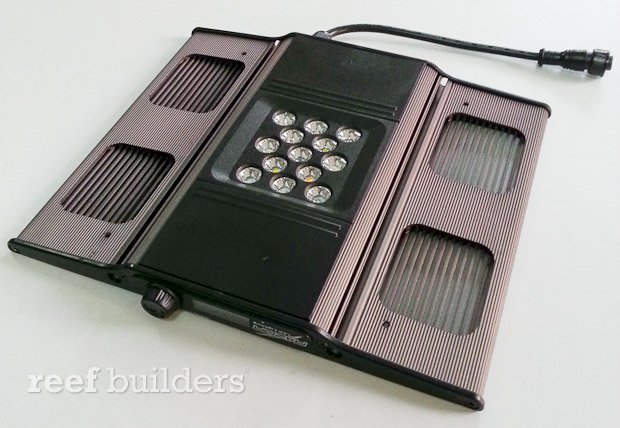
The newly announced Maxspect Razor is a hot and sexy little number that is getting a lot of attention from our tech rabid readers. Therefore we have gathered all the technical and LED details about the fixture to spill to help tide you over until we can get our grubby mitts on one in person. The full lowdown on the MaxSpect Razor LED is after the break.
maxspect razor led

Most of the features of the Razor follow along with the Mazara X that came before it; a built-in controller, dual channel control, six time points per channel to set your lighting schedule, etc… That’s where the similarities end though. As we touched on before in our first announcement of the Razor, gone is the ability to individually replace LEDs as the end user sees fit.

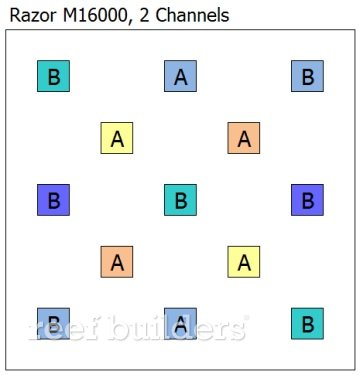
Instead, all the LEDs are mounted on a single MCPCB that gets changed out in a single shot. While that doesn’t offer the same amount of flexibility as before, it does simplify the design, makes it a little more reliable and a whole lot more affordable. We expect that because the modules are being marketed as user replaceable, more options will become available to let you mix and match things to suit your needs.
maxspect razor ledmaxspect razor led

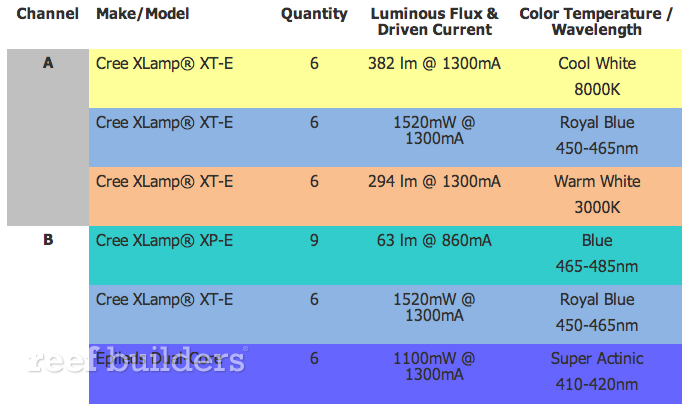
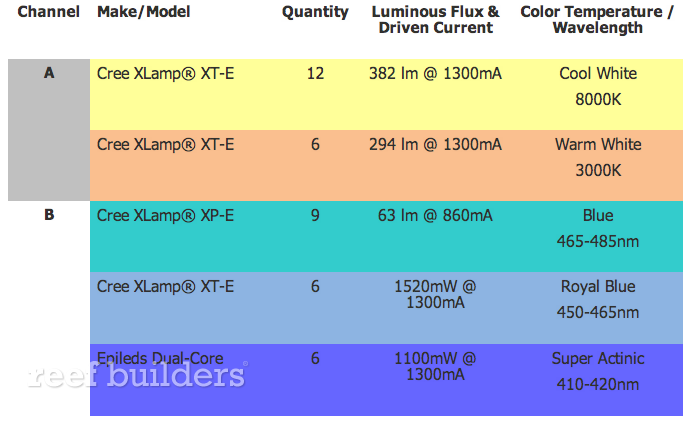
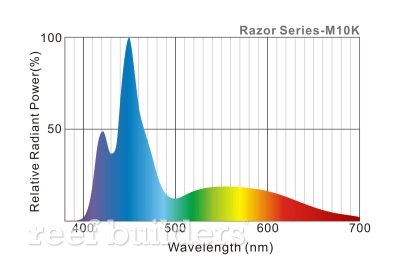
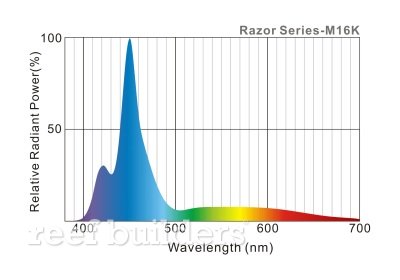
As of right now, two versions are being announced. The first being the Razor LED M10K, which is supposed to approximate a 10000K color temperature with all channels at 100%. Obviously, that color temperature can be manipulated to the end users preference. The second version is the Razor LED M16K which is designed to have a bluer color temperature closer to 16000K. This change in overall color temperature is done with a few changes in LED setup.

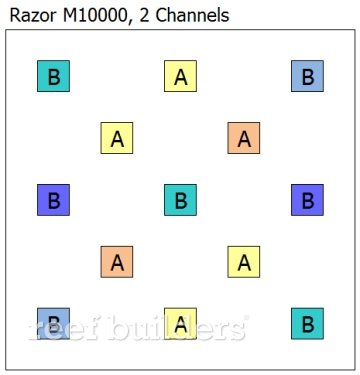
So what are you getting for the 150W of this fixture? To start with, on the Razor LED M10K, each module is using four 8000K cool white Cree XT-Es @ 1300mA and two 3000K warm white Cree XT-Es @ 1300mA on channel A. Channel B consists of three Cree XP-E blues @ 860mA, two Cree XT-E royal blues @ 1300mA, and two Epileds “dual core” 410-420nm violets at 1300mA. The Razor LED M16K changes things slightly by replacing two of the 8000K cool white XT-Es with another pair of Cree XT-E royal blues on channel A.
maxspect razor ledmaxspect razor led

Maxspect is continuing to adopt new technology using the new XT-E whites for cost savings, as well as increasing output, similar to what they are doing with the new Mazara X, which is going to be using the new Cree XB-D. Both the XB-D and the XT-E white are using Cree’s silicon carbide technology, which is dramatically reducing the cost of high output, high quality LEDs. Some may question why the use of warm white LEDs. These add some additional red spectrum in a way similar to other manufacturers are using discrete red LEDs, but in a way that will blend better and create less obvious color shadows.

The new Epileds “dual core” 410-420nm LED is interesting too though. While it’s not clear at this time whether it’s two identical chips at the same wavelength in the same package, or if they have a 410nm and a 420nm chip in the same package for a little wider spectral range, it is clear that it’s great to see a high power, high output LED in this wavelength range.

There has been no mention yet if these fixtures have any form of daisy chaining, be it wired or wireless to control multiple fixtures from a single location, or whether there will be “dumb” versions like the Mazara X, but we’re sure things like that will be cleared up shortly at Interzoo, where these fixtures will be officially announced.


Posted in Reef News |
Search More:  
   
  • http://www.facebook.com/people/Frode-Numan/659084887 Frode Numan

    Wow, good work Maxspect.
    Can’t wait for the PAR graphs on these babies.
    But why a 10000K and 16000K version, now I can’t choose again :P

  • Clive Bentley

    The options for a base color temperature are probably to appeal to a larger crowd. In the US, most will probably gravitate to the bluer M16K, while Europe will most likely prefer the whiter M10K. Sure, both can be adjusted up or down to suit the needs of the user, but the closer to the final color temperature desired, the less light output you lose from reducing one channel or the other to get the results you want.

    There may also be applications for the M10K in freshwater too, but I’d think that a different LED module would be better suited for that with less blue and more red.

  • http://www.facebook.com/profile.php?id=608040062 Ioannis Mylothridis

    I like the fact that they use cool whites + warm whites instead of red leds. Very curious to see how it performs in Interzoo next week!

  • JakeAdams

    Agreed on the use of warm and cool whites instead of reds, and on groping it in person next week. 

  • http://pulse.yahoo.com/_3PQR2S2EAZUDJKVYUCKLCWJ37Q Micheal

    Can’t wait to see a price point on this.    I’m hoping the lack of individual channels that you can dim (i.e. each color, not just whiter side/ bluer side) means the price point is lowered.

    Granted my setup is hidden inside of a fishroom, so “sexy sleek” isn’t a requirement for me, but at the right price I could overlook that sexy is a selling point :D

  • Clive Bentley

    If you look back to the original announcement, Maxspect is setting a target price of $450. That may change by the time it’s released, but I wouldn’t expect by much.

  • http://pulse.yahoo.com/_3PQR2S2EAZUDJKVYUCKLCWJ37Q Micheal

    That’s not too shabby at all for 150W of LEDs.    Very VERY competitively priced it seems,  at this price I can probably overlook the lack of individual channels with each distinct LED and simply tune the blues and whites as they are. Also looks to have a built in controller, seems like win all around. Although at 24″ maybe a bit too compact? Oh well can’t wait to see it released to get my eyes on it.

  • CaliReefer

    Loving this light, one thing that strikes me a little odd is on the spectral graph, the 420nm area differs between the 2 graphs, yet both models have the same amount of 420nm LEDs, so why does it seem like there is less 420 on the 16k version? Going off the graph (and my preference is 20k light) I would still pick the 10k version because it seems to have more of everything except royal blue which is the same output even though the 16k light has 6 more royal blue LEDs. Something just doesn’t look right.. but I still think it is a killer light and a killer price.

    Edit: I figured it out, the extra royal blues is skewing the graph on the 16k version.

  • http://www.facebook.com/Maxspect Maxspect LED

    You hit the nail right on the head Clive :)

    In fact, we are going to release a freshwater version (F6000) shortly after the announcement of the M10000 and M16000, named also after the (approximate) output color temperature.

  • http://twitter.com/AMDPhenomX4 Jared Kaczynski

    Wish they would’ve used the Luxeon ES series. They’re a bit cheaper and the royal blue especially beats out the XT-E by a good margin. Better CRI too. If only Cree wasn’t such a concrete requirement for a light to be bought.

  • Clive Bentley

    While the Rebel ES royal is higher output than the XT-E royal, pricing is similar when bought in volume. There is no chance that you could beat the price of the XT-E white though. It’s based on Cree’s silicon carbide technology, and has reduced the cost of these high output LEDs substantially. While it’s nice to be able to pick and choose the LEDs you want for a fixture, regardless of brand, sometimes its easier to source as much as you can from a single supplier. Also, sourcing Luxeon LEDs in Asia is a little harder than Cree.

  • http://www.facebook.com/people/Frode-Numan/659084887 Frode Numan

    I understood it Clive, but my problem is that I will have to choose. But as I am from Europe, you helped me there ;)

  • http://www.facebook.com/people/Matt-Meadows/100001064246230 Matt Meadows

    It seems a little odd to me that the two models have the same size blue spike, but the 10K model also has a larger violet and larger red/green/yellow spike. It appears to me that the 10K version puts out more total light intensity– can anyone explain what’s going on here? The graphs would make MUCH more sense if they used a standard marker of intensity like most radiometers give you, so that you can more accurately compare the graphs.

  • Clive Bentley

    The graphs are all relative to the maximum intensity seen on each particular version. With LEDs, the blue spike is always the largest, so it always sets the limits. The rest of the spectral chart shows the relative intensity based on that maximum. This really isn’t all that different from any other company sporting spectral plots. Yes, it may help a little if they used the same scale, but taking a little time to compare the two will show the differences without too much effort. These are just representative, so they aren’t something to take as gospel.

  • http://www.facebook.com/people/Matt-Meadows/100001064246230 Matt Meadows

    Yeah, I see how the axis is labeled 0-100% intensity. I supposed in reality the 10K blue spike is significantly shorter, since the violet spike should be almost exactly the same size on the two graphs, whereas it’s (seemingly) double the size on the 10K. 

    I guess actually using a radiometer has spoiled me. It gave graphs using the actual unit of intensity, and you could put the two plots of two LEDs on the same graph for a very tell-tale comparison……..I won’t pretend to understand the unit of intensity the radiometer used, but it did give me a very good indication of the intensity of the light from the LEDs I was testing (all at 700mA, with no optics, to keep things as uniform as possible).

  • Clive Bentley

    Yeah, sometimes you do get spoiled by the tools you use. When it comes to making a representative picture of what to expect with different products, it’s sometimes easier to just hit the auto-scale button, and leave it at that. While to those familiar with looking at spectral plots would perhaps prefer the scale to be the same, to those who aren’t that familiar, it may be confusing seeing the overall output of one being much lower proportionately. Using the same scale would be easier if there was a specific unit of measurement, like mW/m^2, rather than relative intensity.