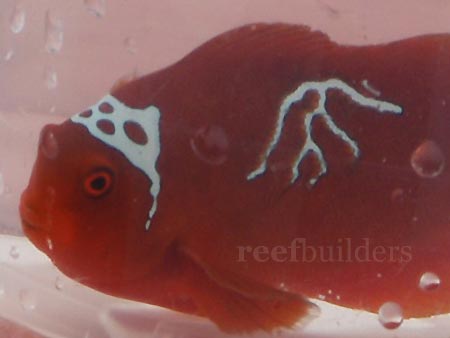
Wicked lightning maroon clownfish emerges from the PNG

By on Sep 21, 2008

This magnificent maroon clownfish Premnas biaculeatus was recently caught in Papua New Guinea by famed fish collector Steve Robinson.  As far as we know this individual is one of a kind but perhaps with more collections other similar specimens may be discovered. If this is a sign of things to come then it seems like Papua New Guinea will be a treasure trove of new morphs and species.  The photo was taken topside in PNG right after collection so please excuse the blurry-cam. This specimen is as sensational as the original picasso true percula clownfish which was imported several years back. Perhaps this amazing maroon clownfish will be the progenitor of a domestic strain of “Lightning Maroon Clowns”. You heard it here first!

Posted in Reef News |
Search More:  
   
  • http://blog.marinedepot.com jeffry r. johnston

    I did indeed hear it here first! Dude, this is so cool … thanks for sharing. Sent the link to a few others to share.

  • http://blog.marinedepot.com jeffry r. johnston

    I did indeed hear it here first! Dude, this is so cool … thanks for sharing. Sent the link to a few others to share.

  • Pingback: Maroon Clown ID please? - RareClownfish.com

  • Robbie

    Is it just me – Or should we not be a little more concerned by the fact that very Rare fish species are being taken from the ocean?

    Hey, I’ve got a huge marine tank full of fish, all of which are available in large numbers in the wild or alternatively tank bread – But I’m just not comfortable about these rare species being removed from the ocean…………..

    What are your thoughts?

  • Robbie

    Is it just me – Or should we not be a little more concerned by the fact that very Rare fish species are being taken from the ocean?

    Hey, I’ve got a huge marine tank full of fish, all of which are available in large numbers in the wild or alternatively tank bread – But I’m just not comfortable about these rare species being removed from the ocean…………..

    What are your thoughts?

  • MithunKarmakar

    Indeed we should be concerned.. if this is the start of a new subspecies then we definitely should conserve them otherwise a new species will be lost even before emerging. From the above post its clear that these fishes are very less in number..so chances of possible breeding is very low.. if we start removing them from that phase its likely that this species will be lost forever

  • MithunKarmakar

    Indeed we should be concerned.. if this is the start of a new subspecies then we definitely should conserve them otherwise a new species will be lost even before emerging. From the above post its clear that these fishes are very less in number..so chances of possible breeding is very low.. if we start removing them from that phase its likely that this species will be lost forever

  • Matt Pedersen

    I’m inclined to disagree with the concern over pulling “rare morphs” from the ocean. The chances are that these mutations have occurred before in the past several thousand years, and they have not proven beneficial in the past, so why now. True, this could represent a new shift in the species color patterning, but what are the odds that this mutation is going to “take hold” in the wild? In fact, it is far more likely that this “new form” will be preserved by an enterprising breeder rather than mother nature. In other words, while the rare odd wild Picasso Perc does get collected, once again, they are rare probably because if anything, the non-barred patterning could actually be a disadvantage and something selected against in nature. There’s a reason that most all clownfish are vertically striped ;) It’s a bit presumptive to assume that these mutations have never occured before, and that something is unique about this particular 10-20 year slice of earth history to think that right now is the “starting point” for a new species. The theory could certainly be right, but more likely this is a normal genetic variation, much like albinism, that can occasionally occur.

  • Matt Pedersen

    I’m inclined to disagree with the concern over pulling “rare morphs” from the ocean. The chances are that these mutations have occurred before in the past several thousand years, and they have not proven beneficial in the past, so why now. True, this could represent a new shift in the species color patterning, but what are the odds that this mutation is going to “take hold” in the wild? In fact, it is far more likely that this “new form” will be preserved by an enterprising breeder rather than mother nature. In other words, while the rare odd wild Picasso Perc does get collected, once again, they are rare probably because if anything, the non-barred patterning could actually be a disadvantage and something selected against in nature. There’s a reason that most all clownfish are vertically striped ;) It’s a bit presumptive to assume that these mutations have never occured before, and that something is unique about this particular 10-20 year slice of earth history to think that right now is the “starting point” for a new species. The theory could certainly be right, but more likely this is a normal genetic variation, much like albinism, that can occasionally occur.

  • Pingback: Lightning maroon clownfish from Papua New Guinea appears at Blue Zoo Aquatics

  • Pingback: April Fooled…even me!? - The Lightning Project

  • Pingback: Lightning Maroon Link Blitz - The Lightning Project

  • Pingback: coupon

  • Pingback: New lightning maroon clownfish video emerges showing a successful pairing | The Depot of Talk

  • Pingback: Was this Lightning Maroon #3? – the ongoing story of abberant Maroon Clownfish from PNG - The Lightning Project

  • Pingback: The Genetic Possibilities behind the “Lightning” trait in PNG White Stripe Maroon Clownfish, Premnas biaculeatus. - The Lightning Project