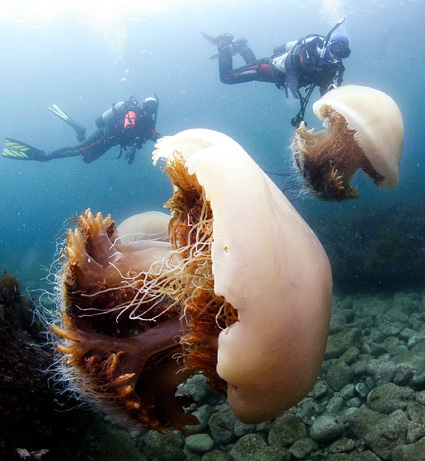
Giant jellyfish invade Japanese waters

By on Nov 17, 2009

giant-jellyfish-invasion
Gigantic jellyfish, weighing up to quarter ton (450 lbs) and reaching up to six feet in diameter, are moving Northward invading Japanese waters and plaguing the local fishing industries. The Nomura jellies (Nemopilema nomurai) are tainting and killing fish in nets and are even to blamed for capsizing a 10-ton vessel after the Nomura jellies loaded the nets. Scientists are looking at global warming effects and polluted water for the increase in jellyfish activity and its expanding habitat. Polluted waters, like those found off the coast of China, boost growth of microscopic plankton that “jellies” feed on and overfishing has eliminated many of the jellyfish’s natural redators and cut down on the competition for plankton. The jellyfish troubles aren’t just showing up in Japanese waters, the creatures are blamed for decimating fishing industries in the Bering and Black seas, forcing the shutdown of seaside power and desalination plants in Japan, the Middle East and Africa, and terrorizing beachgoers worldwide. According to the U.S. National Science Foundation research estimating that people are stung 500,000 times every year — sometimes multiple times — in Chesapeake Bay on the U.S. East Coast, and 20 to 40 die each year in the Philippines from jellyfish stings.

[via Yahoo! News, Photo Credit: National Geographic]

Posted in Reef News |
Search More:  
   
  • iggy

    I recall reading a situation in Spain. Jellyfish were a result of decimated fish populations where natural predation of larval jellyfish is no longer taking place by small fish and fry. It is a complex situation but this is likely explanation.

  • iggy

    I recall reading a situation in Spain. Jellyfish were a result of decimated fish populations where natural predation of larval jellyfish is no longer taking place by small fish and fry. It is a complex situation but this is likely explanation.

  • http://reefbuilders.com Brian Blank

    Iggy, that is the general consensus. Decreased predator levels and the increase in available food giving creatures like this the edge to take off in insane numbers.

  • http://reefbuilders.com Brian Blank

    Iggy, that is the general consensus. Decreased predator levels and the increase in available food giving creatures like this the edge to take off in insane numbers.

  • http://www.taka-tech.net TAKA

    Thamnaconus modesoides loves this jellyfish.
    http://www.youtube.com/watch?v=RoktEPUa8BE
    Some of Japanese try to use it as food or fertilizer for farms. I was surprised some use it for ice cream!
    http://members.at.infoseek.co.jp/rimssecret/kurage3.htm

  • http://www.taka-tech.net TAKA

    Thamnaconus modesoides loves this jellyfish.
    http://www.youtube.com/watch?v=RoktEPUa8BE
    Some of Japanese try to use it as food or fertilizer for farms. I was surprised some use it for ice cream!
    http://members.at.infoseek.co.jp/rimssecret/kurage3.htm

  • http://reefbuilders.com Brian Blank

    That is a pretty amazing video, problem is they need to start feeding on em a bit earlier ;)

  • http://reefbuilders.com Brian Blank

    That is a pretty amazing video, problem is they need to start feeding on em a bit earlier ;)