

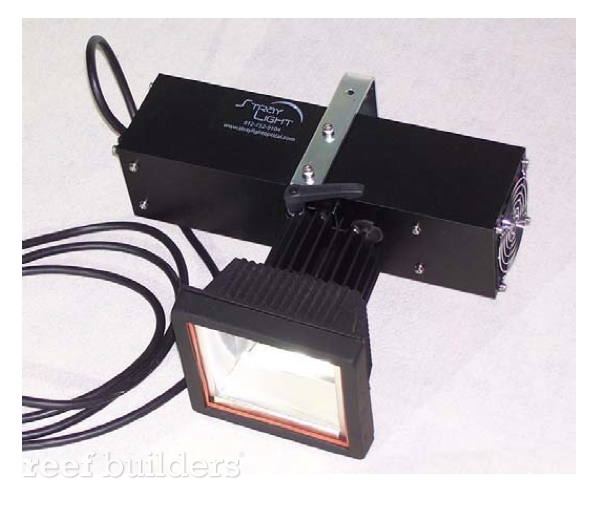
Seashine from Stray Light is the first commercially available LIFI plasma light for hobbyists launching soon
24 Comments

The first commercially available LUXIM LIFI plasma arc light is coming to the aquarium market sooner than we expected. The Seashine™ aquarium light series by Stray Light Optical Technology, based in Scottsburg, Indiana, is debuting sometime in the early part of this year making way for a whole new lighting revolution in the hobby. Based on the LUXIM plasma lighting technology, the Seashine fixture is already in use at the Monterey Bay Aquarium and will soon be available to hobbyists everywhere. More details and specs after the break.
A more efficient lighting option than traditional metal halide systems, the Seashine provides 180-percent higher PAR value than that of a 10,000K 400W MH fixture and using just 290W. The unit also fires up pretty quickly, achieving full brightness in 40 seconds. With a Correlated Color Temperature (CCT) of 5,300K at 100 percent, the Seashine will give you a wide spectrum of lighting possibilities. When dimmed below 50 percent, the Seashine emits a pleasant blue hue we seek in aquarium lighting with the benefits of natural sunlight at the top end.
On top of that, the Seashine will feature either on-board dimming controls or a remote cord controller allowing for dimming from 20 to 100 percent. They offer integration for commercial systems as well as a plethora of other custom controlling solutions with features controllable via a mobile phone.
Gone are the days of replacing MH bulbs every six to nine months, with an effective lifespan of 25,000 hours, the Seashine with provide over six years of use running at 12 hours a day. Besides the energy efficiency gained, the light fixture produces less hear and near infrared radiation that MH bulbs allowing for less reliance on chillers and other cooling devices.
These lights also will be customizable to your tank’s needs with a variety of stock reflectors or the ability to create a custom reflector to fit odd-shaped tanks or other lighting effects. The standard reflector will give 55 degrees of spread with other options including a 100-degree flood, a 30-degree deep and a 55- by 30-degree rectangular reflector.
A nice touch with the light is the warranty and support the company provides. The warranty covers defects in materials and workmanship for five years and three years on electronics and lamp components.
We are waiting to hear back from the company on suggested retail pricing and when the first units will ship and will provide more information as soon as its available. The company will begin taking pre-orders for the Seashine at the end of January.


Finally, it’s here, the light of my dreams.
January 26th, 2010 at 5:06 pm
i ‘ve been doing searches about this light for months and its finally hear, I hope there cheaper then LEDS
January 26th, 2010 at 5:45 pm
It’s a start! Pretty fugly imo. I’m not sure how well the color will work out at full power.
January 26th, 2010 at 5:49 pm
wow
January 26th, 2010 at 6:12 pm
Meh… advertising hype claims.
180 percent higher PAR…. maybe that’s because this light is 5300K vs a 10000K?
Looking at those graphs though, man there’s a TON of red spectrum light in this thing, while yeah at 5m deep it does get pretty extinguished I don’t know who had a tank that big…. oh Steinhart!
Also the life of the bulb worries me too, I cringe whenever I hear about how long LEDs last 50000 hours, and that being a selling point, now these too… *cringe*.. MH bulbs can last MUCH longer than 6 months too, we just changed them out because they get dimmer.
That said, I would be a lot more interested in a bluer version of these, right now it’d be great for greenhouse applications
January 26th, 2010 at 6:20 pm
eesh….5300K? tank will look like lemonade.
January 26th, 2010 at 9:53 pm
like to see how is 20k look like?
January 26th, 2010 at 10:08 pm
“When dimmed below 50 percent, the Seashine emits a pleasant blue hue we seek in aquarium lighting with the benefits of natural sunlight at the top end.”
I would like to see the PAR values @ 50%. If these have a controller that can adjust multiple times during one photoperiod, It will give us the ability to emulate nature much better. I am excited to see these in action, but first need a price.
Good article on PAR:
http://www.advancedaquarist.com/2009/7/aafeature2/view?searchterm=values%20sun%20reef
January 26th, 2010 at 10:10 pm
I’m looking forward to seeing this run in a hobbyist application. The bulb should be replaceable and in 6 years, will probably be a lot more friendly on the wallet. MH’s do work yes, efficient not really. There are so many practical applications in the hobby for plasma, LED, OLED, etc. It’s just a matter of time before they become more widespread and avialable not only to potential manufacturers but to hobbyists too.
Remember when computers cost an arm and a leg back in the day?
January 26th, 2010 at 10:18 pm
They need to package that up to look nicer. Harsh corners, black, not slick looking at all.
January 26th, 2010 at 10:49 pm
you guys can diss all you want but having seen one of these in person, that very exhibit at MBA in fact, I can tell you I will be first in line to buy one or two of these lights and I am willing to pay a premium to use it.
Remember that 6K is the color temperature of the sun and that corals still look good out in the wild. There is a big difference between the balanced spectrum 6K light the plasma arc light puts out and the narrow/yellowish wavelength 6K of halides, leds and fluorescents. And don’t forget that you can always use a fair amount of blue actinic LED supplementation to balance out the color rendition to your liking.
January 26th, 2010 at 10:53 pm
Wow, sounds great! I think you could have a very natural light cycle with this lamp hoked up to a controller. Set it to gradually ramp up from 0% at dawn to about 70% over 4 hours, hold steady at 70% about 4 hours for midday, then gradually ramp down to 0% over the next 4 hours. That would probably keep the spectrum between 10000K and 20000k most of the time. Just guesses. Can’t wait to see it in action!
January 26th, 2010 at 10:59 pm
For those of you who are newer to the blog, we posted this original video of a Plasma Arc light ramping up and down in intensity. You can just make out the color shift. It’s much easier to see at the end of the video when the lamp is quickly ramped up in intensity.
January 26th, 2010 at 11:02 pm
The key to adapting this technology to aquarium use is all in the reflector (how to make a tiny pill sized light source spread out the PAR efficiently so it does not fry corals right under it). And also dimming to achieve the proper color output. How will this affect PAR and bulb life?? Should be interesting how this company approaches our hobby, since from glancing at their website it looks like they have no experience in our industry. I would love to see Aqua Illumination, Sunlight Supply, or Icecap do something with this technology.
January 26th, 2010 at 11:04 pm
Looks much nicer than the last one they showed us. I still want to see the MBA coral growth data.
January 26th, 2010 at 11:19 pm
Jake,
I think this video shows the transition from blue to white better as the bulb warms up… Maybe because I took the video with a cheap point and shoot, so the white balance was not auto adjusted…
http://www.youtube.com/watch?v=oqYl0ksLlho
January 26th, 2010 at 11:21 pm
Jake, what was it lighting at the MBA? Corals? Or seaweed/algae?
What a bulb looks like and what the corals “see” can be two different things. I understand the Sun is close in color (and by close I mean in number only that spectral plot looks NOTHING like the sun, but more a cold star and a hot star super imposed), but what color are most corals you find in nature near the surface??
January 26th, 2010 at 11:48 pm
Either way, go ahead about the trendsetter Jake, I’ll wait until the technology catches up and becomes cheaper and more palatable to me
January 26th, 2010 at 11:50 pm
I’m with Jake on this one. 5300K is fairly red on the spectrum but I am hoping Luxim will be able to release lamps with more halide salts that shift the spectrum to the cooler side sometime soon. Very promising.
January 27th, 2010 at 9:25 am
thanks for posting those vid links. Now I better understand how these things actually work. The color change with ramping the power up and down could be a really cool way to simulate a natural daylight phase.
January 27th, 2010 at 12:21 pm
I can’t wait to use this new light source to grow my indoor greenhouse tomato plants. When will it be available for this use? I look forward to seeing a professional strength plant growing model out soon. Let me know when this happens.
February 26th, 2010 at 4:30 am
Im hoping that they need a guy that has a 110 gallon reef for a free try out to let every one know how good they are by the way i will need three so hit me back with all the info seashine you have my email thank’s G.K
March 1st, 2010 at 12:35 pm
Very informative.
Thank you.
August 24th, 2010 at 11:57 am
Ahh! That\’s great idea for today. I will use this article for the prototype of my new project, thanks a lot. I will bookmark you website in my good place
September 1st, 2010 at 4:11 am