become obsessive:
Reef Builders RSS Feed Contact Reef Builders Reef Builders on Twitter Reef Builders on Facebook Reef Builders on Google Buzz

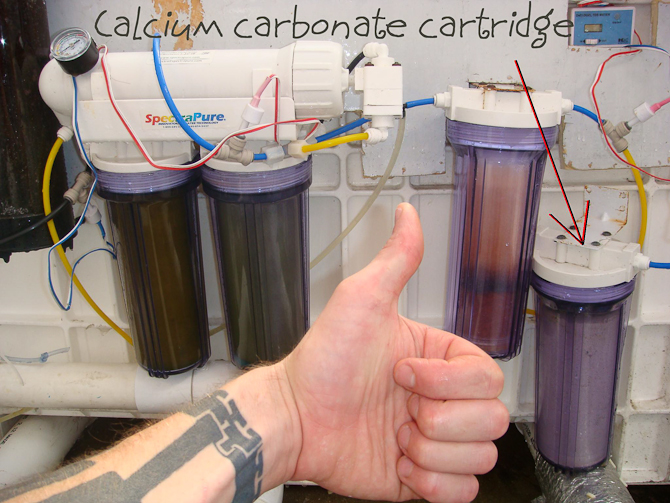
The RO/DI Calcium Carbonate Cartridge

52 Comments

I hope to spawn the acceptance of the idea that R/O units should have one more filtration module standard. What would be in this new canister? Aragonite. CaC03. Calcium carbonate. Yup, the reef aquarist’s best friend. Basically coral skeleton (there are also some oceanic processes that percipate aragonite straight from seawater.) This stuff dissolves in water below a pH of 8.2 which comes in very handy for our purposes of maintaining proper levels of essential elements in solution in our aquariums. Follow the link to continue reading on the Calcium Carbonate Cartridge and how you can easily make your top-off water work for you.
A calcium reactor uses carbon dioxide that dissolves in the water, that creates carbonic acid that lowers the pH, and thus dissolves the aragonite. So I was thinking that if the aragonite will dissolve with a pH lower than 8.2, then newly made R/O DI water should have a pH of 7.0, dissolving the aragonite, and thus supplementing the fresh water with carbonate ,calcium, magnesium, strontium, and all the other iums that was incorporated into the aragonite, the very same elements that your growing coral will re-use to make their skeleton, and in the same proportions (corals also lay down other elements within the calcium carbonate matrix of their skeleton).

Water leaving the canister should have a higher pH, preventing you from adding acidic (saltwater speaking) water directly to your aquarium. Some people use kalkwasser with their top off water, and this is a great way to increase pH, and calcium, but it can be dangerous if overdosed. With an aragonite canister there is no potential to fry your coral with alkalinity. In fact that comes out at a perfect 8.2. When tested on a TDS meter water leaving the R/O is reads 8-15ppm, after the De-ionizer 0-1ppm. Then after the aragonite canister, 25-50ppm. So we strip out all the bad stuff, then add some of what we want, all without mixing and measuring and such.

To create my pH-adjusting, calcium-adding canister I simply took a DI cartridge that was spent, emptied out the resin and replaced it with aragonite sand. I am currently using a sand grade a step or two above oolitic sand. I worry about impaction and dead spots if the grains are too small. So far mine have been functioning for months with maintenance. I can see that some of the sand has dissolved and in few months I will top off the canister with new sand.

Creating the proper balance of elements in our reef tanks are important to ensure the health of the inhabitants. Any help we can get in achieving these parameters makes our job of providing proper conditions that much easier. There are a lot of little tricks we can do, that when added up will give us more successful reefing experience.

Justin Credabel
Director of Aquaculture
Underwater World Enterprises

Related Posts:

  • No Related

  1. Thats a good idea! also it might help some balling light users that need a way to add some trace elements without getting things too complicated.

  2. This is a good idea, but I thought aragonite doesn’t dissolve until pH goes below 7.4 – 7.6 range.


  3. Jackie, after running through the RO membrane and DI filter, your water should be at 7.0 pH so you are at a point where you will be able to dissolve the aragonite without doing anything different than what you have coming out of your filter.

  4. have you tested for the actual cal., alk. and pH before and after this to see how much it actually chanages the chemistry of the effluent?

    If it’s notably elevated, would this not be something to consider as a potential problem when using this water for mixing salt, which usually contains a lot of calcium and buffers?


  5. Wow…this sounds like a great idea. I’ve added it to my blog to spread the word about it.

    Keep us informed on how it pans out.

  6. I think there may be some faulty logic here, but it’s been a while since I took geochemistry so I may very well be mistaken.

    Seawater has a much, much higher ionic strength than fresh water due to all the dissolved salts allowing compounds like CaCO3 to dissolve at higher pHs. Because CaCO3 dissolves in a reactor of seawater at pH=7.0 does NOT mean it will readily dissolve in fresh water at 7.0.

    Rainwater meets a lot of CO2 falling through the air and becomes acidic enough to dissolve CaCO3 in limestone rocks and mar the surfaces of old tombstones and gothic cathedrals. But after it’s made it’s way through your tap I don’t know if it will dissolve much calcium at all. I suspect to make this work at all you’d need a CO2 source for your canister like a calcium reactor.

    Down in my basement in a box somewhere I’m sure I have all my old notes and textbooks from courses where I had to determine just how soluble CaCO3 was in different types of waters. Maybe I’ll go dig some of that stuff up.

    Of course if you’ve got one of these canisters set up already it would be easy for you to demonstrate that it works by doing a CaCO3 titration of the water out of the RO/DI both before and after the canister.

  7. Pickle has a good point about using the CCC method to harden water that is intended for use with seawater mixes that are designed for use with “R.O” water. In any case, this is still a great method to harden water intended for top off.

  8. I just tested it, and the PH change is notably different, coming out of the CA chamber around 8.5. That is enough to sell me

  9. I would like to see some values on whether or not this actually works. The reason why CO2 is used in media is to get the pH low enough that the slow dripping is enough to keep the tank happy only worrying about coral usage. At higher pHs even though aragonite will dissolve the rate is much slower.

    So someone, get some Ca/Alk readings before/after and find out.

  10. Ed: Something might be wrong with your testing, The pH should not raise above a level which it won’t dissolve anymore.

  11. I could care less about it dissolving into solution, if it buffers my top off water to 8 or so, then I am fine with that

  12. That’s my point, it shouldn’t have buffered it up to 8.5.

  13. [...] The RO/DI Calcium Carbonate Cartridge [...]

  14. Using aragonite or crushed coral to buffer make up water has been around for a long time. I use a bag or crushed coral in a trash can to keep pH up for make up water for a freshwater system. I would also like to see some Ca numbers pre and post chamber.

  15. Reverse osmosis water has a pH of about 6, but when it is exposed to the atmosphere the CO2 levels even out and it neutrals out to about 7. The water entering the CaCO3 chamber therefore probably has a pH of about 6 dissolving some CaCO3 and raising the pH and TDS.

    Many people in the freshwater world use RO water for fish that come from an acidic environment especially if they have alkaline tap water so they can provide their fish with optimal conditions, usually for breeding fish.


  16. Here’s a question, those calcium test kits only are accurate for salt water right? Or could they also be used to test tap water?

    I know pH typically is fresh/salt.

  17. Tim: Why does RO water have a pH of six–if it needs to equilibrate with the atmosphere to come up to 7 that suggests an excess of dissolved CO2? Where did that excess come from?

    Mike: A calcium titration is essentially measuring all the calcium ions by reacting each of them. The concentration of salt won’t affect it.

  18. It removes the buffering capacity of the water, not the CO2 so that is the reason for the lower pH. Also when the RO water reacts with the air the CO2 can actually lower it, if there is an imbalance (kind of had that backwards). It can really range as low as 5 sometimes.


  19. People shouldn’t worry about low pH of RO water (5,6 or 7) when added to saltwater though because it only takes a little bit of base to neutralize the acidic RO water.


  20. I don’t see the benefit to this. Anyone that does probably doesn’t know water chemistry that well. Why would you need to harden water for top off. If you are keeping up with your alk demands, your pH should be fine. People worry too much about pH levels. If your kH is good low pH levels could only be caused by increased dissolved CO2.

  21. Assume for a minute that an RO+DI is ultra-efficient and removes everything out of the water but H’s and O’s. The only thing present is H2O and the self-ionization products H+ and OH-. The amount (or more accurately the activity) of H+ ions defines the pH.

    If the water is pure, the H+ and OH- will be in equal proportions: the pH will be 7.0.

    If the RO water has a depressed pH (5 or 6) it means that something is getting through that is causing more H+ ions than OH-. The most reasonable thing that would do that is dissolved CO2 which forms carbonic acid and includes 2 H+ as dissociation products. “Buffering capacity” is pretty vague.

    I don’t have any RO water handy to test–does anyone else have water this acidic coming out of their RO unit? This doesn’t jive with my understanding of chemistry.

  22. The RO membrane removes dissolved ions (HCO3 and CO3), but not dissolved gases (CO2) so the water leaving the membrane has less buffering capacity and more CO2, lower pH. Also if it is pure water (RO/DI) CO2 will just redissolve from the air lowering the pH. And when you measure alkalinity you measure buffering capacity. Pure water will have almost no KH and there for any little bit of acid (CO2) added will greatly change the pH.


  23. you guys are all assuming that even the best R.O. removes 100% of impurities. Reverse Osmosis works on filtering out percentages but there is still always some that gets through and it is still common not to use a final stage DI chamber.

  24. Correct, but the RO membrane still removes most (95-99%), when at optimum working capacity, of the ions, leaving the CO2 that was in the incoming water creating an imbalance.


  25. pH coming out of my 3 stage R/O unit (no DI) is 6.5. It has always been my understanding that this is normal due to the C02 levels in the RO water right when it is dispensed (as stated above).

    Before I set up an ATO with a reservoir where the water sits for a while before being added to the tank I used to pour it right in. The amount added with a typical topoff in my 90 gallon (1/2 gallon or so) never caused a dip in the reading of my pH monitor more than about .2, and it bounced right back after about 20 seconds.

    I’m not dogging the idea of the aragonite canister stage , but it just doesn’t seem necessary and could be problematic if it does significantly raise the pH/Alk/Cal. of the water if you are using it to mix salt. The hard source water combined with the buffers and calcium in the salt could cause a calcium precipitation event in your fresh new water.

  26. I don’t see how it could be bad, but I think it would be interesting to see if there is a difference in calcium numbers when running on it on just an RO unit vs an RO/DI unit.

    I think its a cool idea and could eliminate the need for kalk.


  27. Why not put a splitter/diverter before the Calcium chamber. When making new salt water use the pure RO/DI water but when using it for ATO then run it through the calcium chamber. I like the idea of less work to maintain proper calcium and trace element levels. It gives me more time to enjoy the fruits of my labor:)


  28. The reason that this is not particularly useful is that at 25-50ppm TDS, there is not a significant amount of calcium or carbonate being added in the top-off. Water straight from the tap has just as much (if not more). No one would suggest that adding tap water is a significant method of supplimenting Ca or alk.

    pH is not an issue. RO/DI water is pretty much completely unbuffered, so it readily changes pH when added to the aquarium without significantly dropping the tank pH.

  29. Pretty cool!

    I imagine just putting a handful of aragonite at the bottom (or in a stocking) of your top-off container would work equally well

    The pure water with a ph 7.0 would slowly dissolve the sand right?

  30. I’m interested in this idea too. I have been adding Tech Cb (parts A&B) to my aquarium for 2 years and everything seems fine. I don’t know much about the actual chemistry of my water, and I harldy ever test my water, sometimes I test Cal, PH, Nitrates, but not often. I have an extra canister ready to be put in line. I don’t have to make salt water b/c I get it from our local CMS. Should I put live sand in the canister, or just add it to my 55g top off container?


  31. Cool! Tons of Comments. I love a little controversy.
    The intent with the cartridge is a very low labor way of adding a little more important trace elements. I like to be able to set something up on a system and not think about it for 3 months at a time. So I like the canister especially for when I get lazy with Kalk (which I also do on some systems) sure 25-50 ppm isn’t a lot, but its something, plus its not just calcium and carbonate but all the other important trace elements in the aragonite.
    Growing blue Heliopora, or Pipe Organ? Got some old skeleton? Put it in one of these and get out some of the unique elements in their skeletal structure, that might not be found in other species’ skeletons, or commercial additives you use.
    This is by now means an excuse to stop using a two-part or take off a calcium reactor. Just a little nudge in the right direction as far as parameters go. We can use all the help we get.


  32. I would not use live sand. Tons of nutrients, plus everything in it will die, more nutrients. Just plain old dead aragonite


  33. I haven’t tested the calcium coming out becuase I only have a regular salt water test kit. La Motte Colorimeters work, but I don’t have one here. pH is 8.2 out of the cartirdge though


  34. I honestly think the money could be spent on dual sediment filter ect. pH stability in tank is due to alkalinity and biological processes, not top off water effects.

    Read about pH values with zero buffer capacity. It is not that critical.

  35. http://www.advancedaquarist.com/issues/july2002/chem.htm

    From Randy Holmes-Farley

    “Recommended Uses for Calcium Carbonate

    Here are the ways that I recommend using such products:

    If you are using a calcium carbonate/CO2 reactor, and have not yet made the leap to using limewater to help raise the pH, why not use CaCO3-saturated water as evaporation replacement? However you replace evaporated water, let the freshwater sit in contact with CaCO3 prior to adding it to the tank. If you have a big reservoir that you use, all the better. Just put some Southdown aragonite sand (or other product) on the bottom when you fill it up, and away you go….It won’t raise the pH nearly as much as limewater, but may be simpler and less expensive, and is likely better than nothing.

    If you are using any additive other than limewater (which itself uses most or all of the evaporation replacement water) you can incorporate this material into the evaporation replacement. If you are using baking soda for alkalinity supplementation, this method may help raise the pH (should that be needed). If you are using expensive two part balanced additives or two part separate additives, you will end up using less of them. If it is sand that you use with the evaporation replacement water, then the net effect will likely be lower costs over time as you use slightly less of the additives. Of course, because of the limited potency of this method, we are talking about a 2-10 percent reduction in the use of these other additives, but in a large tank that may be significant to some people.

    In a tank with a low calcification rate, such as one with few corals or with mostly slow-growing corals, you might even get away with this method alone. The cost associated with even the commercial products will be fairly low, and using Southdown sand will be almost nonexistent. Still, it may be adequate to maintain pH, alkalinity, and calcium in such situations. Moreover, it will never (or almost never) become unbalanced the way separate additions of calcium and alkalinity might become over time. “


  36. Speculation vs anecdotal info vs guessing vs science. It sure does make for fun.

  37. How funny, I do pretty much the same thing. I have my calcium carbonate in a phosban reactor, and I have it hooked up right before my ato float valve. So the water coming in just runs through it before going to the float/sump.

    I’m surprised more people don’t do this.

    Adam


  38. Sort of like adding back very soft purified water.Randy Farley is implying there is limited usage for this. Are you using a Calcium reactor at a very slow rate, or have little to no calcification going on? Guess the missing info is water is alkalinity and calcium at 25-50 TDS?

    Looks interesting just not convinced still it does much.

  39. I don’t think it does much either. It just does a little. Every little bit counts. And it’s easy.


  40. Interesting read… the question is whether or not the results of using Calcium Carbonate are useful enough to justify the cost.

    PS- Is your name REALLY Justin Credabel?

  41. I have yet to work out a cost per ppm calcium or anything like that. That fact that most people can rig something up with left over plastic and extra sand can make it pretty cheap


  42. What do you mean by REALLY?


  43. Credabel is my Middle Name


  44. Justin,

    I personally think this is pretty awesome, and I’m going to rig one up in the near future. Adam Blundell’s addition via reactor inline with ATO is a neat idea too, and could save some money on additional RO Sumps and fittings.

    -Daniel


  45. Uh-oh. I think I feel a song coming on…


  46. The only thing I see is that (I’d call the water coming out of the Aragonite filter as “buffered water”):

    1. You should be using RO/DI water for salt mixing since reef salt already have the proper kH/Ca/Mg/K content, using buffered water to mix with salt may throw the parameters off the chart.

    2. Using buffered water as top-off water to provide additional kH/Ca/Mg to your reef aquarium may or may not be needed. Most of us already are dosing kalkwasser, A/B part solutions or using a Calcium Reactor / Kalk (Nelson) Reactor to maintain a proper level of kH/Ca/Mg in our aquarium.

    While the additional kH/Ca/Mg from the buffered water is welcome, it’s hardly enough to sustain the needs of a regular reef aquarium.

    So it is kind of like stuck in the middle, if you use buffered water as top-off water, then you must check the kH/Ca/Mg content in the buffered water and tone down the dosage of kalkwasser or reduce flow of your Ca Reactor or else you would risk overdosing.

    IMO this is just an extra step that’s not entirely needed especially for folks who’ve been running on kalkwasser / Ca reactor stably for years.

    3. The same can be done very easily by adding aragonite sand / crushed corals to your top-off water bucket, without having to setup another filter unit in your RO/DI setup.


  47. Read this and happed to be making RODI for a PWC this weekend. Used my new Pinpoint pH monitor (new and calibarated a week ago) and was shocked to see a reading of 9.0. I then tested a 5 gallon bucket of aged RODI water and got 8.9. TDS test is 0 for both.

    So much for the RO stripping idea.


  48. It’s amazing how many people are arguing about this (and unless I am mistaken occasionally arguing the same point repetitively).

    The feedback I want to provide is from my experience in the water treatment industry with respect to boosting ph of ro water. I do not want to feed controversy but merely share my experience on the subject

    I have been using calcite and corosex to boost ph for drinking water (not my thing but people want it so we research and implement it) and what is crucial is flow rate through the media. I would tend to believe that the same knowledge would apply to reconstituting with aragonite. The slower the flow the more concentrated the end product. Depending where you are putting this reactor in the ATO line or at least with some setups the flow is quite fast providing minimal benefit. In regards to putting media at the bottom of a stagnant bucket I would liken it to dumping a bag of carbon down a well to treat your water, it just isn’t effective. You need to promote contact with the media if you are going to bother with this process. Perhaps using a recirculating method such as using that reactor on the ATO bucket instead would be an alternative to using an extra stage on your ro if it seems impractical to do so.

    Thanks for the writeup Justin. I always appreciate seeing people thinking outside the box and believe that you are on to something as an easy supplement for top-off water. I will definitely be checking back since some people seem to have very strong opinions about this idea.

    @Seymour
    Try taking a few cups of the same water and blowing into it through a straw while monitoring the ph. It is possible that your source water is just very oxygen rich or that the ionic balance of your source water is affecting the ph of your product. Regardless it may be an interesting experiment.

    -Ian


  49. My bad… Can’t use an electrical measurement of pH on 0 tds water. I checked again with a liquid kit and sure enough it is below 7.


  50. I had that brewing the last couple days. Enjoy!!!

Leave a Reply