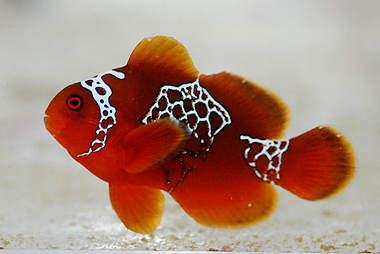
Lightning maroon clownfish from Blue Zoo Aquatics will be entrusted to an accomplished fishbreeder

By on Mar 30, 2010

The Lightning Maroon Clownfish from Papua New Guinea is the newest feather in the cap of the Seasmart Program and thanks to decisions being made at Blue Zoo Aquatics, the lightning maroon clownfish may eventually become a shining example of sustainability and ethics in the marine aquarium trade. In an unprecedented turn of events, Blue Zoo Aquatics has rebuffed the countless stratospheric offers for the lightning maroon clownfish, opting instead to select a buyer that is an accomplished fishbreeder in the United States who can give this fish the undivided attention it will need to establish a productive breeding program. One of the benefits of short-chain supply fish like this maroon clownfish from Seasmart is that it is straightforward to know the general collection area from which this fish was collected, and to pair it up with other maroon clownfish from the same area which may also be carrying some of the genetics which produce the extraordinary lightning bands of this clownfish. One of the other really cool facts about the lightning maroon clownfish is that the Seasmart participating fisherman who collected this fish was handsomely rewarded for his catch, a far cry from the average price of $0.02 per fish that an Indonesian fisherman can expect. The lightning maroon clownfish from PNG has already appeared on the Blue Zoo Aquatics Collector’s Choice for a modest $2500 with a SOLD sticker but regardless of the price, it is very heartening to know that BZA selected the future owner of the fish based on it’s potential to become the founding member an established strain of clownfish in the aquarium trade. There are so many more details about the Seasmart program which made it possible to have this fish available to the US, and so many more questions about the future of this fish. For now we can tell you that Ret Talbot, who was in PNG writing a story about the Seasmart program when this fish was captured, will be writing up a full article in the next BZA newsletter to be released tomorrow afternoon/evening. Huge thanks to Ret Talbot, Kris Wray, Mark martin and the Blue Zoo staff for keeping Reef Builders readers in the loop on the history and future of the lightning maroon clownfish. We look forward to BZA’s official announcement in tomorrow’s newsletter and be sure to follow the break for many more images of the lightning maroon clownfish.

Meme Purgatorio (who screened this batch of animals) and Iga Ware. Iga is a resident of Fishermans Island and a SEASMART-trained fisher. Photo by Ret Talbot

Left side of the Lightning Maroon Clownfish, Photo by Ret Talbot

Right side of the Lightning Maroon Clownfish, Photo by Ret Talbot

Posted in Reef News |
Search More:  
   
  • Jeremy Maneyapanda

    FWIW, I hope it is gentically inheritable, and I hope it does become reproduceable. But me hoping that doesnt make it fact. I still have fears about trying to procreate this though. Im afraid it will lead to steps such as the deformity craze in some freshwater species (balloon bodies, hunchbacks, etc). Hypothetically, if this fish is paired with a normal maroon, and DOES produce offspring with this pattern, those offspring will SURELY be bred to fish with close direct relatedness. And so on and so on. That principle worries me a bit.

  • Jeremy Maneyapanda

    FWIW, I hope it is gentically inheritable, and I hope it does become reproduceable. But me hoping that doesnt make it fact. I still have fears about trying to procreate this though. Im afraid it will lead to steps such as the deformity craze in some freshwater species (balloon bodies, hunchbacks, etc). Hypothetically, if this fish is paired with a normal maroon, and DOES produce offspring with this pattern, those offspring will SURELY be bred to fish with close direct relatedness. And so on and so on. That principle worries me a bit.

  • http://www.lightning-maroon-clownfish.com Matt Pedersen

    @ Jeremy, I am 100% in agreement with your stance, and now that the “cat is out of the bag” (see your recent Blue Zoo Newsletter) I’m the first to embrace cautious optimism.

    I personally have great distaste for the “guppified” fish, but then again, the first fish that got me into breeding were Green Sailfin Mollies AND Guppies ;) We already have seen a “deformity craze” of sorts in Clownfish with the advent of “stubbies”, thankfully they don’t seem to have taken hold.

    I am taking the “African Cichlid Breeder’s” approach to my marine fish breeding in general, and this fish fits more than comfortably in the notion of getting quality wild broodstock with a known collecting location and as much of a backstory as possible. Of course, the reasoning for that stems from knowing how you got from point A to point B…you can’t get that information if it’s lost in the process.

    I think inbreeding concerns are largely unfounded. In fish, it’s generally considered that you have to LINE BREED (sibling crossings in subsequent generations, i.e. F1 X F1, F2 X F2 etc.) to the F6 generation before you have true problems with inbreeding. It really shouldn’t take that amount of line breeding to establish the variation. I don’t think we’ll have any back-crossing opportunities anytime soon (i.e. breeding a F1 offspring back to the F0 Lightning), but who knows..that methodology has even more potential to quickly get the results we’d want.

    I’m plenty content to put F1 PNG Maroons with this fish as a parent out there and let any established or aspiring breeder have a go at it. Assuming all the F1 offspring will be normlaly colored, it will be a level playing field, be it ORA & Sustainable Aquatics or a teenage hobbyist in the middle of nowhere Michigan. Sure, some folks might not like this approach. “Tough Luck”…this is how we’re gonna do it! The reality is that since sib pairings will likely be the way to go, the mroe sib pairings we can get made, the more chances we have to win the proverbial lottery. Might really drag down the value of “Lightning Maroons” rather quickly if many people get lucky, that’s a risk of taking this approach. But, part of what told me this is potentially possible is the fact that in the few months following ORA’s release of Platinum Perculas, 3 other breeders have had Platinum offspring show up in their own breeding of Picasso Perculas decending from the ORA line.

    In the end, going back to “collecting location” and “inbreeding”, the fact remains that whether they show the lightning patterning or not, they will be PNG Maroons, and the BEST fish to OUTCROSS to, in order to prevent excessive inbreeding, will be MORE PNG Maroons. Sure, if things go crazily well, there will be people who won’t pair up these fish with PNG Maroons. I’m not a fan of that, but it will happen. Regardless, taking on this fish offered me a chance and a platform to have a dialog about concepts that seem very foreign to the marine aquarium industry, but are firmly engrained in the more ethical breeders on the FW side of the hobby. We don’t need to learn these lessons for ourselves, they’re already well learned on the FW side of things. So I’m glad I was given the opportunity to apply those methodologies and ethics to what could be the foundation of a new “strain” of PNG Maroons.

    OK, enough babbling, I could chat about this for eons, but I really need to get work done today!!!!

  • http://www.lightning-maroon-clownfish.com Matt Pedersen

    @ Jeremy, I am 100% in agreement with your stance, and now that the “cat is out of the bag” (see your recent Blue Zoo Newsletter) I’m the first to embrace cautious optimism.

    I personally have great distaste for the “guppified” fish, but then again, the first fish that got me into breeding were Green Sailfin Mollies AND Guppies ;) We already have seen a “deformity craze” of sorts in Clownfish with the advent of “stubbies”, thankfully they don’t seem to have taken hold.

    I am taking the “African Cichlid Breeder’s” approach to my marine fish breeding in general, and this fish fits more than comfortably in the notion of getting quality wild broodstock with a known collecting location and as much of a backstory as possible. Of course, the reasoning for that stems from knowing how you got from point A to point B…you can’t get that information if it’s lost in the process.

    I think inbreeding concerns are largely unfounded. In fish, it’s generally considered that you have to LINE BREED (sibling crossings in subsequent generations, i.e. F1 X F1, F2 X F2 etc.) to the F6 generation before you have true problems with inbreeding. It really shouldn’t take that amount of line breeding to establish the variation. I don’t think we’ll have any back-crossing opportunities anytime soon (i.e. breeding a F1 offspring back to the F0 Lightning), but who knows..that methodology has even more potential to quickly get the results we’d want.

    I’m plenty content to put F1 PNG Maroons with this fish as a parent out there and let any established or aspiring breeder have a go at it. Assuming all the F1 offspring will be normlaly colored, it will be a level playing field, be it ORA & Sustainable Aquatics or a teenage hobbyist in the middle of nowhere Michigan. Sure, some folks might not like this approach. “Tough Luck”…this is how we’re gonna do it! The reality is that since sib pairings will likely be the way to go, the mroe sib pairings we can get made, the more chances we have to win the proverbial lottery. Might really drag down the value of “Lightning Maroons” rather quickly if many people get lucky, that’s a risk of taking this approach. But, part of what told me this is potentially possible is the fact that in the few months following ORA’s release of Platinum Perculas, 3 other breeders have had Platinum offspring show up in their own breeding of Picasso Perculas decending from the ORA line.

    In the end, going back to “collecting location” and “inbreeding”, the fact remains that whether they show the lightning patterning or not, they will be PNG Maroons, and the BEST fish to OUTCROSS to, in order to prevent excessive inbreeding, will be MORE PNG Maroons. Sure, if things go crazily well, there will be people who won’t pair up these fish with PNG Maroons. I’m not a fan of that, but it will happen. Regardless, taking on this fish offered me a chance and a platform to have a dialog about concepts that seem very foreign to the marine aquarium industry, but are firmly engrained in the more ethical breeders on the FW side of the hobby. We don’t need to learn these lessons for ourselves, they’re already well learned on the FW side of things. So I’m glad I was given the opportunity to apply those methodologies and ethics to what could be the foundation of a new “strain” of PNG Maroons.

    OK, enough babbling, I could chat about this for eons, but I really need to get work done today!!!!

  • http://www.rettalbot.com/onassignment/PNG.html Ret Talbot

    Great discussion (for the most part). :-)

    I’m pleased the fish is in capable hands, and I know Matt is the first to agree that this is a very big gamble. However, as he told me during an interview (or maybe it was just a too-late-at-night IM), regardless of the variation, the fish he acquired are fantastic broodstock that will be of value to the hobby regardless of if the variation replicates down the road (although I of course in rooting for the F1s to lightning up!).

    Regarding this fish’s rarity, just a few comments from what I saw in PNG. There are others of these fish on the exact same reef, which, while not 100 certain, does suggest to me that genetics play a role. For the person concerned about removing a rare species from the wild, keep in mind that this is a variation, not a species. The species is plentiful and current collections are WAY below TAC. I know we all know that, but I just thought I’d address the above point for the person who stumbles on this page and wants to use the “taking the last one” argument against the hobby. ;-)

    Like I said, I’m thrilled Matt has the fish. Be sure to follow his blog. While he can’t promise success, I can promise that the ride will be worth taking.

    Thanks to Jake and all the folks at ReefBuilders for covering this important story. Cheers! -Ret

    P.S. Gresh, I am very interested in telling Meme’s story :-)

  • http://www.rettalbot.com/onassignment/PNG.html Ret Talbot

    Great discussion (for the most part). :-)

    I’m pleased the fish is in capable hands, and I know Matt is the first to agree that this is a very big gamble. However, as he told me during an interview (or maybe it was just a too-late-at-night IM), regardless of the variation, the fish he acquired are fantastic broodstock that will be of value to the hobby regardless of if the variation replicates down the road (although I of course in rooting for the F1s to lightning up!).

    Regarding this fish’s rarity, just a few comments from what I saw in PNG. There are others of these fish on the exact same reef, which, while not 100 certain, does suggest to me that genetics play a role. For the person concerned about removing a rare species from the wild, keep in mind that this is a variation, not a species. The species is plentiful and current collections are WAY below TAC. I know we all know that, but I just thought I’d address the above point for the person who stumbles on this page and wants to use the “taking the last one” argument against the hobby. ;-)

    Like I said, I’m thrilled Matt has the fish. Be sure to follow his blog. While he can’t promise success, I can promise that the ride will be worth taking.

    Thanks to Jake and all the folks at ReefBuilders for covering this important story. Cheers! -Ret

    P.S. Gresh, I am very interested in telling Meme’s story :-)

  • Jeremy Maneyapanda

    @ Matt, well, some facts here have put things in a whole new light. If your intentions are true, then my fears have become unfounded. They were my “fears”, not my assumptions of what was fact. If indeed you plan to follow a stable breeding program, then more power to you.

    However, in regards to your comment that inbreeding or line breeding concerns are unfounded, I must disagree. The details you mentioned are indeed accurate IMO, (that deleterious effects may not show until F6, or IMO even later generations), but that does not mean such problems are unfounded. Point in fact, we HAVE seen such deleterious problems in CB marines already by “certain” breederes, who have proliferates the desired traits by such breeding regimes. And, as I mentioned in my original “rant”, should such a “porduct plan” get put into play, would lightning maroons ever be put into a breeding program where such issue may come about, and be ignored? Well, that was my fear, that it would lead to that directions as iot has with stubbies, balloon bodies, etc etc etc. But, again, if this fish is in your control, and you have a stable preeding platform planned, and can insitutte it, good for you, and I applaud that.

    I am curious to know *HOW* prevalent this fish patterning is on maroons in PNG? Im ignorant to the facts, but I would assume it is VERY infrequent, as, now I am only aware of 3 of these fish. Are the periodically seen on the reefs there, and just RARELY collected? Or are they collected every time seen, and thus, a massive majority?

  • Jeremy Maneyapanda

    @ Matt, well, some facts here have put things in a whole new light. If your intentions are true, then my fears have become unfounded. They were my “fears”, not my assumptions of what was fact. If indeed you plan to follow a stable breeding program, then more power to you.

    However, in regards to your comment that inbreeding or line breeding concerns are unfounded, I must disagree. The details you mentioned are indeed accurate IMO, (that deleterious effects may not show until F6, or IMO even later generations), but that does not mean such problems are unfounded. Point in fact, we HAVE seen such deleterious problems in CB marines already by “certain” breederes, who have proliferates the desired traits by such breeding regimes. And, as I mentioned in my original “rant”, should such a “porduct plan” get put into play, would lightning maroons ever be put into a breeding program where such issue may come about, and be ignored? Well, that was my fear, that it would lead to that directions as iot has with stubbies, balloon bodies, etc etc etc. But, again, if this fish is in your control, and you have a stable preeding platform planned, and can insitutte it, good for you, and I applaud that.

    I am curious to know *HOW* prevalent this fish patterning is on maroons in PNG? Im ignorant to the facts, but I would assume it is VERY infrequent, as, now I am only aware of 3 of these fish. Are the periodically seen on the reefs there, and just RARELY collected? Or are they collected every time seen, and thus, a massive majority?

  • Jeremy Maneyapanda

    oops. Sorry, typo- 2 of these fish…

  • Jeremy Maneyapanda

    oops. Sorry, typo- 2 of these fish…

  • Matt S
  • Matt S
  • http://www.lightning-maroon-clownfish.com Matt Pedersen

    Just a followup for historical reference – the blog alluded to for the Lightning Maroon Clownfish can be found at – http://www.lightning-maroon-clownfish.com

    @ Jeremy, I never noticed your last comments, but truly, a breeder can only be responsible for his own actions and can only act as a role model and a mentor to future breeders. My work to establish this variant in captivity could yes, one day, lead to Balloon Belly Stubby Lightning Gold Stripe Maroons. I can guarantee such a fish will not be coming out of my breeding programs, and I can only discourage everyone else from trying to go that route!

  • http://www.lightning-maroon-clownfish.com Matt Pedersen

    Just a followup for historical reference – the blog alluded to for the Lightning Maroon Clownfish can be found at – http://www.lightning-maroon-clownfish.com

    @ Jeremy, I never noticed your last comments, but truly, a breeder can only be responsible for his own actions and can only act as a role model and a mentor to future breeders. My work to establish this variant in captivity could yes, one day, lead to Balloon Belly Stubby Lightning Gold Stripe Maroons. I can guarantee such a fish will not be coming out of my breeding programs, and I can only discourage everyone else from trying to go that route!