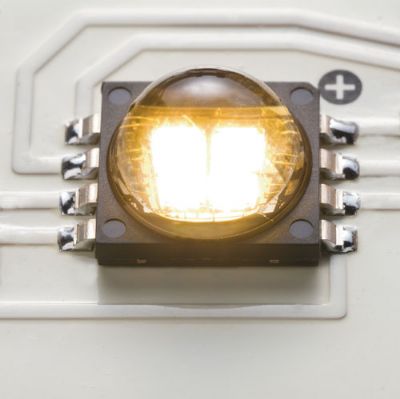
Cree breaks 200 lumens per watt LED efficiency barrier

By on Feb 05, 2010

The 200 lumen per watt efficacy barrier has just been breached by a fresh round of testing on Cree’s latest generation LEDs. Seems like just this past summer we reported the new advancements of Cree’s XP-G LED reaching a record 132 lumens per watt at the nominal drive current of 350mA and that record was also broken in December with gains of up to 186 lumens per watt under the same conditions.  Cree announced via a press release that a  “industry-best reported efficacy record of 208 lumens per watt for a white power LED.” Hitting 200 lumens per watt with these CREE LEDs was achieved with a color temperature of 4579k. While this high barrier has been broken, we won’t see these fall into production LED fixtures anytime soon. We’ve got the full press release after the break.

Thanks Mike!

DURHAM, N.C., February 3, 2010 — Cree, Inc. (Nasdaq: CREE), a market leader in LED lighting, announces another industry-best reported efficacy record of 208 lumens per watt for a white power LED. This R&D result passes a significant milestone within the solid-state lighting industry as well as demonstrates Cree’s relentless drive to increase the performance of its LEDs.

Cree’s tests confirmed that the LED produced 208 lumens of light output and achieved 208 lumens per watt efficacy at a correlated color temperature of 4579 K. The tests were conducted under standard LED test conditions at a drive current of 350 mA at room temperature.

“We have now broken the elusive 200-lumen-per-watt efficacy barrier for a single white power LED,” said John Edmond, Cree co-founder and director of advanced optoelectronics. “This is a result of improvements in blue optical output power, lower operating voltage and higher conversion efficiency. We continue to push the envelope in white LED technology to enable the highest efficiency white lighting products in the marketplace.”

While this level of performance is not yet available in Cree’s production LEDs, Cree continues to lead the industry with the broadest family of high-performance LEDs.

About Cree
Cree is leading the LED lighting revolution and setting the stage to obsolete the incandescent light bulb through the use of energy-efficient, environmentally friendly LED lighting. Cree is a market-leading innovator of lighting-class LEDs, LED lighting solutions, and semiconductor solutions for backlighting, wireless and power applications.

Cree’s product families include recessed LED down lights, blue and green LED chips, high-brightness LEDs, lighting-class power LEDs, power-switching devices and radio-frequency/wireless devices. Cree solutions are driving improvements in applications such as general illumination, electronic signs and signals, variable-speed motors, and wireless communications.

For additional product and company information, please refer to www.cree.com.

This press release contains forward-looking statements involving risks and uncertainties, both known and unknown, that may cause actual results to differ materially from those indicated. Actual results may differ materially due to a number of factors, including the risk we may be unable to develop and release commercial products with performance ratings comparable to the development results described above; the rapid development of new technology and competing products that may impair demand or render Cree’s products obsolete; and other factors discussed in Cree’s filings with the Securities and Exchange Commission, including its report on Form 10-K for the year ended June 28, 2009, and subsequent filings.

via [CREE]

announces another industry-best reported efficacy record of 208 lumens per watt for a white power LED.
Posted in Reef News |
Search More:  
   
  • Alfred

    Done deal. When these are able to be binned in high enough numbers I will transition to an LED fixture. I give it the normal 18-months before they can be mass produced and we see nice fixtures available.

    Great find, as always Reefbuilders!

  • Alfred

    Done deal. When these are able to be binned in high enough numbers I will transition to an LED fixture. I give it the normal 18-months before they can be mass produced and we see nice fixtures available.

    Great find, as always Reefbuilders!

  • Alfred

    Done deal. When these are able to be binned in high enough numbers I will transition to an LED fixture. I give it the normal 18-months before they can be mass produced and we see nice fixtures available.

    Great find, as always Reefbuilders!

  • nick

    these won’t be reasonably priced for at least 5 years they havent even raised the kelvin enough

    one thing i don’t understand is the sun is about 100 lumens/per watt

    why would you want these over your tank?

    I think that Luxim light with supplemental actinics will be the way to go

  • nick

    these won’t be reasonably priced for at least 5 years they havent even raised the kelvin enough

    one thing i don’t understand is the sun is about 100 lumens/per watt

    why would you want these over your tank?

    I think that Luxim light with supplemental actinics will be the way to go

  • nick

    these won’t be reasonably priced for at least 5 years they havent even raised the kelvin enough

    one thing i don’t understand is the sun is about 100 lumens/per watt

    why would you want these over your tank?

    I think that Luxim light with supplemental actinics will be the way to go

  • Alfred

    @nick

    That’s pretty funny. How is the sun 100 lumens/watt? Where in the world did you get that number?

    I think the LiFi lamp will make strides if they can mix some of the halide salts to get a higher CCT closer to 10000K.

    I looked at Cree’s website and they already have mass produced bins (S2) that have 148 – 156 lumens/watt!!!

    Amazing.

  • Alfred

    @nick

    That’s pretty funny. How is the sun 100 lumens/watt? Where in the world did you get that number?

    I think the LiFi lamp will make strides if they can mix some of the halide salts to get a higher CCT closer to 10000K.

    I looked at Cree’s website and they already have mass produced bins (S2) that have 148 – 156 lumens/watt!!!

    Amazing.

  • Alfred

    @nick

    That’s pretty funny. How is the sun 100 lumens/watt? Where in the world did you get that number?

    I think the LiFi lamp will make strides if they can mix some of the halide salts to get a higher CCT closer to 10000K.

    I looked at Cree’s website and they already have mass produced bins (S2) that have 148 – 156 lumens/watt!!!

    Amazing.

  • Ken

    Moores law has come into lighting, amazing. The pace of development is simply amazing.

  • Ken

    Moores law has come into lighting, amazing. The pace of development is simply amazing.

  • Mike

    Actually IIRC the Sun is approximately 100 lumens/watt, now the question asked is why do we want more than the Sun? Well the Sun puts out about 1000 watts over 1 square meter of area at the surface, and some of us might not want to put 1000 watts of LEDs over that same area if we can get away with using less energy to do so.

  • Mike

    Actually IIRC the Sun is approximately 100 lumens/watt, now the question asked is why do we want more than the Sun? Well the Sun puts out about 1000 watts over 1 square meter of area at the surface, and some of us might not want to put 1000 watts of LEDs over that same area if we can get away with using less energy to do so.

  • Mike

    Actually IIRC the Sun is approximately 100 lumens/watt, now the question asked is why do we want more than the Sun? Well the Sun puts out about 1000 watts over 1 square meter of area at the surface, and some of us might not want to put 1000 watts of LEDs over that same area if we can get away with using less energy to do so.

  • Ben

    Also, another reason we want lighting output above that of the Sun is because it in itself is a limiting factor for hard corals. They grow well enough in nature under it, but there’s nothing stopping them from using MORE light to convert to MORE growth.

  • Ben

    Also, another reason we want lighting output above that of the Sun is because it in itself is a limiting factor for hard corals. They grow well enough in nature under it, but there’s nothing stopping them from using MORE light to convert to MORE growth.

  • tahir

    They seem to be in MCE format and even with high Kelvin achievement won’t be as useful as single DIE LEDs such as XP-G. This LED would give you very visible spot light effect when used with optics and cause some serious coral bleaching with too much light being at one given tight space.
    XP-G are sufficient enough when it comes to lumen to lumen comparison with MH bulbs and I think it would be silly to wait go for these newly improved MCE format LEDs.

    Tahir
    Manchester (UK)

  • tahir

    They seem to be in MCE format and even with high Kelvin achievement won’t be as useful as single DIE LEDs such as XP-G. This LED would give you very visible spot light effect when used with optics and cause some serious coral bleaching with too much light being at one given tight space.
    XP-G are sufficient enough when it comes to lumen to lumen comparison with MH bulbs and I think it would be silly to wait go for these newly improved MCE format LEDs.

    Tahir
    Manchester (UK)

  • anthonyn

    There is a LIMIT to how much light corals need.
    The zooxanthellae get saturated.
    All the Green House propagators have to use shade cloth to reduce PAR, not just heat.

  • anthonyn

    There is a LIMIT to how much light corals need.
    The zooxanthellae get saturated.
    All the Green House propagators have to use shade cloth to reduce PAR, not just heat.

  • nick

    @Ben. I don’t know how true that is about more lighting equals more growth although i’m sure they can grow faster under a little brighter lighting. However wouldn’t this overdrive the zooxanthellae and possible cause a coral aneurysm from oxygen production?

  • nick

    @Ben. I don’t know how true that is about more lighting equals more growth although i’m sure they can grow faster under a little brighter lighting. However wouldn’t this overdrive the zooxanthellae and possible cause a coral aneurysm from oxygen production?

  • nick

    However i just realized that you can use a much larger lens to stretch out this light even more and use even less electricity to fully cover an aquarium

  • nick

    However i just realized that you can use a much larger lens to stretch out this light even more and use even less electricity to fully cover an aquarium

  • http://coralidea.com Jake Adams

    You can give as coral all the light in the universe but water flow is the limiting factor of photosynthesis. Without more flow a coral cannot use any more light.

  • http://coralidea.com Jake Adams

    You can give as coral all the light in the universe but water flow is the limiting factor of photosynthesis. Without more flow a coral cannot use any more light.

  • Mike

    @Nick (and others): Lumens per watt is a measure of efficiency, not actual light power. 200 lumens per watt doesn’t mean anything without knowing how many watts are involved, and really is silly to compare to the Sun.

    Standard LEDs do spread it out fairly wide considering their directionality, you’re not going to put corals 1 cm from these guys, they’ll be quite a few inches away.

    Besides 1 of these, or 2 of the XPGs that are out now… almost the same light output.

  • Mike

    @Nick (and others): Lumens per watt is a measure of efficiency, not actual light power. 200 lumens per watt doesn’t mean anything without knowing how many watts are involved, and really is silly to compare to the Sun.

    Standard LEDs do spread it out fairly wide considering their directionality, you’re not going to put corals 1 cm from these guys, they’ll be quite a few inches away.

    Besides 1 of these, or 2 of the XPGs that are out now… almost the same light output.

  • Alfred

    @Jake,

    I loved that article you wrote on flow. I know this is an aside, but do you know a relatively inexpensive flow meter? I don’t want to measure a floating piece of food and I saw one flow meter but it was >$500.

  • Alfred

    @Jake,

    I loved that article you wrote on flow. I know this is an aside, but do you know a relatively inexpensive flow meter? I don’t want to measure a floating piece of food and I saw one flow meter but it was >$500.

  • Rental

    At midday over your average reef the sun produces 2000 lumens at the water surface. Once you get a few inches away from an MC-E (running at max current) it will quickly drop way below this.

    MC-Es are very thermally efficient, so what you may lose in lumens you may gain in ease of cooling. I use both MC-E and XP-G and they have trade-offs.

    I’ve always pushed for spotlights to be the way forward for LED fixtures. Great stuff.

  • Rental

    At midday over your average reef the sun produces 2000 lumens at the water surface. Once you get a few inches away from an MC-E (running at max current) it will quickly drop way below this.

    MC-Es are very thermally efficient, so what you may lose in lumens you may gain in ease of cooling. I use both MC-E and XP-G and they have trade-offs.

    I’ve always pushed for spotlights to be the way forward for LED fixtures. Great stuff.

  • Rental

    At midday over your average reef the sun produces 2000 lumens at the water surface. Once you get a few inches away from an MC-E (running at max current) it will quickly drop way below this.

    MC-Es are very thermally efficient, so what you may lose in lumens you may gain in ease of cooling. I use both MC-E and XP-G and they have trade-offs.

    I’ve always pushed for spotlights to be the way forward for LED fixtures. Great stuff.

  • Pingback: Cree introduces new record-breaking XM LED hitting 160 lumens per watt

  • http://pulse.yahoo.com/_NU6KEUSJ7IID3LCDT25IZG2BGQ Better Daze

    the sun is about 100 lumens/watt? what the hell are you talking about?