

Hands-On, In-Depth, with Reed Mariculture’s RotiGrow System

By on Nov 02, 2010

Pseudochromis flavivertext, Sunrise Dottybacks, 35 days post hatch

Sunrise Dottybacks Pseudochromis flavivertext, 35 days old, raised exclusively on the RotiGrow System for Rotifers and Greenwater

Last month ReefBuilders featured the new RotiGrow System from Reed Mariculture.  As promised, this next installment looks at the hands-on results with the most modern marine algae paste system available to marine fish breeders.  This system was actually designed for large scale foodfish operations.  We tried to solicit independent feedback from large-scale producers, but were surprised to learn that no one wants to talk about it.  Why?  Well, Reed Mariculture believes that no one wants their competition to know what they’re using!

Initial Successes

After months of using these products, I can safely say I have never been so impressed.  While I haven’t run these product through rigorous scientific methodology,  my personal experiences suggest that we are only beginning to see the benefits of these new feeds.

In short, I have seen much higher larval survival in clownfish batches than I ever obtained utilizing live algae.  On average, it seems clownfish survival has doubled or better.  Using my old techniques, I seldom would rear more than 50 or 75 Onyx Perculas from a single clutch.  When moving the two clutches I currently have going, I counted 187 in one, and 171 in another.   I even reared 150-plus Black Ocellaris from a single clutch, phenomenal results considering some breeders can’t even get that many eggs out of a pair.  One of my local reefing friends, Jay Hansen, is rearing his very first batch of Gold Stripe Maroon Clownfish (Premnas biaculeatus ‘Sumatra’) using only my very generic instructions and the RotiGrow System.  He now has hundreds through metamorphosis on his very first try (historically the average hobbyist first success with this species may be only single or low double-digit survival rates).

I also had a glimmer of hope with preliminary work trying to rear the Green Chromis with only rotifers and these products…made it 48 hours longer than previously documented attempts.  Consider that light collected wild Green Chromis (Chromis viridis) larvae need only be the size of a five-day-old Dottyback (approximately 5 mm in length) in order to be “tank raised”, and the reality is we might be making a step in the right direction with this very difficult species.

Perhaps the most stunning successes I’ve seen is improvements in Dottyback production.  I am not alone in this regard – Addy-Zone Hatcheries are seeing dramatic improvements in their culture of Pseudochromis fridmani, the Orchid Dottyback.  The only change was the switch to the new RotiGrow System.  Personally, I’ve been able to acheive unthinkable success  on my very first attempt to rear Pseudochromis flavivertex, the Red Sea Sunrise Dottyback.  Early larval survival is phenomenal.  Using RotiGrow Plus for rotifer culture and occasional enrichment, and RotiGreen for Greenwater Technique, I’ve achieved results that have been suggested to be easily five times better than some commercial hatcheries have ever been able to produce.  That statement is based on private conversations, but the numbers are quite real.  Even if you disregard what commercial hatcheries do, most hobbyist breeders have never thought these types of numbers could be achieved.

2.5 day old Sunrise Dottybacks in Greenwater Culture with RotiGreen Omega

2.5 day old Sunrise Dottybacks in Greenwater Culture with RotiGreen Omega

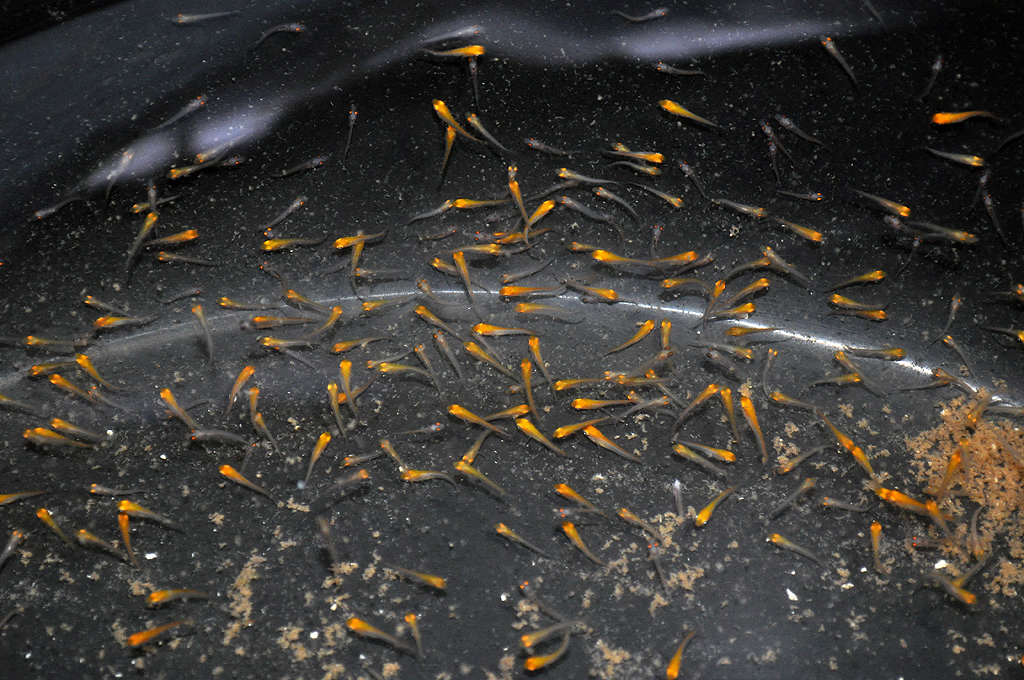
At 12 days post hatch, I documented an official count of 999 babies in the run (With many more out of the photograph’s view, and thus, easily 1000+), in a 16 gallon black round tub.

999 (the official count) of 12 day old Sunrise Dottybacks

999 (the official count) 12 day old Sunrise Dottybacks

By day 30, settlement was well underway.  I split off some from a batch and counted 170.  A  photographic count on what remainds was 497…and that doesn’t count what I couldn’t see.  The official count is 667 dottybacks, but the actual number must be higher.  Of course, nothing says “tons of dottybacks” better than video!  Production was so insanely high from a single run that I probably will not have a need to cultivate this species again!

YouTube Preview Image

Why It’s a Value

Those who’ve known me for a long time know I used to be a proponent of live algae.   If you’ve looked at algae pastes before, they may seem like a substantial investment (a.k.a. “expensive”).  In fact, the cost is what kept me away from algae pastes for so long…I thought I was doing it better and cheaper with live algae.  Well, it turns out that when I really did the math, the materials it cost me to set up a phytoplankton culture station was easily the same as a couple liters of frozen algae pastes.  But that’s before I added in the ongoing costs of light, bulbs, saltwater, bleach and dechlor to sterilize, 2L bottles, and ongoing replacement of tubing to keep things clean.  Then, add on the hour I spent every week harvesting and splitting cultures, the gallons of live phytoplankton I had to store in my refrigerator, and the monthly hours I spent filling 2L bottles with saltwater I mixed and bleached to keep it sterilized until I used it.

Now, I grab a couple cubes of frozen paste, thaw them in a jar in my refrigerator, and use a pipette to add drops into the cultures and baby fish as needed.  Does live phytoplankton sound easier?  Or look at it this way — over the next two years my phytoplankton needs will set me back about $1.50 a week, or $6 a month.  Would you spend $6.00 a month to get back 4-8 hours of your free time to do other things? Bottom line, I will never culture live algae again unless it is absolutely proven that I can’t get the results I need from the RotiGrow system from Reed.

Most hobbyist marine fish breeders are looking at purchasing 2 algae products and being fully ready to go.  1L of RotiGrow Plus, and 1L of RotiGreen Omega, combined will set you back $140 + shipping.   Toss in ChlorAm-X® (for ammonia control with rotifers and fish larvae, essential stuff) @ $40 and 1 million Rotifers for $20 if you don’t already have rotifers!  For $200 (or about $0.30 per day) Reed Mariculture / Reef Nutrition can get you started with the latest improvements in larval feeds, and you’ll wind up with a two-year supply of high-quality nutritionally balanced rotifer cultures and exceptional greenwater phytoplankton that’s more than adequate for most all hobby-level breeders!  That’s right, a two-year supply high quality live rotifers and greenwater for roughly the cost of one or two really nice corals.

Additional Information

Interestingly, this article truly only scratches the surface of the story.  Reed Mariculture has put out a tremendous amount of documentation and data on this.  There is a substantial Rotifer Compendium that goes into great detail about the latest rotifer revelations, mirroring a lot of what Randy Reed presented at MACNA 2010.   It may all seem to be a bit much until you realize that unlike other producers of similar products, Reed Mariculture’s main business is not the aquarium hobby, but the aquaculture and mariculture industry, most often foodfish.  The simple truth is that we, as hobbyists, are benefiting from the R&D being invested to improve the hatchery rearing of species like Cod and Barramundi!  When it comes to rearing baby fish, from a science standpoint, it truly surpasses the skills required for most coral cultivation!

My Tips for Hobbyist Breeders

For a hobbyist end-user, here’s my quick suggestions based on how I’m working with the RotiGrow System.  When you get a 1L package of frozen paste, let it thaw ever so slightly so it’s not a solid brick.  Take it out of the bag, put it on a cutting board, and with a very sharp knife, cut it into cubes small enough to fit into a jar you’ll use to store thawed feeds.  This is a messy process, but a one time ordeal!

Put the cubes into a zip lock bag and store them in your freezer, being very careful to mark which is which (I included the packaging label). It is highly important that you don’t confuse RotiGreen (optimized for Greenwater fish culture) and RotiGrow Plus (optimized for rotifer enrichment culture).

RotiGrow Plus is too rich in lipids for larval fish, and when (mis)used with fish, at higher concentrations can cause severe adverse reactions. It is also important to thaw RotiGreen slowly, overnight in the refrigerator.  Reed Mariculture conveyed that thawing too rapidly can cause micro-clumps to form, which can cause problems for some larvae (probably affecting the gills).  So, keep a couple of cubes thawed in your refrigerator (again, keep RotiGrow Plus and RotiGreen separate and well marked) and when things get low, thaw out another cube or two.

For daily rotifer culturing, I’m using approximately 10 to 20 drops of thawed RotiGrow Plus into a five gallon rotifer culture every morning depending on how clear the culture is.  I keep a few rotifer cultures going so I have backups if I crash one (this has been a rare occurrence with this system).  I also add in 20 drops of liquid ClorAm-X (prepared by taking 16 tsp. of CloramX powder and mixing with 1L of distilled water) for ammonia control.  In short, I feed RotiGrow Plus and dose my ClorAm-X solution at a 1:1 ratio.  Of course, regular rotifer harvest is necessary, but I keep it at low levels of maybe 50% per week unless I’m ramping up for a new batch of fish or the culture seems to be waning (this harvest level is far lower than what Reed recommends).  You’ll find your own protocol that works best for your needs.  Reed Mariculture also provides far more in-depth instruction on rotifer culture at Rotifer.com

For greenwater technique, there is certainly no exact science or dosage I can recommend.  My base dose seems to be 5 to 10 drops per gallon once or twice per day.  Dosing will vary depending on your needs.  It helps to first swirl your drops of RotiGreen into water before adding them to the larval rearing tank — if you don’t do this, the liquid paste is so  thick that it simply falls to the bottom, unsuspended.

In Conclusion

To recap my personal experience with the RotiGrow System,  I haven’t cultivated phytoplankton in over a year and I certainly do not miss it.  It would seem, based on the hundreds of Clownfish I’ve already reared and sold, as well as the hundreds of Clownfish and Dottyback babies in the basement, that for the time being, I no longer have any need to culture phytoplankton.  With the time demands of a new baby in our family, I can tell you I might very well not be breeding fish were it not for the RotiGrow system taking away the often times burdensome task of culturing phytoplankton.

Word on the street suggests we may be seeing another new line in the future specifically targeted at the hobbyist-scale marine breeder.   As I don’t have the “dirt” on these future release yet, I wouldn’t let those rumors stop you from jumping in on this new system now, as this is already a huge leap forward for a fish breeder.  It takes a lot for me to personally endorse anything, but on this rare occasion, I cannot say enough about the benefits I’m seeing using these products— I strongly recommend them to anyone contemplating marine fish breeding.


Posted in Food |
Search More:  
   
  • Craig Johnston

    Awesome report!

    I look forward to using it soon.

    Thanks again for sharing.

    Craig

  • Craig Johnston

    Awesome report!

    I look forward to using it soon.

    Thanks again for sharing.

    Craig

  • http://fishtalpropagations.com Tal Sweet

    I love this stuff too! Can’t say enough good things about it.

  • http://fishtalpropagations.com Tal Sweet

    I love this stuff too! Can’t say enough good things about it.

  • iggy

    I am confused why product would be better than live food for higher yield.

  • iggy

    I am confused why product would be better than live food for higher yield.

  • Matt Pedersen

    Iggy, actually I believe I can follow up on that. The issue with live phyto is that much like the nutrition of other live food organisms, it changes over time. It turns out that Phyto quickly degrades in nutrition once it is “past its prime”. Algae that is cultured and then stored, is like flash freezing something at the peak of freshness…your retain the peak nutrition. Additionally, the use of live photoplankton in a closed sytem for rearing larvae can have both positive and negative effects on the environmental chemistry around the baby fish. pH swings are one of the most commonly sited concerns, but there are others.

    It doesn’t stop there. If you go back per the first installment, you’ll note that these products are enriched beyond the HUFA levels found even in the live algae counterparts. This changes the nutritional profile of the food organisms that the fish feed on (i.e. rotifers) and raises them to be closer to the levels of natural feeds (i.e. copepod nauplii). You must remember that rotifers are not in fact the natural larval prey for most of the marine fish we’re trying to rear, and normally they lack the appropriate HUFA levels. So, by design, the Rotigrow System raises and balances these HUFA levels beyond what can be acheived by using live algaes, as well as what you could acheive prior utilizing the old frozen algae pastes that Reed manufactures (which cannot raise HUFA levels like these new products can). This all directly results in a more appropriately nutritious food, and that ultimately improves larval survival throughout the process.

  • Matt Pedersen

    Iggy, actually I believe I can follow up on that. The issue with live phyto is that much like the nutrition of other live food organisms, it changes over time. It turns out that Phyto quickly degrades in nutrition once it is “past its prime”. Algae that is cultured and then stored, is like flash freezing something at the peak of freshness…your retain the peak nutrition. Additionally, the use of live photoplankton in a closed sytem for rearing larvae can have both positive and negative effects on the environmental chemistry around the baby fish. pH swings are one of the most commonly sited concerns, but there are others.

    It doesn’t stop there. If you go back per the first installment, you’ll note that these products are enriched beyond the HUFA levels found even in the live algae counterparts. This changes the nutritional profile of the food organisms that the fish feed on (i.e. rotifers) and raises them to be closer to the levels of natural feeds (i.e. copepod nauplii). You must remember that rotifers are not in fact the natural larval prey for most of the marine fish we’re trying to rear, and normally they lack the appropriate HUFA levels. So, by design, the Rotigrow System raises and balances these HUFA levels beyond what can be acheived by using live algaes, as well as what you could acheive prior utilizing the old frozen algae pastes that Reed manufactures (which cannot raise HUFA levels like these new products can). This all directly results in a more appropriately nutritious food, and that ultimately improves larval survival throughout the process.

  • Brandon

    Why don’t we see any ” science” backing up randys findings? You’d think someone, say independent from reed mariculture, would be able to publish similar finds in an actual reviewed journal. Maybe I’m just skeptic but it seems that Randy is pushing his product on hobbyist

  • Brandon

    Why don’t we see any ” science” backing up randys findings? You’d think someone, say independent from reed mariculture, would be able to publish similar finds in an actual reviewed journal. Maybe I’m just skeptic but it seems that Randy is pushing his product on hobbyist

  • Gresham

    There are papers in the works Brandon. When they will be released I do not know.

    Success doesn’t lie…

  • Gresham

    There are papers in the works Brandon. When they will be released I do not know.

    Success doesn’t lie…

  • CJ

    Last I knew Brandon, Matt P doesnt work for Reef Nutrition.

  • CJ

    Last I knew Brandon, Matt P doesnt work for Reef Nutrition.

  • Matt Pedersen

    Brandon, +1 to CJ. I don’t work for Randy, I’m a Sr. Interactive Developer @ a Marketing Firm in Chicago (I telecommute). Randy Reed / Reed Mariculture NEVER asked me to write ANYTHING about their products either. NO ONE pushed it upon me either. I sought out Randy’s OLDER line of algae pastes almost a year ago, and that’s what first brought me into contact with the new line.

    Next up, I want to state that this review is a hands-on review of the new RotiGrow line. The “results” here are not the work of Randy Reed or Reed Mariculture, but my own independent trials with my own fish in my own personal breeding operation.

    Hobbyists Breeders have used Reed’s algae pastes for as long as I’ve been breeding marine fish, and longer still. As far as I know, no other manufacturer out there offers concentrated frozen algae pastes to hobbyists, so as a marine breeder, the options are indeed quite limited to start with. Since marine breeding is such a SMALL endeavor at this point, we’re talking about truly niche products.

    For me, I don’t need “science” in the face of my personal results – the results speak for themselves. This stuff WORKS, and I’ve been able to confirm the improvement via other hobbyist breeders too. So as I stated at the end, I virtually never “Endorse” anything to begin with, any ANY manufacturer or vendor I’ve ever talked with knows my opinion and words are not for sale at any price. I stand fully behind the results I reported here and my statements therein. If you are planning on breeding marine fish, this is something I strongly suggest you consider to meet your phytoplankton needs.

  • Matt Pedersen

    Brandon, +1 to CJ. I don’t work for Randy, I’m a Sr. Interactive Developer @ a Marketing Firm in Chicago (I telecommute). Randy Reed / Reed Mariculture NEVER asked me to write ANYTHING about their products either. NO ONE pushed it upon me either. I sought out Randy’s OLDER line of algae pastes almost a year ago, and that’s what first brought me into contact with the new line.

    Next up, I want to state that this review is a hands-on review of the new RotiGrow line. The “results” here are not the work of Randy Reed or Reed Mariculture, but my own independent trials with my own fish in my own personal breeding operation.

    Hobbyists Breeders have used Reed’s algae pastes for as long as I’ve been breeding marine fish, and longer still. As far as I know, no other manufacturer out there offers concentrated frozen algae pastes to hobbyists, so as a marine breeder, the options are indeed quite limited to start with. Since marine breeding is such a SMALL endeavor at this point, we’re talking about truly niche products.

    For me, I don’t need “science” in the face of my personal results – the results speak for themselves. This stuff WORKS, and I’ve been able to confirm the improvement via other hobbyist breeders too. So as I stated at the end, I virtually never “Endorse” anything to begin with, any ANY manufacturer or vendor I’ve ever talked with knows my opinion and words are not for sale at any price. I stand fully behind the results I reported here and my statements therein. If you are planning on breeding marine fish, this is something I strongly suggest you consider to meet your phytoplankton needs.

  • John B

    If this product was sold in smaller portions that would be great! I know a few, myself included, hobbyists who are interested in just raising a few fry from their clown fish pairs. Not for commercial purposes, just few the sheer enjoyment of raising them and find the prices of cultures to be a big bump in the road or the reason why they don’t follow through with raising their fry.

  • John B

    If this product was sold in smaller portions that would be great! I know a few, myself included, hobbyists who are interested in just raising a few fry from their clown fish pairs. Not for commercial purposes, just few the sheer enjoyment of raising them and find the prices of cultures to be a big bump in the road or the reason why they don’t follow through with raising their fry.

  • Matt Pedersen

    John, perhaps it’s time to arrange a group buy with some of your club members? I did just that when we brought in CloramX – we split the $40 tub 3 ways.

    Still, realistically, Rotifer cultures always need food…doesn’t stop when you are between fish batches. You can always feed the rotifers to your reef too…Randy’s MACNA talk was all about that. I wonder if you could even use the RotiGreen as a phyto feed to a reef…while not designed for that purpose, *maybe* it would show you some positive benefits?

  • Matt Pedersen

    John, perhaps it’s time to arrange a group buy with some of your club members? I did just that when we brought in CloramX – we split the $40 tub 3 ways.

    Still, realistically, Rotifer cultures always need food…doesn’t stop when you are between fish batches. You can always feed the rotifers to your reef too…Randy’s MACNA talk was all about that. I wonder if you could even use the RotiGreen as a phyto feed to a reef…while not designed for that purpose, *maybe* it would show you some positive benefits?

  • Brandon

    Don’t get me wrong. This product system is on the top of my list to try out:-) but I really really love my phytoplankton cultures!

  • Brandon

    Don’t get me wrong. This product system is on the top of my list to try out:-) but I really really love my phytoplankton cultures!

  • Sandy

    Where can you purchase this”paste” from? I went to the site and cannot find it :(

  • Sandy

    Where can you purchase this”paste” from? I went to the site and cannot find it :(

  • http://www.lightning-maroon-clownfish.com Matt Pedersen
  • http://www.lightning-maroon-clownfish.com Matt Pedersen