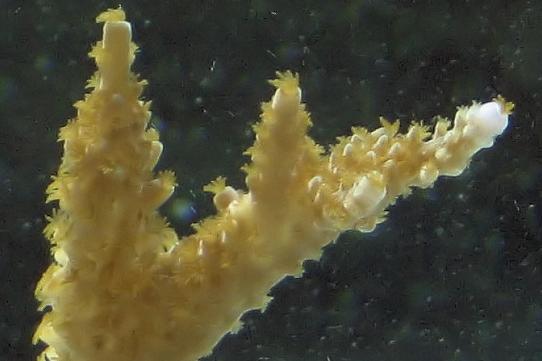

Acropora corals are a mysterious creature with complex needs and one of those that we thought we’d nailed long ago was their “need” for minimal phosphate concentration in the water. A new study by Dunn et. al. which will be published in January 2012 in the Journal of Experimental Marine Biology and Ecology showed that Acropora muricata (A. formosa) grew significantly faster at phosphate concentration of 0.5 mg/l (ppm) than at 0.2 or 0.09 mg/l.
The study begins by noting in the abstract that high phosphate levels do all kinds of things to corals including affecting their growth and skeleton density, zoox. concentrations and fecundity – in personal communication with Jeremy Dunn we learned that it was the expectations of the research that growth rate would be diminished in the high phosphate group.

After keeping genetically distinct samples of Acropora muriata in the three treatments for four months the corals were analyzed for length, weight, density and even coloration of the growth margins. The Acropora grew in all four treatments: slowest at the lowest level of phosphate and they grew fastest at the high phosphate concentration of 0.5mg/l. The study notes that although phosphate increased overall growth, it led to lower skeletal density – this is perhaps not that much of an issue in aquariums but in the wild it would lead to more brittle branches that would be more susceptible to breaking in strong flow.
All the corals appeared healthy as evidenced by the regular extension of the polyps, no recession and no mortalities. It is believed that these Acropora grew faster with increasing phosphate level due to a higher concentration of zooxanthellae, which was also noticeable in the coloration of the corals in the separate treatment groups. Although all the corals started off the experiment with strong presence of white growth margins at the axial tips and the base, in the high phosphate group the growth margins were mostly brown whereas the low phosphate group still had noticeable white margins.

This study of Acropora corals in aquarium and published in a peer-reviewed journal is important not only for its results but also for the coral science field doing research using aquariums which hits very close to home for the everyday reef aquarium hobbyist. As with all things in life, the topic of phosphate and coral growth is not black and white and perhaps future studies of this kind may be able to tease out more details about growing corals in captivity. Big thanks to Dr. Sammarco and Jeremy Dunn for providing their time and materials about this significant coral aquarium research.