

Steamed Palythoas send well-informed aquarist to the emergency room, nearly to the grave

By on Mar 04, 2012

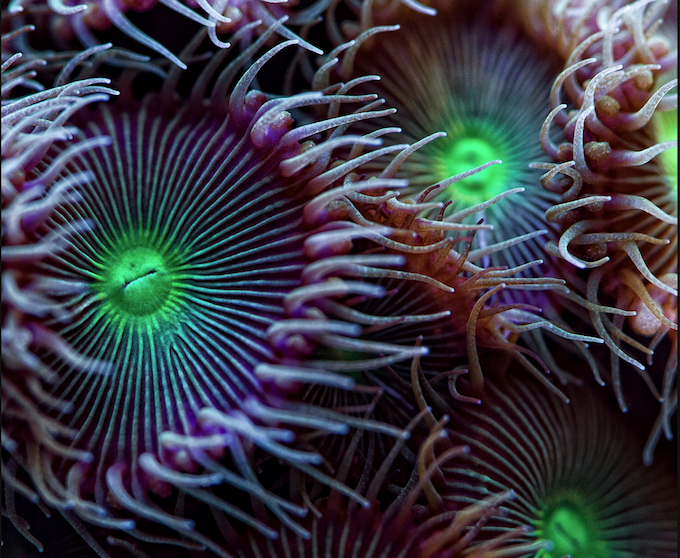
Palytoxin from Palythoa almost killed a man. Photo by Johnny Vincent C.

Palythoa toxin from Palythoa and Zoanthus polyps is widely known to be one of the most poisonous substances in the natural world, gram for gram. Armed with this knowledge a well-informed aquarist suited up for Palythoa removal duty from one of his aquarium rocks with gloves to protect his hands, safety glasses to protect his eyes but he made one crucial mistake that almost cost him his life. 

In a near fatal mis-judgement, this aquarist went to scraping and brushing the Palythoa in a utility sink using hot water, thereby steaming the Palytoxin from the undesirable zoanthids and vaporizing the noxious chemical straight into his unprotected lungs. Half an hour of  breathing in aerosolized palytoxin and home-reefer wasn’t feeling so hot, an hour later he was headed to the emergency room where he began coughing blood and was nearly paralyzed.

Despite having the foresight to print out information about zoanthid and palytoxin to take with him to the hospital, the doctors there were nearly helpless to rescue him. We’re not sure what worked but in the end the would-be Palythoa remover nearly lost his life by protecting only 2/3 of himself from the dangers of palytoxin, although we do know not if he has yet been released from the hospital.

The moral of the story is to not inhale the palytoxin steam that is created when you steam Palythoas with hot water, or to not vaporize them in the first place. The palytoxin from our aquarium zoanthids should never be underestimated, no wonder it was first isolated from zoanthids that Hawaiians called the “Seaweed of Death from Hana”. [reeftools]


Posted in Reef News |
Search More:  
   
  • http://www.facebook.com/profile.php?id=100001443324671 Patrick Jewell

    Wow. Simply unbelievable. Very scary and I already know about palytoxins! I’ve gained a new respect for these beautiful yet dangerous animals. All it takes is 64 micro grams and your a stiff!!! 

    http://en.wikipedia.org/wiki/Palytoxin <– This guy made it on the wiki article. 

  • http://www.madhatterreef.com/ MadHatter’s Reef

    Sometimes… Natural Selection is not enough.

  • http://www.facebook.com/people/Ryan-Reeves/1555916536 Ryan Reeves

     There is no intuition that will arm you with the fact that palythoa toxin can become airborne.  Such a disparaging remark shows your true character as a human.  I’m happy that you let all of us know how perfect you are!  Cheers to you!

  • http://www.facebook.com/ben.leikin Ben Leikin

    Maybe we shouldn’t assume that animals we play freely with aren’t able to defend themselves.

  • Acrocap

    Please keep us posted and we will pray for his speedy recovery.
    This could have been any of us and definately a valuable lesson for all.
    Dave

  • Acrocap

    +1, well said.

  • XD_1

    I think every palytoxin incident I’ve read about involves inhalation. I hope more people know that gloves aren’t enough.

  • skunkmere

     same here or some juice squirts out and hits you in the eye or mouth.

  • jake_harvey

    +1  every hobbyist case ive heard of involves inhaling steam while washing rocks  

  • thatReefGuy

    Wow. I am glad he is going to be OK but I am shocked that he also used protection. 

    Every aquarium book I have ever read has stated to use protection but every time I buy z&p the person at the the many LFS and Frag Swaps that I have been to never uses protection and are very careless with them like they are no big deal. 

    I am glad you posted this.

  • http://www.facebook.com/profile.php?id=622465486 Ryan Thompson

    Are you talking about this?

    http://www.reefcentral.com/forums/showthread.php?t=2117572&highlight=toxin+hospital 

    He was released and is doing good. This story is from 2 months ago.

  • http://www.madhatterreef.com/ MadHatter’s Reef

    I not sure if this is a different case or not but a few years ago man tried boiling zoanthids off a rock with much of the same results of the man spoken of above. This information is out there you just need to look for it. People need to take responsibility for informing themselves of the risks that are all around them. Have a great day Mr. Reeves. 

    - Mr. Perfect

  • JakesPeppermintAngelDoll

     Different case. This one happened last week in Ohio.

  • OrigamiDC

    I’ve had similar happen to me (though I used cold water the first time and still suffered greatly for 8 hours or so) and know the guy in the RC article. In eradicating these pest palys from my tank, the last time I handled them, I wore an insecticide-grade respirator, an eye shield, and shoulder length gloves. Once you’ve been hit by these, you respect them. **By the way, if you have rocks covered in these, the most effective approach is not to scrub them off wet, but to simply take the rock out, let it dry, scrape, and re-cure.

  • Christine Williams

    Remember, there is no antidote for palytoxin–all the hospital can do is to give you supportive care: IE, put you on a respirator if you stop breathing, keep your heart going if it wants to stop, etc. That’s why it is CRITICAL to go to the ER as soon as you start feeling poorly. The sooner you get there, the more likely it is that you will survive.

  • http://www.facebook.com/profile.php?id=100001963641570 Sandi Amyst

     I’ve had great success with salt water tanks, and am learning all I can before starting a reef tank.  Is this beautiful, yet deadly creature something that normally grows on the rocks?

  • Jennifer M

    This has happened before:  http://www.reefcentral.com/forums/showthread.php?t=1083843

    Always be careful….

  • Spencer Matonis

    Those poor paly’s were burned alive O:

  • Clive Bentley

    Yes, they can be found as strays on rocks you buy, but most of us deliberately buy them because they are cheap (not all of them), hardy, and very colorful. Different types contain different concentrations to the palytoxin, but they must all be treated with the same respect.

  • http://www.facebook.com/profile.php?id=100001963641570 Sandi Amyst

     Thanks for the reply.  I will indeed treat them with respect. Cheap, hardy and colorful pretty much describes what I’m looking for. Nice to have places I can learn.

  • http://www.facebook.com/profile.php?id=15706172 Austin Scaccia

    If the guy wore no protective gear you could claim natural selection but he was informed. Just did not expect it to go airborne. It was a stupid troll comment.

  • http://twitter.com/biomekanic Michael Bloss

    There is a basic knowledge of chemistry and physics that if you heat something enough particles become airborne. You can see (smell) this in action if you’ve ever cooked something. Since he was wearing goggles, he must have had some idea it was going to go airborne.

    Yeah, the original comment is trollish, but at the same time, the victim should have thought the whole thing through.

  • http://twitter.com/biomekanic Michael Bloss

     Read Calfo’s “Book of Coral Propagation, Vol. 1″. He’s managed to poison himself through (self admitted) dumb behavior involving hand towels.

  • http://twitter.com/biomekanic Michael Bloss

     It’s seems to be some sort of Europe vs. US view of things. I’ve seen articles in German magazines talking about how to best rid tanks of these horrid pests, and seen the same pictures from the articles on US forums asking “Where can I get these beautiful corals?”

    Personally, I like them as they’re usually easy to care and colorful. Just be careful with them: if you get them shipped to you, wear gloves when you take them out of the bag. Really, you should always wear gloves when you put your hands in the tank, or work with corals. Better safe than sorry.

  • Michael: La Polla

    I am writing this from my bed.

    On Monday, July 23rd, 2012 I
    nearly died from inhaling Palytoxin. I am an Aquatic Specialist from NY
    and I was at a customers house working on his tank. I was asked to
    exterminate a colony of Palythoa that had spread throughout the tank and
    was presumably killing off other corals. I first tried talking the
    customer out of exterminating the coral as I do not like “killing”
    anything. The customer gave it some thought. I mentioned that I could
    replace his rock in exchange for the removal of the Palythoa covered
    rock. He loved my original reef building design so much that he did not
    want to part with the pieces.

    I proceeded, without ANY protection
    except gloves, to pull each piece of rock from the tank, scrub them with
    a wire brush in a tote container, then replace them. I came to my third
    piece, a mother colony, (a mother of all mother colonies) and decided
    it would take too long to use a wire brush. The customer mentioned he
    had a slop sink in the basement I could use. I brought the basketball
    sized rock, which was completely covered with Palythoa, into the
    basement. I then proceeded to place the rock in the sink, turn on just
    the hot water, and plug the drain so that the sink may fill. I stood
    over the piece as the sink filled waiting for the water level to cover
    the top most part of the Palythoa covered rock. I then turned the water
    off and headed back up to the tank. At that point I started coughing and
    choking hard. My throat started closing up and it was becoming
    difficult to breath. There was a disgusting bitter taste in the back of
    my throat. I knew it was from the coral but had no idea how
    severe it was. I remained on the job site for approximately two and a
    half, three more hours, completing the job. I brought the rest of the
    pieces, including the mother colony, right outside where I used a power
    washer to complete the job. (which, by the way, turned out to work the
    best and, in hindsight, I wish I would have thought of that first). I
    finished the coral removal, replaced the rocks,packed up and left for
    lunch and my next account. I stopped at a Phil’s vitamins where I know
    the nutritionist. He gave me some things to take and I left. I went to
    get food, tried to eat, but couldn’t. I went to my next account, the job
    was too large to start at 4:30pm. Besides, I started feeling very ill
    at that point. I left for my shop. I arrived, spoke with the coworker I
    spoke with earlier and once again, he insisted I go to the hospital. He
    did some research on palytoxin inhalation. He didn’t want to scare me so
    he left the info up on the monitor and let me look at it if I so chose
    to. I did. Very frightening stuff. I then went out to my vehicle,
    started getting chills over my whole body, and started convulsing
    uncontrollably. I called me fiance, who is a nurse, and she made several
    calls to get me help. My friend/coworker arrived back at the shop and
    took me to the ER immediately. I was in and out of consciousness, and
    all I could think about was that someone needed to call the customer and
    warn him and his family to get out of the house and air it out. (The
    entire time I was there the A/C was on, all the windows closed and the
    toxins filled up the house eventually sending everyone to the hospital),
    my lungs were burning and extremely painful. I was hyperventilating,
    (55 breaths per minute), and my temperature spiked up to 104.7. I was
    taken into the ER right away and they started me on IV fluids, fever
    reducer, and they drew blood. After a few hours, four bags of IV fluids,
    fever reducer, a chest x-ray, an EKG, urine samples and blood samples
    later, I was feeling better. Enough to sign myself out, against the
    doctors will. I felt that I was being pressured into taking antibiotics
    that I knew I did not need. My WBC count was high, because I was
    poisoned, not because I had a bacterial infection. (even in highly
    trained professions it is hard for individuals to think outside the box)
    Considering how rare this is, outside the box thinking was needed.

    I signed myself out of the hospital and after about twenty minutes, on
    the ride home, my symptoms started up again. Severe chills, convulsing,
    etc. I went home and laid in bed going in and out of consciousness and
    sleep, breathing very shallow and rapid. My fiance came home from her
    graveyard shift and sat with me, begging me to go back to the hospital. I
    refused. She kept ice packs on my head, monitored my temp, (H104.3- L
    99.8), made me drink as much water as possible, put wet cloths on my
    head, neck, wrists, and ankles, kept checking my blood pressure, and
    basically saved my life. (By the way, while in the hospital I had to
    request over and over for ice packs which they gave me sparingly). Then
    the severe joint pain set in which I liken to a severe case of the flu
    times 100! These symptoms lasted approximately three days. The shallow
    breathing subsided, the fever broke, the sweat that came out of me had a
    sweet odor which eventually started to nauseate me. I had bloody sputum
    which also smelled sweet.

    Here I am, 22 days later, still bed ridden with activity intolerance,
    dizzy spells, confusion, disorientation, shortness of breath, an
    intolerance to heat/humidity, head ache,(migraine), blurry vision,
    symptoms of sleep apnea, severe fatigue, muscle weakness, back and neck
    pain, lung pain/discomfort, jumpiness,(hyper sensitivity to sound),
    hyper sensitivity to light and smell, ringing in ears,(low, deep hum),
    blotchy spots of black and white in peripheral vision, and bright points
    of light that streak across plane of vision then vanish. I am currently
    on a detox protocol, plenty of water and fluids, and have multiple
    appointments with a pulmonologist, a neurologist, and soon a toxicologist, if workers comp can find me one.

    Lesson: What you don’t know CAN KILL you…

    The family has since returned home and has returned back to normal
    health. I, on the other hand, getting a very high dose standing directly
    over the vaporized toxin, am suffering from the very debilitating
    consequences of my ignorance or the lack of safety equipment and lack of
    information on my employers part. Palythoa Toxica is something to be
    respected and feared by all who work/play with it and I am putting forth
    a proposition that there be posted warnings and information on the
    dangers of palytoxin as ingestion of this toxin means certain death and
    inhalation’s effects remain to be seen.

    Michael

    Aquatic Specialist