When Evie and I landed in the Netherlands to kick off our European tour, our first stop was meeting up with Danny to tour De Jong Marinelife and explore his home studio. To thank Danny for taking us around, we stopped by Aquariumhuis Romberg in Delft to buy a gift for his world-famous saltwater paludarium before embarking on our road trip south to Interzoo.
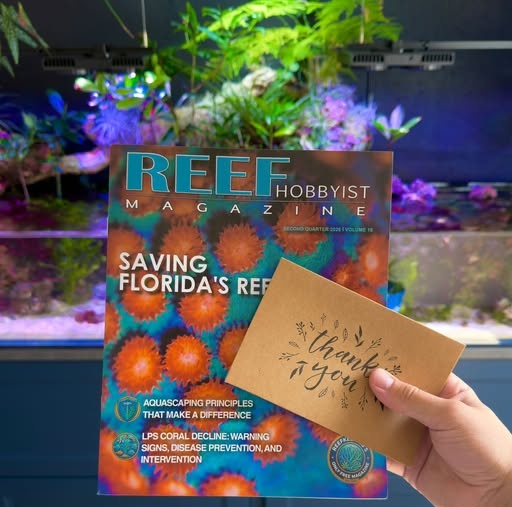
Danny’s build has been generating massive waves across the industry—so much so that his paludarium landed the cover and main feature article in the Q2 2026 issue of Reef Hobbyist Magazine. It’s an exciting crossover moment for us at Reef Builders, especially as our partner Raj Shingadia officially acquired Reef Hobbyist Magazine to continue bridging the gap between print culture and digital media across the global reefing community.
That European road trip proved to be an adventure in itself: reserving an automatic rental car, only to be handed the keys to a manual stick shift. Driving manual down the German Autobahn to Nuremberg was an absolute rush, though navigating Nuremberg’s steep downtown hills, tight European alleys, gridlock traffic, and crowds of jaywalking trade show attendees with three pedals quickly turned into a full-body workout.
After days of non-stop filming at Interzoo, we drove back north into the Netherlands, making a pit stop at the Cologne Cathedral before filming behind-the-scenes manufacturing at Aquarium Perfekt, visiting Meerwasser Böttcher, and returning to Danny’s studio to film his complete paludarium tour.
The LFS Gift Run: Aquariumhuis Romberg & Print Media Synergy
Before heading to Danny’s house, we stopped by Aquariumhuis Romberg. We spent time with Flores, a five-year store employee who maintains his own cold-water marine system featuring local species from the North Sea alongside freshwater setups.
- Sourcing Classic Discosoma: We selected four large red Discosoma mushrooms as a gift for Danny’s system. While designer soft corals get a lot of hype, classic red and purple Discosomas remain remarkably resilient.
- Nutrient Dynamics for Softies: In mature systems running slightly elevated nitrates, Discosoma mushrooms thrive and multiply rapidly.
- Free LFS Print Distribution: Local fish stores remain the lifeblood of the hobby. Just like picking up livestock at Aquariumhuis Romberg, hobbyists can grab free physical copies of Reef Hobbyist Magazine directly at their local shop to read in-depth build breakdowns like Danny’s.
DANNY’S PERSPECTIVE — THE RHM COVER & LFS CULTURE:
Receiving the message with the opportunity to be featured felt like a dream come true. To be featured on someone’s social media page is one thing, but seeing my work printed on an actual piece of paper and distributed around the globe felt so surreal! I couldn’t believe it, it was a real milestone for me. I’ve been sharing my aquariums on social media for many years so seeing one of my projects make its way onto a physical magazine feels really special. I feel incredibly grateful for the opportunity and I hope my article inspired some fellow hobbyists to try something new or think a little differently about what’s possible in this hobby.
I also love visiting aquarium stores and pet stores in general. No matter how much of the hobby ‘happens’ online, there’s something completely different about walking into a store and seeing livestock in person. I’m always discovering things and leaving with new ideas and inspiration for my projects. Stores like Aquariumhuis Romberg are the kind of places where you run into local hobbyists and end up sharing your experiences, trade livestock and equipment and talk about your hobby.
Paludarium Mechanics & Terrestrial Plant Care
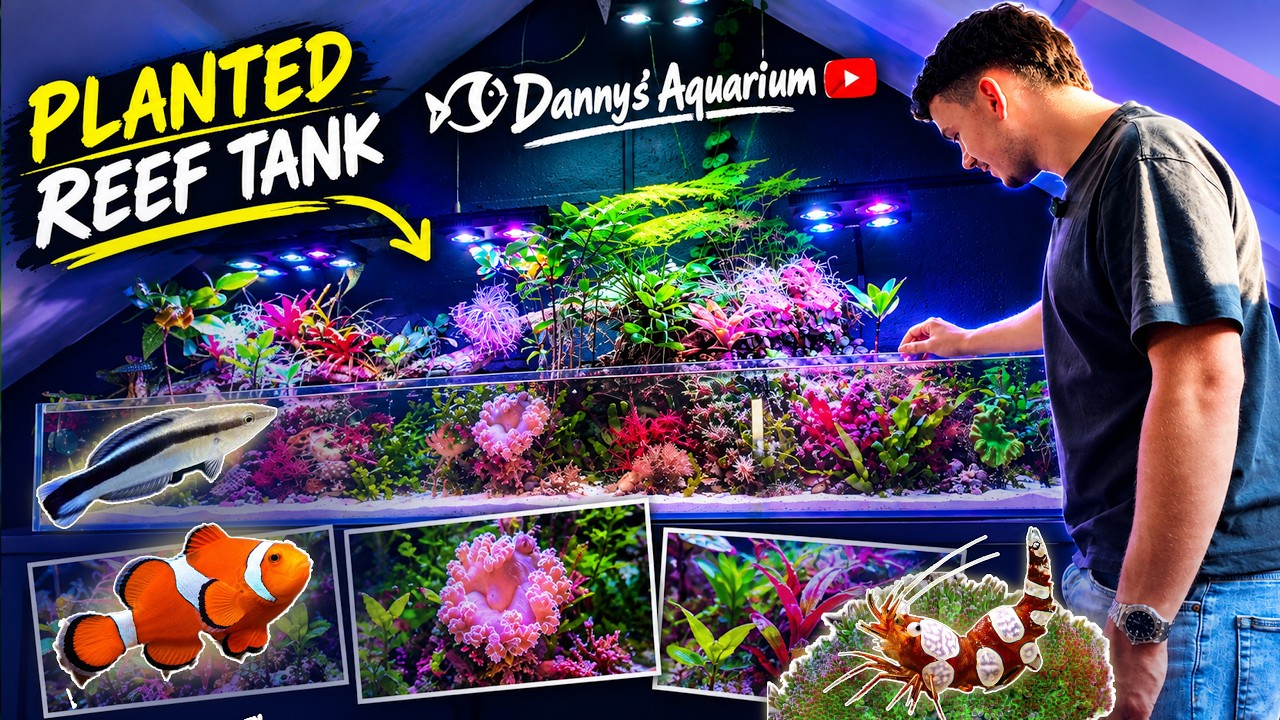
Danny’s setup measures 250cm x 55cm x 30cm (roughly 8 feet in length) and holds approximately 70 gallons of water around heavy rockwork. Evie took a deep dive with Danny into the terrestrial and emergent mechanics that allow house plants and marine flora to coexist:
| Structural & Environmental Zone | Components & Species | Care Protocols & Engineering Notes |
| Emergent Plant Base | Asparagus fern, airplants (Tillandsia), begonias, moss, string of turtles | Built on an egg-crate frame lined with pond liner resting directly on top of the glass rim. |
| Watering Strategy | Daily RODi hand-spraying | Prevents salt creep build-up on terrestrial leaves and keeps delicate mosses hydrated. |
| Lighting Array | Five DALUA Illumagic X4 LED Fixtures. | 1 center fixture runs a freshwater spectrum; 4 outer fixtures run reef spectrums set to daylight settings. |
| Photoperiod | 12:00 PM to 9:00 PM (or adjusted to midnight) | Allows peak viewing hours when home while keeping photoperiod consistent for plants. |
DANNY’S PERSPECTIVE — PLANT CARE & PALUDARIUM LESSONS:
One of the biggest challenges of this paludarium (or so I thought) was going to be managing the salt creep from the saltwater below. The terrestrial plants I have growing on this setup aren’t tolerant of salt, so when I first built this setup, I was a bit concerned on how this could possibly work out long term.
During the first few weeks, I did lose a couple of plants simply because they were positioned too close to the water. Through a bit of trail and error, I found that the sweet spot for keeping plants is roughly 4-5 inches above the waterline. Since figuring that out, salt creep really hasn’t been the challenge I expected it to be.
People often assume a ton of work goes into maintaining a setup like this, but truth be told, it’s super easy. Honestly, I can’t think of an easier aquarium I’ve owned. The mangroves and macro algae do a lot of work for me by continuously taking up nutrients from the water. Because nuisance algae basically competes for the same nutrients, they have no chance of taking over.
That’s probably one of the biggest lessons I’ve learned from this project. Sometimes it’s much easier to just let nature take care of things naturally than to interfere with it through dosing all kinds of nutrient-lowering solutions and installing lots of equipment. I think a lot of reefers can benefit from including some non-invasive macroalgae species or mangroves into their systems. Whether that’s directly in their display tank or tucked away in the sump, they are a great tool for nutrient management while also adding something living and interesting to the aquarium.
Water Chemistry: Freshwater Root Tabs & Biological Filtration
Having spent 11 years in commercial chemical manufacturing, seeing how Danny manages water quality without fancy dosing equipment or aggressive testing is a testament to biological balance.
- Freshwater Root Tabs for Mangroves: In a unique crossover technique, Danny uses standard freshwater root tabs inserted directly into the sand bed with tweezers every few months to feed mangrove root systems.
- Zero Chemical Dosing: The system runs without phytoplankton, zooplankton, or dedicated macroalgae liquid fertilizers.
- Simplified Water Management: Danny does not test parameters, relying instead on a 10% water change every 1 to 3 weeks. Dense growth of Caulerpa, Halimeda (“Atomic Broccoli”), Gracilaria, and red feather algae (Halymenia) acts as the primary biological export engine.
- Sump-Less Filtration Mechanics: Rather than a traditional sump, an empty canister filter handles surface skimming and inline water heating. Flow is driven across the 8-foot footprint via multiple internal powerheads and dedicated return pumps hidden behind the rockwork feeding specific zones (including a tide pool and mangrove spray bar).
Livestock Interactions & Ecosystem Stability
The biological diversity inside Danny’s 8-foot display balances delicate invertebrates with active reef fish:
- Tank-Bred Multibar Angelfish: Sourced directly as a tank-bred specimen bred by De Jong Marinelife.
- Cleaner Wrasse First-Aid: After a powerhead injury left a deep gash on the cleaner wrasse’s back, Danny removed the fish and applied a topical iodine swab directly to the wound before returning it to the display,resulting in a fully healed scar.
- Micro-Ecosystem Tide Pool: A dedicated low-flow pocket houses multiple maxi-mini carpet anemones, a pink sea cucumber with yellow feeding tentacles, and a colony of sexy shrimp.
- Filefish & Coral Synergy: A pair of filefish share the display. While they previously picked off torches and Acanthophyllia, they leave the soft corals, leather corals, bubble corals, and feather dusters completely alone.
- Fish Community: Features two Royal Grammas, a pair of dottybacks (including a neon hybrid), two Pajama Cardinals, a Tomini Tang, and a pair of clownfish.
Conclusion
Driving across Europe—from navigating Nuremberg’s downtown traffic with a manual clutch to visiting Aquariumhuis Romberg in Delft with Danny—highlighted what makes this hobby special.
Seeing Danny’s build highlighted on the cover of Reef Hobbyist Magazine Q2 2026 confirms that the industry is taking notice of bio-balanced aquascaping. With Raj Shingadia bringing RHM under the broader Reef Builders ecosystem, we are excited to keep supporting creators who push marine keeping forward. Danny’s setup proves that by balancing macroalgae nutrient uptake, utilizing crossover methods like freshwater root tabs for mangroves, and maintaining steady water changes, you can build an ecosystem that thrives on natural discipline.
DANNY’S FINAL THOUGHTS:
Even after all this time, I definitely don’t feel like this project is finished. If anything, during the past two years the paludarium has shown me what works, what doesn’t, and what I would do differently if I were building it again today. And that’s exactly what I’m planning to do.
I want to completely rebuild the paludarium while keeping the same aquarium and stand. The mangroves have grown a lot. They’re starting to outgrow the space, block light, and I simply don’t like the current shape they’re in.
For the next version, I want the mangroves to become the centerpiece of the aquarium. Around them, I’d love to create more distinct habitats like a coastal area filled with macroalgae and soft corals, larger tide pools, and an optically deeper, bluer reef section on the opposite side. I’ve even been thinking about creating an isolated freshwater stream higher up that could flow down through the terrestrial section while remaining completely separated from the saltwater below. It would really help me with the mosses.
There are also plenty of things I want to improve on the setup as well. Like better flow, fewer areas where detritus can collect, automatic misting for the plants, and maybe even tide pools where the water level actually rises and falls and the paludarium is only one of the ideas I have.
This version of the paludarium has now been seen well over 20 million times across my social media pages, which is something I never could have imagined when I first started building it. One of the most rewarding parts has been seeing how many people around the world discovered the concept through these videos. With the next version, I hope I can take everything I’ve learned, push the idea even further and inspire an even larger audience to look at saltwater aquariums a little differently.
Over the next year or so, one of my biggest goals is to take Danny’s Aquariums beyond my attic bedroom and into a dedicated studio. I’d love to create a space where I’m no longer limited by what I can fit into my home and where I can build completely different freshwater aquariums, reef tanks, paludariums and terrariums. More importantly, it would give me the space to experiment on a much bigger scale and document these projects from beginning to end.
But I don’t want it to become just a room filled with aquariums and cameras. I’d love for it to occasionally become a place where I can invite local hobbyists over, hang out, talk about the hobby and share ideas.
I have an almost ridiculous number of ideas for future projects.. from interesting species and ecosystems to concepts I simply don’t have the space to attempt right now. Having a dedicated studio would open the door to bigger builds, more experimentation, a stronger local community and, hopefully, collaborations with other people and brands within the hobby who want to help bring some of these ideas to life.
There’s still a lot to come.
Visiting Danny’s Aquarium | One of the Coolest Aquariums!
Watch our full studio walkthrough with Danny, including our stop at Aquariumhuis Romberg, mushroom coral additions, and complete paludarium breakdown. Grab a free copy of Reef Hobbyist Magazine at your local fish store to read Danny’s print cover feature!
Until next time, ReefBuilders! Snailed It – Shawn Hale