Full rundown of PacificSun’s big bet on high LED diversity in the Hyperion R2

By on Dec 07, 2011

In case you haven’t noticed, there’s a war going on in the aquarium LED reef light market for more diversity of LEDs and more and more control of separate channels. You can see a trend in mainstream aquarium products meeting many of these demands.The AI Nano, Ecoxotic’s multicolor LED spotlight and RGB Panorama Pro, the Maxspect Mazarra, JBJ Unibody, the Vertex Lumina and Ecotech Marine’s Radion all have more LEDs and more control than comparable LED aquarium lights did last year.

Better still, AcanLighting’s Full Spectrum KR93 comes in a Japanese and a North American edition with a multitude of LEDs and control channels and even the micro brewed NanoBox Reef LED light is getting in on the diverse LED action. Now the Hyperion R2 from pacificSun LED is here with nine colors of LEDs and eight channels of control and we can’t wait to see how reefers paint their corals with such a broad diversity of light. Follow the break to learn more about these separate LED colors and what PacificSun believes these will do for you and your reef tank. 

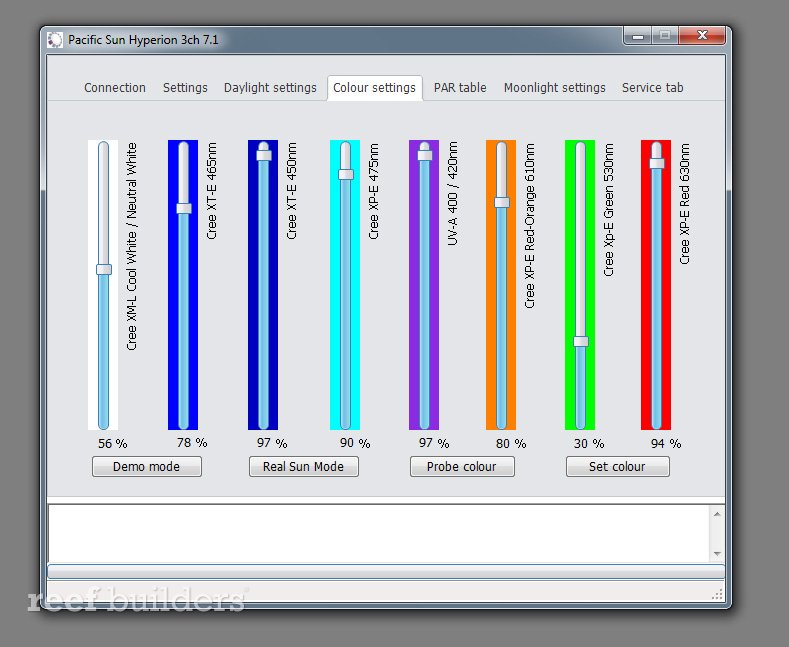
Below you’ll find the dizzying array of LED colors that are used in the Hyperion R2 8-channel LED light and PacificSun’s own assessment of why they went with those specific LEDs. We definitely agree with the usefulness of those individual wavelength emission peaks but the bigger challenge is getting all the colors to mix well and avoiding the disco ball look. Coming soon, a look at the PacificSun LED light in action over real live corals.

•    Cree XM-L Cool White LEDs & Cree XM-L Neutral White LEDs - Cool White and Neutral white grouped in one channel
•    Cree XT-E Royal Blue 450nm 3.3W each Produce very strong and deep light – true 450nm(peak)
•    Cree XT-E Royal Blue 465n, 3.3W each Colour
•    Cree XP-E Green 530nm 3.3W each
•    Cree XP-E Red 630nm 3.3W each
•    Cree XP-E Orange 610nm3.3W each
We decided not to use RED led emitters with spectrum above 660nm(typical RED led chips used in other fixtures) – after many month of tests our reference panels – noticed undesirable growth of algae in the aquarium. Application Ref-Orange color (610 nm) and red (630nm) – allows you to highlight the warm colors – without stimulating algae growth. Both colours, Red-Orange and Red can be controlled independent.
•    UV-A 400nm & 420nm 3W each This led chips stimulates better and much stronger corals pigmentation – this light is very “weak” for human eyes – but it is very important for producing GFP-like fluorescent proteins.
•    Cree XP-E 475nm Typical “blue” light – it improve CRI also.

Posted in Reef News |
Search More:  
   
  • http://www.facebook.com/kristofer.goldsmith Kristofer Goldsmith

    “Better still, AcanLighting’s Full Spectrum KR93 comes in a Japanese and a North American edition with a multitude of LEDs and control channels”

    I was under the impression from playing with the the Acan that it only had two channels…

    While it might not be as adjustable as the competition- if you have a fast moving yellow fish in the tank, the Acan has a pretty neat effect.

  • http://pulse.yahoo.com/_3PQR2S2EAZUDJKVYUCKLCWJ37Q Micheal

    Man, I think LEDs are just getting too crazy… K.I.S.S.

    Royal blues and cool whites, and I’m fine.
    Reds, blues, oranges(WTF?), neutral white, another royal blue that’s peaks 5nm away…. *sigh*

  • Ken Phannavong

    Yea give me cool white, royal blue and uv.  Anything else is wasting watt, green, red, yellow does not belong.  

  • Julio Mercader

    @font-face {
    font-family: “Cambria”;
    }p.MsoNormal, li.MsoNormal, div.MsoNormal { margin: 0cm 0cm 10pt; font-size: 12pt; font-family: “Times New Roman”; }div.Section1 { page: Section1; }

    Whether blue and white light is all your coral needs will
    depend on the depth at which it was collected. For colonies collected at 3 m or
    less, Mass et al (2010, Journal of Experimental Biology) demonstrate that photosynthethic
    performance is enhanced by 50% under full PAR spectrum, which includes red and
    green. The opposite holds true for deep colonies, which will support higher
    oxygen flux under blue light.


  • http://www.facebook.com/people/Mathieu-Gagné/659241296 Mathieu Gagné

    I’ve found that some green and red is really great for color rendition. I’m not sure about the effect of adding orange!

  • Anonymous

    you are right that using only white and a couple blues will get the job done but every color of light that you omit is a color of light that you are missing out on your corals. Green seems like the most easy color to dismiss but without it you don’t get red fluorescence.

  • http://pulse.yahoo.com/_3PQR2S2EAZUDJKVYUCKLCWJ37Q Micheal

    Yeah but every color you add you’re losing overall lighting power because the photosynthesis of corals may not be usable at that wavelength.

    With a cool white you only really lose the super deep violets 700nm, you get some red between 660-700nm, you get green and yellow for days, and you lose out a bit on blue 480nm… you can throw blue back in if you feel you need it with their 485nm blues, and you can’t get that post 700nm red back because the single red actually peaks around 640nm… fact of the matter is you get more red wavelengths out of a cool white than you do out of a pure red LED!

  • http://www.facebook.com/kristofer.goldsmith Kristofer Goldsmith

    For anyone who’s interested in what Julio is talking about…

    http://jeb.biologists.org/content/213/23/4084.full.pdf